

116
L.M. Mitnik and V.A. Dubina
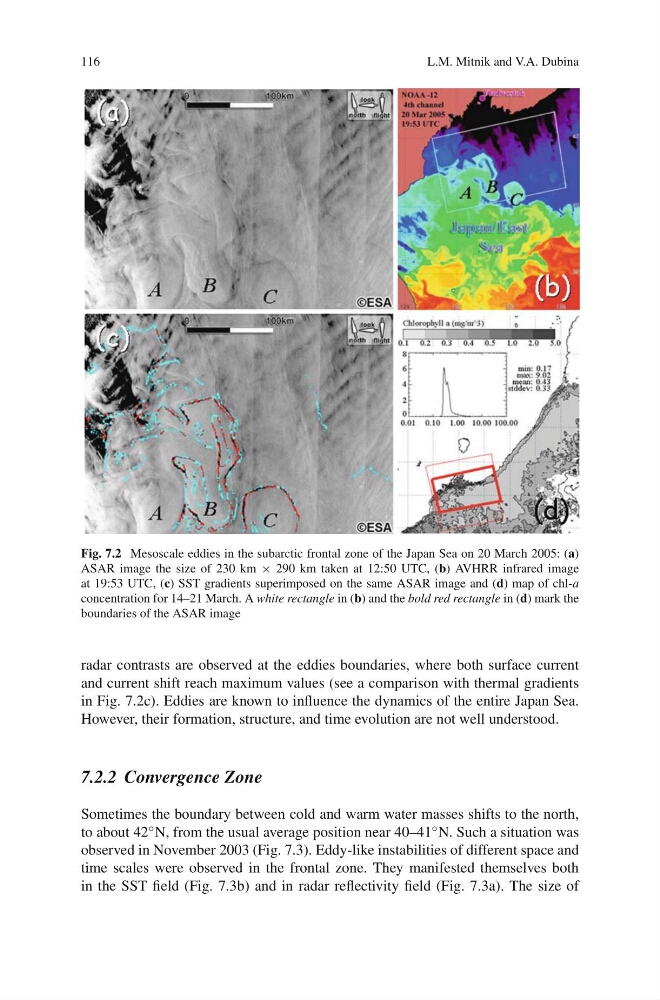
Fig. 7.2 Mesoscale eddies in the subarctic frontal zone of the Japan Sea on 20 March 2005: (a)
ASAR image the size of 230 km × 290 km taken at 12:50 UTC, (b) AVHRR infrared image
at 19:53 UTC, (c) SST gradients superimposed on the same ASAR image and (d) map of chl-a
concentration for 14–21 March. A white rectangle in (b) and the bold red rectangle in (d) mark the
boundaries of the ASAR image
radar contrasts are observed at the eddies boundaries, where both surface current
and current shift reach maximum values (see a comparison with thermal gradients
in Fig. 7.2c). Eddies are known to influence the dynamics of the entire Japan Sea.
However, their formation, structure, and time evolution are not well understood.
7.2.2 Convergence Zone
Sometimes the boundary between cold and warm water masses shifts to the north,
to about 42 ◦ N, from the usual average position near 40–41 ◦ N. Such a situation was
observed in November 2003 (Fig. 7.3). Eddy-like instabilities of different space and
time scales were observed in the frontal zone. They manifested themselves both
in the SST field (Fig. 7.3b) and in radar reflectivity field (Fig. 7.3a). The size of
L.M. Mitnik and V.A. Dubina
Fig. 7.2 Mesoscale eddies in the subarctic frontal zone of the Japan Sea on 20 March 2005: (a)
ASAR image the size of 230 km × 290 km taken at 12:50 UTC, (b) AVHRR infrared image
at 19:53 UTC, (c) SST gradients superimposed on the same ASAR image and (d) map of chl-a
concentration for 14–21 March. A white rectangle in (b) and the bold red rectangle in (d) mark the
boundaries of the ASAR image
radar contrasts are observed at the eddies boundaries, where both surface current
and current shift reach maximum values (see a comparison with thermal gradients
in Fig. 7.2c). Eddies are known to influence the dynamics of the entire Japan Sea.
However, their formation, structure, and time evolution are not well understood.
7.2.2 Convergence Zone
Sometimes the boundary between cold and warm water masses shifts to the north,
to about 42 ◦ N, from the usual average position near 40–41 ◦ N. Such a situation was
observed in November 2003 (Fig. 7.3). Eddy-like instabilities of different space and
time scales were observed in the frontal zone. They manifested themselves both
in the SST field (Fig. 7.3b) and in radar reflectivity field (Fig. 7.3a). The size of