

96
W.T. Liu et al.
production of turbulence. Equation (6.2) is solved simultaneously with similarity equations for temperature and humidity. An alternative to using the neutral
C D is to express z 0 as a function of U ∗ . For example, Liu and Tang (1996)
incorporated such a relation in solving the similarity equation. They combined
a smooth flow (Nikuradse, 1933) and rough flow (Charnock, 1955) relations
to give
Z 0 = 0.11
ν
U *
+ 0.011
U 2
*
g
(6.3)
where ν is the kinematic viscosity and g is the acceleration due to gravity.
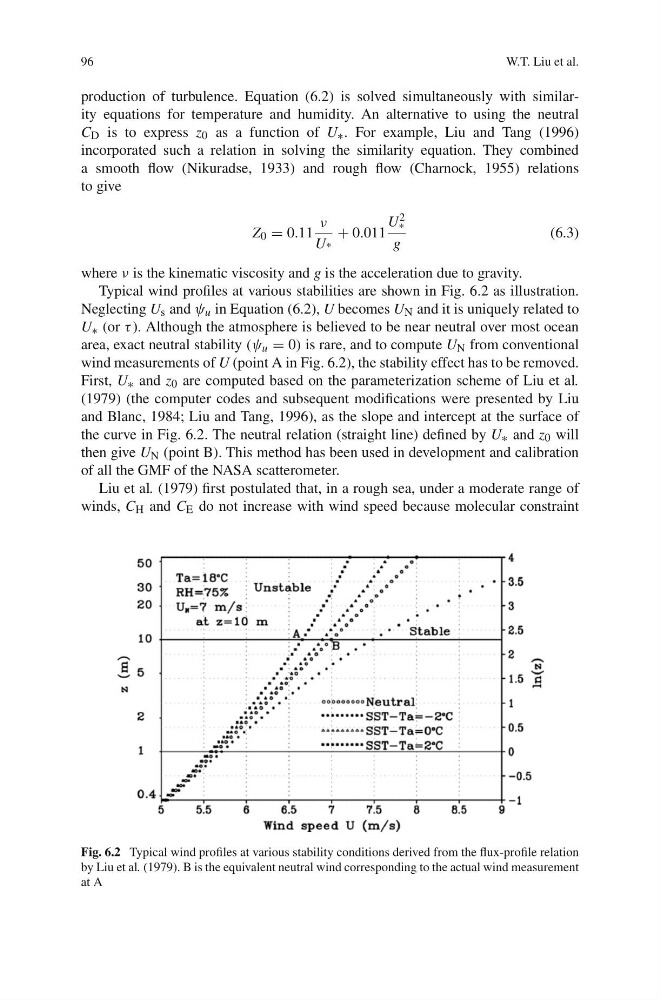
Typical wind profiles at various stabilities are shown in Fig. 6.2 as illustration.
Neglecting U s and ψ u in Equation (6.2), U becomes U N and it is uniquely related to
U ∗ (or τ ). Although the atmosphere is believed to be near neutral over most ocean
area, exact neutral stability (ψ u = 0) is rare, and to compute U N from conventional
wind measurements of U (point A in Fig. 6.2), the stability effect has to be removed.
First, U ∗ and z 0 are computed based on the parameterization scheme of Liu et al.
(1979) (the computer codes and subsequent modifications were presented by Liu
and Blanc, 1984; Liu and Tang, 1996), as the slope and intercept at the surface of
the curve in Fig. 6.2. The neutral relation (straight line) defined by U ∗ and z 0 will
then give U N (point B). This method has been used in development and calibration
of all the GMF of the NASA scatterometer.
Liu et al. (1979) first postulated that, in a rough sea, under a moderate range of
winds, C H and C E do not increase with wind speed because molecular constraint
Fig. 6.2 Typical wind profiles at various stability conditions derived from the flux-profile relation
by Liu et al. (1979). B is the equivalent neutral wind corresponding to the actual wind measurement
at A
W.T. Liu et al.
production of turbulence. Equation (6.2) is solved simultaneously with similarity equations for temperature and humidity. An alternative to using the neutral
C D is to express z 0 as a function of U ∗ . For example, Liu and Tang (1996)
incorporated such a relation in solving the similarity equation. They combined
a smooth flow (Nikuradse, 1933) and rough flow (Charnock, 1955) relations
to give
Z 0 = 0.11
ν
U *
+ 0.011
U 2
*
g
(6.3)
where ν is the kinematic viscosity and g is the acceleration due to gravity.
Typical wind profiles at various stabilities are shown in Fig. 6.2 as illustration.
Neglecting U s and ψ u in Equation (6.2), U becomes U N and it is uniquely related to
U ∗ (or τ ). Although the atmosphere is believed to be near neutral over most ocean
area, exact neutral stability (ψ u = 0) is rare, and to compute U N from conventional
wind measurements of U (point A in Fig. 6.2), the stability effect has to be removed.
First, U ∗ and z 0 are computed based on the parameterization scheme of Liu et al.
(1979) (the computer codes and subsequent modifications were presented by Liu
and Blanc, 1984; Liu and Tang, 1996), as the slope and intercept at the surface of
the curve in Fig. 6.2. The neutral relation (straight line) defined by U ∗ and z 0 will
then give U N (point B). This method has been used in development and calibration
of all the GMF of the NASA scatterometer.
Liu et al. (1979) first postulated that, in a rough sea, under a moderate range of
winds, C H and C E do not increase with wind speed because molecular constraint
Fig. 6.2 Typical wind profiles at various stability conditions derived from the flux-profile relation
by Liu et al. (1979). B is the equivalent neutral wind corresponding to the actual wind measurement
at A