

6 Scatterometer’s Unique Capability in Measuring Ocean Surface Stress
95
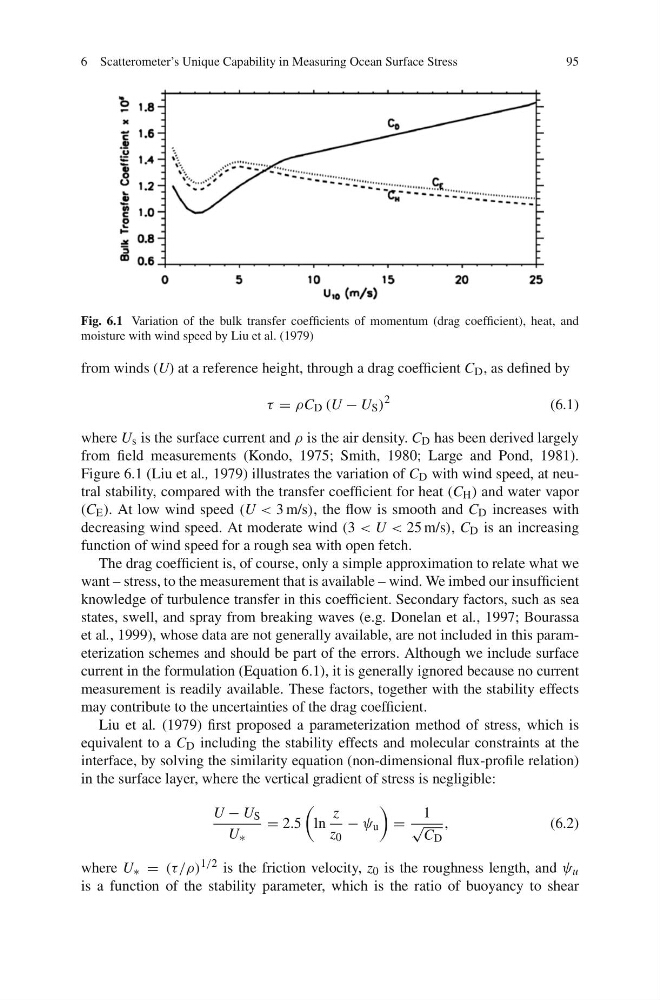
Fig. 6.1 Variation of the bulk transfer coefficients of momentum (drag coefficient), heat, and
moisture with wind speed by Liu et al. (1979)
from winds (U) at a reference height, through a drag coefficient C D , as defined by
τ = ρC D (U − U S )
2
(6.1)
where U s is the surface current and ρ is the air density. C D has been derived largely
from field measurements (Kondo, 1975; Smith, 1980; Large and Pond, 1981).
Figure 6.1 (Liu et al., 1979) illustrates the variation of C D with wind speed, at neutral stability, compared with the transfer coefficient for heat (C H ) and water vapor
(C E ). At low wind speed (U < 3 m/s), the flow is smooth and C D increases with
decreasing wind speed. At moderate wind (3 < U < 25 m/s), C D is an increasing
function of wind speed for a rough sea with open fetch.
The drag coefficient is, of course, only a simple approximation to relate what we
want – stress, to the measurement that is available – wind. We imbed our insufficient
knowledge of turbulence transfer in this coefficient. Secondary factors, such as sea
states, swell, and spray from breaking waves (e.g. Donelan et al., 1997; Bourassa
et al., 1999), whose data are not generally available, are not included in this parameterization schemes and should be part of the errors. Although we include surface
current in the formulation (Equation 6.1), it is generally ignored because no current
measurement is readily available. These factors, together with the stability effects
may contribute to the uncertainties of the drag coefficient.
Liu et al. (1979) first proposed a parameterization method of stress, which is
equivalent to a C D including the stability effects and molecular constraints at the
interface, by solving the similarity equation (non-dimensional flux-profile relation)
in the surface layer, where the vertical gradient of stress is negligible:
U − U S
U ∗
= 2.5
ln
z
z 0
− ψ u
=
1
√
C D
,
(6.2)
where U ∗ = (τ/ρ)
1/2 is the friction velocity, z 0 is the roughness length, and ψ u
is a function of the stability parameter, which is the ratio of buoyancy to shear
95
Fig. 6.1 Variation of the bulk transfer coefficients of momentum (drag coefficient), heat, and
moisture with wind speed by Liu et al. (1979)
from winds (U) at a reference height, through a drag coefficient C D , as defined by
τ = ρC D (U − U S )
2
(6.1)
where U s is the surface current and ρ is the air density. C D has been derived largely
from field measurements (Kondo, 1975; Smith, 1980; Large and Pond, 1981).
Figure 6.1 (Liu et al., 1979) illustrates the variation of C D with wind speed, at neutral stability, compared with the transfer coefficient for heat (C H ) and water vapor
(C E ). At low wind speed (U < 3 m/s), the flow is smooth and C D increases with
decreasing wind speed. At moderate wind (3 < U < 25 m/s), C D is an increasing
function of wind speed for a rough sea with open fetch.
The drag coefficient is, of course, only a simple approximation to relate what we
want – stress, to the measurement that is available – wind. We imbed our insufficient
knowledge of turbulence transfer in this coefficient. Secondary factors, such as sea
states, swell, and spray from breaking waves (e.g. Donelan et al., 1997; Bourassa
et al., 1999), whose data are not generally available, are not included in this parameterization schemes and should be part of the errors. Although we include surface
current in the formulation (Equation 6.1), it is generally ignored because no current
measurement is readily available. These factors, together with the stability effects
may contribute to the uncertainties of the drag coefficient.
Liu et al. (1979) first proposed a parameterization method of stress, which is
equivalent to a C D including the stability effects and molecular constraints at the
interface, by solving the similarity equation (non-dimensional flux-profile relation)
in the surface layer, where the vertical gradient of stress is negligible:
U − U S
U ∗
= 2.5
ln
z
z 0
− ψ u
=
1
√
C D
,
(6.2)
where U ∗ = (τ/ρ)
1/2 is the friction velocity, z 0 is the roughness length, and ψ u
is a function of the stability parameter, which is the ratio of buoyancy to shear