

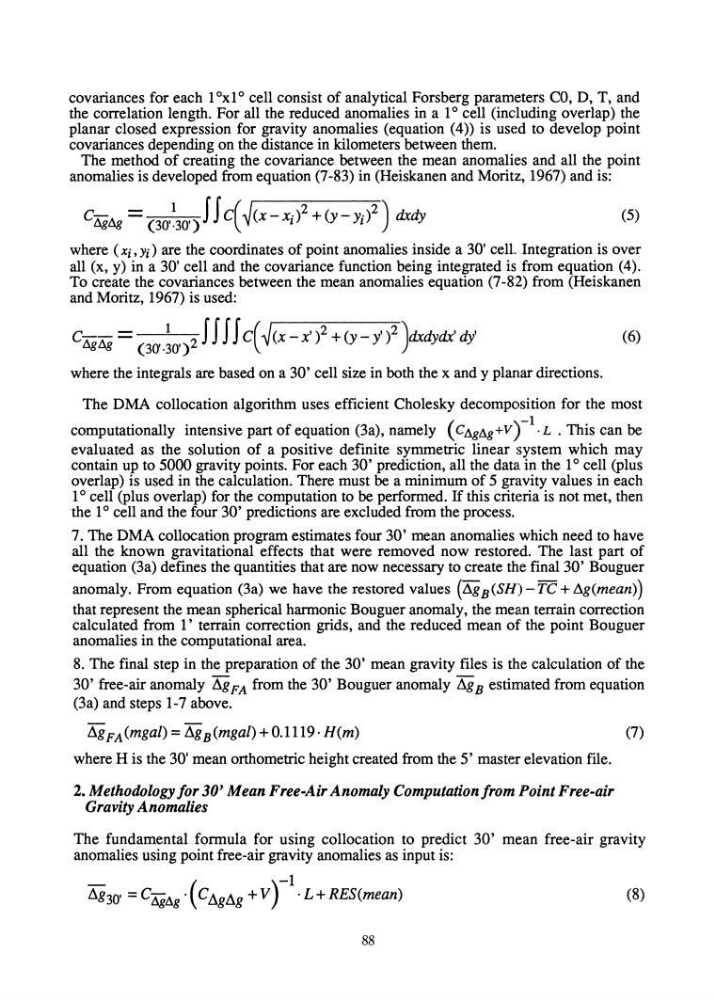
covariances for each 1 °xl 0 cell consist of analytical Forsberg parameters CO, D, T, and
the correlation length. For all the reduced anomalies in a 1 0 cell (including overlap) the
planar closed expression for gravity anomalies (equation (4» is used to develop point
covariances depending on the distance in kilometers between them.
The method of creating the covariance between the mean anomalies and all the point
anomalies is developed from equation (7-83) in (Heiskanen and Moritz, 1967) and is:
C~dg = (30'\0') J J C( ~(x - Xi)2 + (y - Yi)2) dxdy
(5)
where (Xi, Yi) are the coordinates of point anomalies inside a 30' cell., Integration is over
all (x, y) in a 30' cell and the covariance function being integrated is from equation (4).
To create the covariances between the mean anomalies equation (7-82) from (Heiskanen
and Moritz, 1967) is used:
c-- = 1 J J J J c(~(X - x,)2 + (y - y,)2 )dxdYdx' dy'
dgdg
(30'.30,)2
(6)
where the integrals are based on a 30' cell size in both the x and y planar directions.
The DMA collocation algorithm uses efficient Cholesky decomposition for the most
computationally intensive part of equation (3a), namely (CL1gdg+v)-l.L. This can be
evaluated as the solution of a positive definite symmetric linear system which may
contain up to 5000 gravity points. For each 30' prediction, all the data in the 1 0 cell (plus
overlap) is used in the calculation. There must be a minimum of 5 gravity values in each
1 0 cell (plus overlap) for the computation to be performed. If this criteria is not met, then
the 1 0 cell and the four 30' predictions are excluded from the process.
7. The DMA collocation program estimates four 30' mean anomalies which need to have
all the known gravitational effects that were removed now restored. The last part of
equation (3a) defmes the quantities that are now necessary to create the final 30' Bouguer
anomaly. From equation (3a) we have the restored values (~gB(SH)-TC+~g(mean»)
that represent the mean spherical harmonic Bouguer anomaly, the mean terrain correction
calculated from l' terrain correction grids, and the reduced mean of the point Bouguer
anomalies in the computational area.
8. The final step in the preparation of the 30' mean gravity files is the calculation of the
30' free-air anomaly I1g FA from the 30' Bouguer anomaly 11g B estimated from equation
(3a) and steps 1-7 above.
I1g FA (mgal) = !1gB(mgal) + 0.1119· H(m)
where H is the 30' mean orthometric height created from the 5' master elevation file.
2. Methodology for 30' Mean Free-Air Anomaly Computation/rom Point Free-air
Gravity Anomalies
(7)
The fundamental formula for using collocation to predict 30' mean free-air gravity
anomalies using point free-air gravity anomalies as input is:
I1g 30 , = C~L1g . ( C AgAg + V) -1. L + RES (mean)
(8)
88
the correlation length. For all the reduced anomalies in a 1 0 cell (including overlap) the
planar closed expression for gravity anomalies (equation (4» is used to develop point
covariances depending on the distance in kilometers between them.
The method of creating the covariance between the mean anomalies and all the point
anomalies is developed from equation (7-83) in (Heiskanen and Moritz, 1967) and is:
C~dg = (30'\0') J J C( ~(x - Xi)2 + (y - Yi)2) dxdy
(5)
where (Xi, Yi) are the coordinates of point anomalies inside a 30' cell., Integration is over
all (x, y) in a 30' cell and the covariance function being integrated is from equation (4).
To create the covariances between the mean anomalies equation (7-82) from (Heiskanen
and Moritz, 1967) is used:
c-- = 1 J J J J c(~(X - x,)2 + (y - y,)2 )dxdYdx' dy'
dgdg
(30'.30,)2
(6)
where the integrals are based on a 30' cell size in both the x and y planar directions.
The DMA collocation algorithm uses efficient Cholesky decomposition for the most
computationally intensive part of equation (3a), namely (CL1gdg+v)-l.L. This can be
evaluated as the solution of a positive definite symmetric linear system which may
contain up to 5000 gravity points. For each 30' prediction, all the data in the 1 0 cell (plus
overlap) is used in the calculation. There must be a minimum of 5 gravity values in each
1 0 cell (plus overlap) for the computation to be performed. If this criteria is not met, then
the 1 0 cell and the four 30' predictions are excluded from the process.
7. The DMA collocation program estimates four 30' mean anomalies which need to have
all the known gravitational effects that were removed now restored. The last part of
equation (3a) defmes the quantities that are now necessary to create the final 30' Bouguer
anomaly. From equation (3a) we have the restored values (~gB(SH)-TC+~g(mean»)
that represent the mean spherical harmonic Bouguer anomaly, the mean terrain correction
calculated from l' terrain correction grids, and the reduced mean of the point Bouguer
anomalies in the computational area.
8. The final step in the preparation of the 30' mean gravity files is the calculation of the
30' free-air anomaly I1g FA from the 30' Bouguer anomaly 11g B estimated from equation
(3a) and steps 1-7 above.
I1g FA (mgal) = !1gB(mgal) + 0.1119· H(m)
where H is the 30' mean orthometric height created from the 5' master elevation file.
2. Methodology for 30' Mean Free-Air Anomaly Computation/rom Point Free-air
Gravity Anomalies
(7)
The fundamental formula for using collocation to predict 30' mean free-air gravity
anomalies using point free-air gravity anomalies as input is:
I1g 30 , = C~L1g . ( C AgAg + V) -1. L + RES (mean)
(8)
88