

100.000
0_000
o
100
- CrZ95A
___ OSU91A
}OO
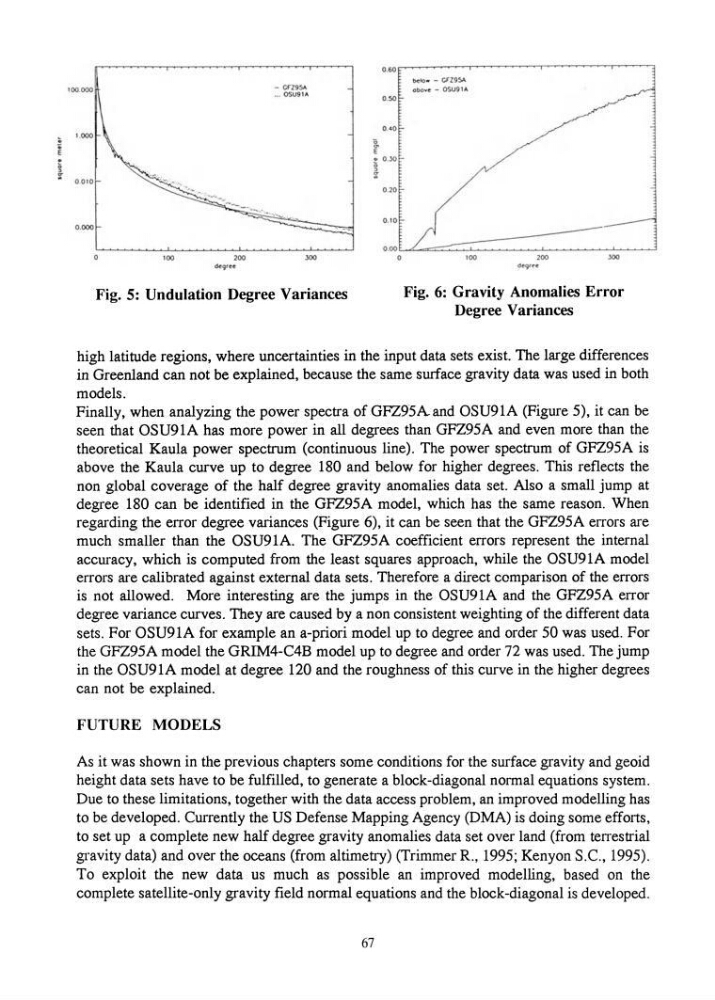
Fig. 5: Undulation Degree Variances
0_50
0 .40
<;
E
~ O, X)
~
0 .20
0 ,10
belO- - crZ95A
obOvt - O'SU91A
O ,oo~~=:"""",-,--------~~~--'-------.. _ _ _ -,--_--.J
o
'00
}OO
Fig. 6: Gravity Anomalies Error
Degree Variances
high latitude regions, where uncertainties in the input data sets exist. The large differences
in Greenland can not be explained, because the same surface gravity data was used in both
models.
Finally, when analyzing the power spectra of GFZ95 A and OSU91A (Figure 5), it can be
seen that OSU91A has more power in all degrees than GFZ95A and even more than the
theoretical Kaula power spectrum (continuous line). The power spectrum of GFZ95A is
above the Kaula curve up to degree 180 and below for higher degrees. This reflects the
non global coverage of the half degree gravity anomalies data set. Also a small jump at
degree 180 can be identified in the GFZ95A model, which has the same reason. When
regarding the error degree variances (Figure 6), it can be seen that the GFZ95A errors are
much smaller than the OSU91A. The GFZ95A coefficient errors represent the internal
accuracy, which is computed from the least squares approach, while the OSU91A model
errors are calibrated against external data sets. Therefore a direct comparison of the errors
is not allowed. More interesting are the jumps in the OSU91A and the GFZ95A error
degree variance curves. They are caused by a non consistent weighting of the different data
sets. For OSU91A for example an a-priori model up to degree and order 50 was used. For
the GFZ95A model the GRIM4-C4B model up to degree and order 72 was used. The jump
in the OSU91A model at degree 120 and the roughness of this curve in the higher degrees
can not be explained.
FUTURE MODELS
As it was shown in the previous chapters some conditions for the surface gravity and geoid
height data sets have to be fulfilled, to generate a block-diagonal normal equations system.
Due to these limitations, together with the data access problem, an improved modelling has
to be developed. Currently the US Defense Mapping Agency (DMA) is doing some efforts,
to set up a complete new half degree gravity anomalies data set over land (from terrestrial
gravity data) and over the oceans (from altimetry) (Trimmer R ., 1995; Kenyon S.c., 1995).
To exploit the new data us much as possible an improved modelling, based on the
complete satellite-only gravity field normal equations and the block-diagonal is developed.
67
0_000
o
100
- CrZ95A
___ OSU91A
}OO
Fig. 5: Undulation Degree Variances
0_50
0 .40
<;
E
~ O, X)
~
0 .20
0 ,10
belO- - crZ95A
obOvt - O'SU91A
O ,oo~~=:"""",-,--------~~~--'-------.. _ _ _ -,--_--.J
o
'00
}OO
Fig. 6: Gravity Anomalies Error
Degree Variances
high latitude regions, where uncertainties in the input data sets exist. The large differences
in Greenland can not be explained, because the same surface gravity data was used in both
models.
Finally, when analyzing the power spectra of GFZ95 A and OSU91A (Figure 5), it can be
seen that OSU91A has more power in all degrees than GFZ95A and even more than the
theoretical Kaula power spectrum (continuous line). The power spectrum of GFZ95A is
above the Kaula curve up to degree 180 and below for higher degrees. This reflects the
non global coverage of the half degree gravity anomalies data set. Also a small jump at
degree 180 can be identified in the GFZ95A model, which has the same reason. When
regarding the error degree variances (Figure 6), it can be seen that the GFZ95A errors are
much smaller than the OSU91A. The GFZ95A coefficient errors represent the internal
accuracy, which is computed from the least squares approach, while the OSU91A model
errors are calibrated against external data sets. Therefore a direct comparison of the errors
is not allowed. More interesting are the jumps in the OSU91A and the GFZ95A error
degree variance curves. They are caused by a non consistent weighting of the different data
sets. For OSU91A for example an a-priori model up to degree and order 50 was used. For
the GFZ95A model the GRIM4-C4B model up to degree and order 72 was used. The jump
in the OSU91A model at degree 120 and the roughness of this curve in the higher degrees
can not be explained.
FUTURE MODELS
As it was shown in the previous chapters some conditions for the surface gravity and geoid
height data sets have to be fulfilled, to generate a block-diagonal normal equations system.
Due to these limitations, together with the data access problem, an improved modelling has
to be developed. Currently the US Defense Mapping Agency (DMA) is doing some efforts,
to set up a complete new half degree gravity anomalies data set over land (from terrestrial
gravity data) and over the oceans (from altimetry) (Trimmer R ., 1995; Kenyon S.c., 1995).
To exploit the new data us much as possible an improved modelling, based on the
complete satellite-only gravity field normal equations and the block-diagonal is developed.
67