

A rigorous combination of the full normal equations system from satellite-only and surface
data normal equations up to a specific degree and order with a block diagonal normal
equations system, generated from surface data has to be done. For this combination the
strategy developed by Bosch (1993) can be applied. First a low degree harmonic normal
equations system is set up from the incomplete surface gravity and ge.oid height data sets.
Because no prerequisites have to be taken into consideration, each measurement can be
weighted individually. With the current computational capabilities it is exPected, that such
a system can be generated up to degree and order 100. A combination of this system with
an a-priori satellite-only normal equations system (for example complete to degree and
order 60 with some resonant coefficients) is done by adding both normals together. Then
the system is solved, to provide an intermediate solution, which is necessary for the
regularization of surface data sets, before they are analyzed for the higher degrees and
orders. To generate complete data sets, gaps in the surface data are filled with this
intermediate solution. Further, a levelling of weights is done, to fulfill the conditions for
block-diagonal normal equations. Finally the block diagonal normal equations system is
set up and used, to complete the already derived full normal equations system. By this
procedure a normal equation system up to degree and order 360 is generated, which is
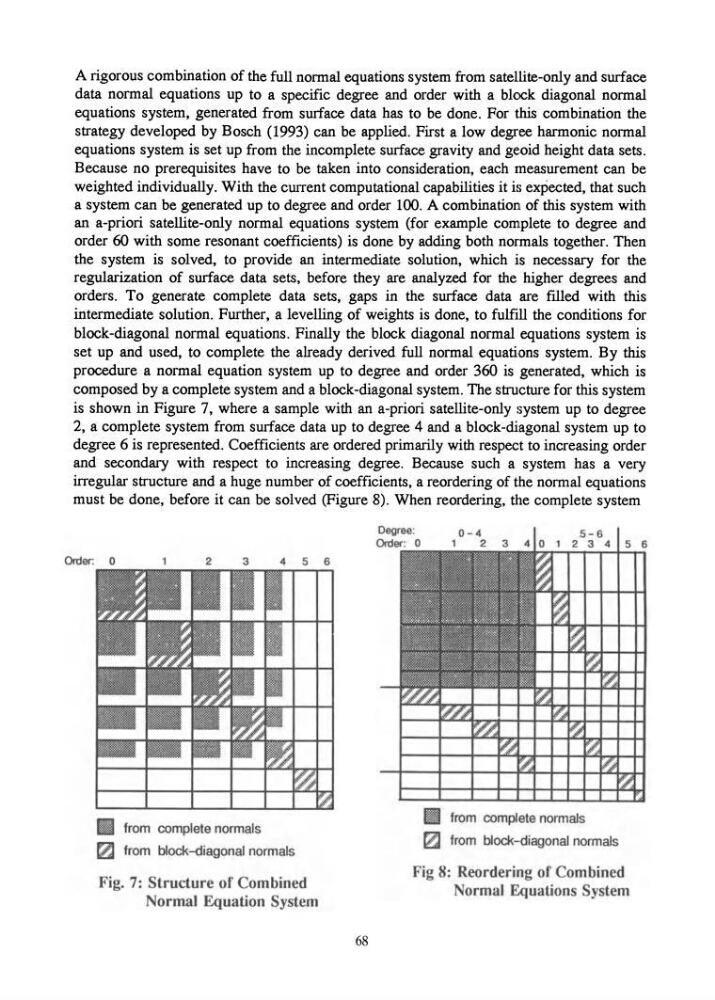
composed by a complete system and a block-diagonal system. The structure for this system
is shown in Figure 7, where a sample with an a-priori satellite-only system up to degree
2, a complete system from surface data up to degree 4 and a block-diagonal system up to
degree 6 is represented. Coefficients are ordered primarily with respect to increasing order
and secondary with respect to increasing degree. Because such a system has a very
irregular structure and a huge number of coefficients, a reordering of the normal equations
must be done, before it can be solved (Figure 8). When reordering, the complete system
Order: 0
2
3
4 5 6
II from complete normals
~ from block-diagonal normals
Fig. 7: Structure of Combined
Normal Equation System
68
II from complete normals
~ from block-diagonal normals
Fig 8: Reordering of Combined
Normal Equations System
data normal equations up to a specific degree and order with a block diagonal normal
equations system, generated from surface data has to be done. For this combination the
strategy developed by Bosch (1993) can be applied. First a low degree harmonic normal
equations system is set up from the incomplete surface gravity and ge.oid height data sets.
Because no prerequisites have to be taken into consideration, each measurement can be
weighted individually. With the current computational capabilities it is exPected, that such
a system can be generated up to degree and order 100. A combination of this system with
an a-priori satellite-only normal equations system (for example complete to degree and
order 60 with some resonant coefficients) is done by adding both normals together. Then
the system is solved, to provide an intermediate solution, which is necessary for the
regularization of surface data sets, before they are analyzed for the higher degrees and
orders. To generate complete data sets, gaps in the surface data are filled with this
intermediate solution. Further, a levelling of weights is done, to fulfill the conditions for
block-diagonal normal equations. Finally the block diagonal normal equations system is
set up and used, to complete the already derived full normal equations system. By this
procedure a normal equation system up to degree and order 360 is generated, which is
composed by a complete system and a block-diagonal system. The structure for this system
is shown in Figure 7, where a sample with an a-priori satellite-only system up to degree
2, a complete system from surface data up to degree 4 and a block-diagonal system up to
degree 6 is represented. Coefficients are ordered primarily with respect to increasing order
and secondary with respect to increasing degree. Because such a system has a very
irregular structure and a huge number of coefficients, a reordering of the normal equations
must be done, before it can be solved (Figure 8). When reordering, the complete system
Order: 0
2
3
4 5 6
II from complete normals
~ from block-diagonal normals
Fig. 7: Structure of Combined
Normal Equation System
68
II from complete normals
~ from block-diagonal normals
Fig 8: Reordering of Combined
Normal Equations System