

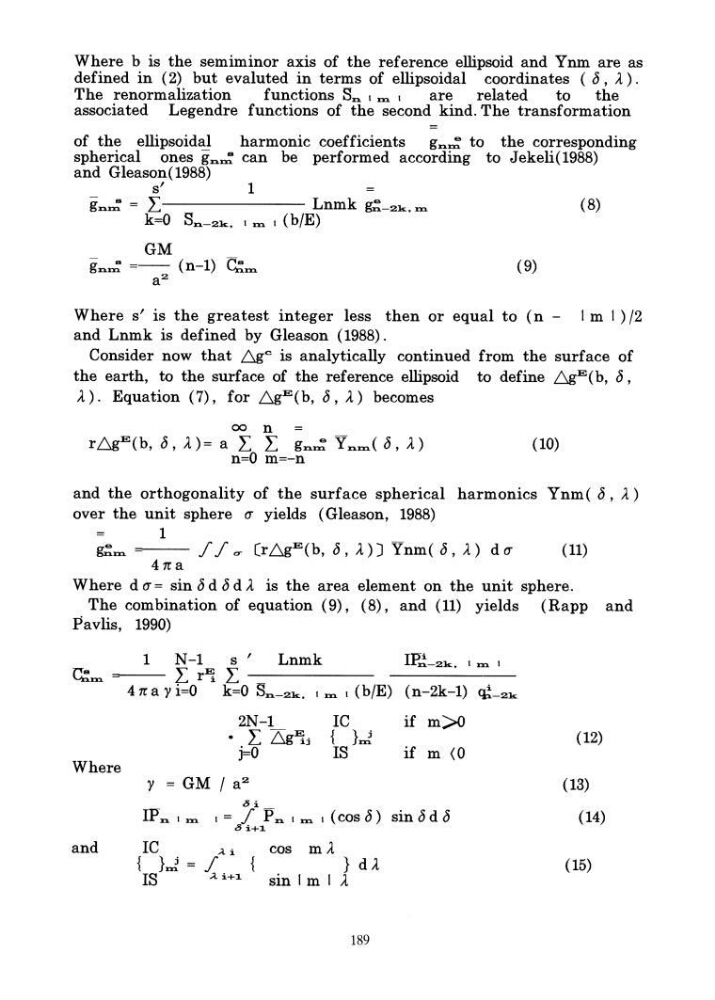
Where b is the semiminor axis of the reference ellipsoid and Ynm are as
defined in (2) but evaluted in terms of ellipsoidal coordinates (~, A).
The renormalization
functions Sn. I D>. I
are related
to
the
associated Legendre functions of the second kind. The transformation
of the ellipsoidal
harmonic coefficients gn.~ to the corresponding
spherical ones gn.r::. can be performed according to Jekeli(1988)
and Gleason(1988)
s'
1
gn.r::. = L
Lnmk g:-2k. D>.
( 8)
k=O Sn.-2k. I D>. I (b/E)
GM
gn.r::. = - (n-1) ~D>.
(9)
a 2
Where s' is the greatest integer less then or equal to (n - I m I ) 12
and Lnmk is defined by Gleason (1988).
Consider now that ,6~t' is analytically continued from the surface of
the earth, to the surface of the reference ellipsoid to define 6gE(b, ~,
A). Equation (7), for 6gE(b, ~, A) becomes
00 n =
r6gE(b, ~, ,1)= aLL gn.~ Yn.D>.( ~, A)
(10)
n=O m=-n
and the orthogonality of the surface spherical harmonics Ynm( ~, A)
over the unit sphere u yields (Gleason, 1988)
1
(11)
41t'a
Where d U= sin ~ d ~ d A is the area element on the unit sphere.
The combination of equation (9), (8), and (11) yields (Rapp and
Pavlis, 1990)
1 N-1
s '
Lnmk
~D>. =---- L r~ L -_-----IP~_2k. I D>. I
41t' a}' i=O
k=O Sn.-2k. I D>. I (b/E) (n-2k-1) q!-2k
Where
and
2N-1
IC
· L 6g~j
j=0
{ }~
IS
}' = GM I a 2
IC
A. i
{ }~ =.f
{
IS
A. i+1
cos mA
} dA
sinlmlA
189
if m>O
if m (0
(12)
(13)
(14)
(15)
defined in (2) but evaluted in terms of ellipsoidal coordinates (~, A).
The renormalization
functions Sn. I D>. I
are related
to
the
associated Legendre functions of the second kind. The transformation
of the ellipsoidal
harmonic coefficients gn.~ to the corresponding
spherical ones gn.r::. can be performed according to Jekeli(1988)
and Gleason(1988)
s'
1
gn.r::. = L
Lnmk g:-2k. D>.
( 8)
k=O Sn.-2k. I D>. I (b/E)
GM
gn.r::. = - (n-1) ~D>.
(9)
a 2
Where s' is the greatest integer less then or equal to (n - I m I ) 12
and Lnmk is defined by Gleason (1988).
Consider now that ,6~t' is analytically continued from the surface of
the earth, to the surface of the reference ellipsoid to define 6gE(b, ~,
A). Equation (7), for 6gE(b, ~, A) becomes
00 n =
r6gE(b, ~, ,1)= aLL gn.~ Yn.D>.( ~, A)
(10)
n=O m=-n
and the orthogonality of the surface spherical harmonics Ynm( ~, A)
over the unit sphere u yields (Gleason, 1988)
1
(11)
41t'a
Where d U= sin ~ d ~ d A is the area element on the unit sphere.
The combination of equation (9), (8), and (11) yields (Rapp and
Pavlis, 1990)
1 N-1
s '
Lnmk
~D>. =---- L r~ L -_-----IP~_2k. I D>. I
41t' a}' i=O
k=O Sn.-2k. I D>. I (b/E) (n-2k-1) q!-2k
Where
and
2N-1
IC
· L 6g~j
j=0
{ }~
IS
}' = GM I a 2
IC
A. i
{ }~ =.f
{
IS
A. i+1
cos mA
} dA
sinlmlA
189
if m>O
if m (0
(12)
(13)
(14)
(15)