

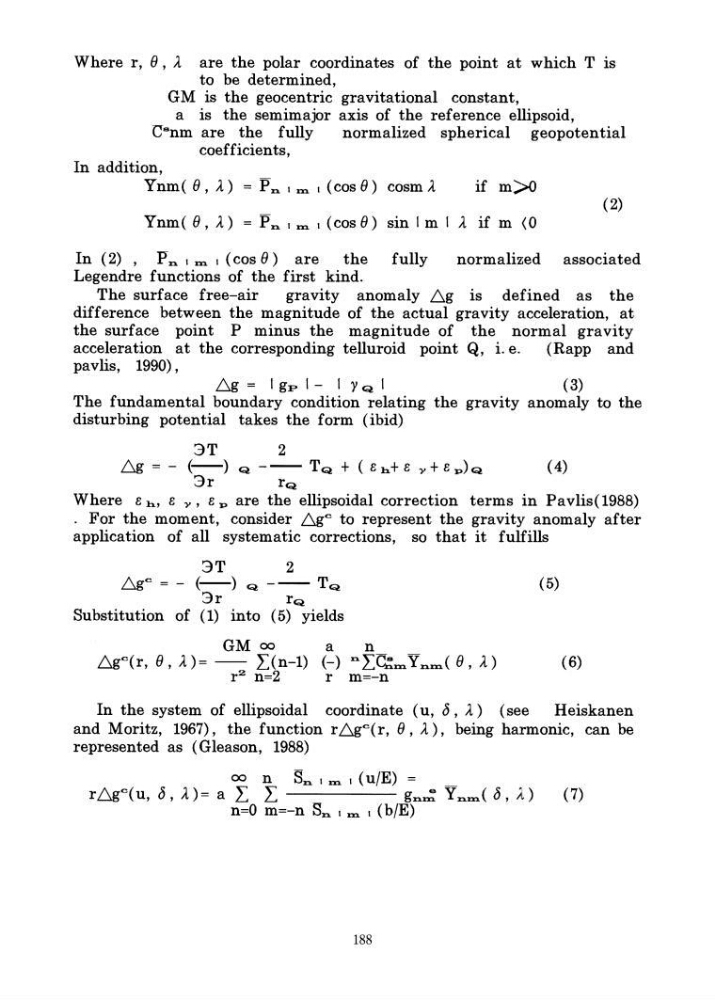
Where r, e, A are the polar coordinates of the point at which T is
to be determined,
GM is the geocentric gravitational constant,
a is the semimajor axis of the reference ellipsoid,
C"nm are the fully
normalized spherical geopotential
coefficients,
In addition,
Ynm( e, A) = P n I 1n I (cos e) cosm A
if m>O
(2)
Ynm( e, A) = P n 11n I (cose) sin I m I A if m (0
In (2), P n I 1n I (cos e ) are the fully normalized associa ted
Legendre functions of the first kind.
The surface free-air
gravity anomaly,6.g is defined as the
difference between the magnitude of the actual gravity acceleration, at
the surface point P minus the magnitude of the normal gravity
acceleration at the corresponding telluroid point Q, i. e.
(Rapp and
pavlis, 1990) ,
.6.g = I gp I - I ')' Q I
( 3)
The fundamental boundary condition relating the gravity anomaly to the
disturbing potential takes the form (ibid)
3T
2
.6.g = - ( - ) Q - -
T Q + ( e h+ e 'Y + e p) Q
(4)
3r
rQ
Where e h, e 'Y, e p are the ellipsoidal correction terms in Pavlis(1988)
. For the moment, consider .6.gc to represent the gravity anomaly after
application of all systematic corrections, so that it fulfills
3T
2
.6.gc = _ ( - ) Q _ _ T Q
(5)
3r
rQ
Substitution of (1) into (5) yields
GM 00
a
n
.6.gC(r, e, A) = - ~::
r m=-n
(6)
In the system of ellipsoidal coordinate (u, ~, A) (see
Heiskanen
and Moritz, 1967), the function r .6.gc( r, e, A), being harmonic, can be
represented as (Gleason, 1988)
00
n
Sn I 1n I (u/E) =
r.6.gC(u, ~, A)= aLL
gnr: Yn1n( ~, A)
(7)
n=O m=-n Sn I 1n I (b/E)
188
to be determined,
GM is the geocentric gravitational constant,
a is the semimajor axis of the reference ellipsoid,
C"nm are the fully
normalized spherical geopotential
coefficients,
In addition,
Ynm( e, A) = P n I 1n I (cos e) cosm A
if m>O
(2)
Ynm( e, A) = P n 11n I (cose) sin I m I A if m (0
In (2), P n I 1n I (cos e ) are the fully normalized associa ted
Legendre functions of the first kind.
The surface free-air
gravity anomaly,6.g is defined as the
difference between the magnitude of the actual gravity acceleration, at
the surface point P minus the magnitude of the normal gravity
acceleration at the corresponding telluroid point Q, i. e.
(Rapp and
pavlis, 1990) ,
.6.g = I gp I - I ')' Q I
( 3)
The fundamental boundary condition relating the gravity anomaly to the
disturbing potential takes the form (ibid)
3T
2
.6.g = - ( - ) Q - -
T Q + ( e h+ e 'Y + e p) Q
(4)
3r
rQ
Where e h, e 'Y, e p are the ellipsoidal correction terms in Pavlis(1988)
. For the moment, consider .6.gc to represent the gravity anomaly after
application of all systematic corrections, so that it fulfills
3T
2
.6.gc = _ ( - ) Q _ _ T Q
(5)
3r
rQ
Substitution of (1) into (5) yields
GM 00
a
n
.6.gC(r, e, A) = - ~::
r m=-n
(6)
In the system of ellipsoidal coordinate (u, ~, A) (see
Heiskanen
and Moritz, 1967), the function r .6.gc( r, e, A), being harmonic, can be
represented as (Gleason, 1988)
00
n
Sn I 1n I (u/E) =
r.6.gC(u, ~, A)= aLL
gnr: Yn1n( ~, A)
(7)
n=O m=-n Sn I 1n I (b/E)
188