

CR90 vs SW80 transverse normal down-track
rms
0.112
0.612
0.612
mm
-0.451
-1.434
-1.253
max
+0.298
1.906
1.897
SR94 vs SW80 transverse normal down-track
rms
0.051
0.306
0.307
mIn
-0.185
-1.052
-0.992
max
0.224
0.898
1.046
Gradiometer
0 1
K1
M2
S2
rms
0.32
0.41
1.07
0.43
mm -6.09
-7.98
-17.78
-3.83
max +6.64 +4.20 +15.92 +6.44
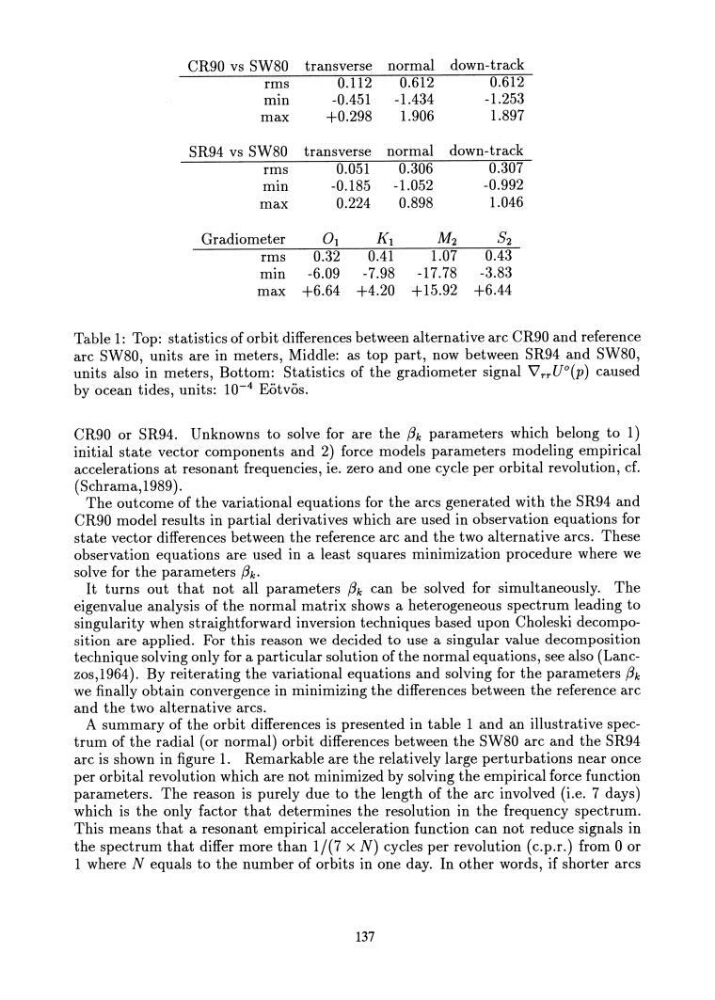
Table 1: Top: statistics of orbit differences between alternative arc CR90 and reference
arc SW80, units are in meters, Middle: as top part, now between SR94 and SW80,
units also in meters, Bottom: Statistics of the gradiometer signal VrrUO(p) caused
by ocean tides, units: 10- 4 Eotvos.
CR90 or SR94. Unknowns to solve for are the (3k parameters which belong to 1)
initial state vector components and 2) force models parameters modeling empirical
accelerations at resonant frequencies, ie. zero and one cycle per orbital revolution, d.
(Schrama, 1989).
The outcome of the variational equations for the arcs generated with the SR94 and
CR90 model results in partial derivatives which are used in observation equations for
state vector differences between the reference arc and the two alternative arcs. These
observation equations are used in a least squares minimization procedure where we
solve for the parameters {3k.
It turns out that not all parameters {3k can be solved for simultaneously. The
eigenvalue analysis of the normal matrix shows a heterogeneous spectrum leading to
singularity when straightforward inversion techniques based upon Choleski decomposition are applied. For this reason we decided to use a singular value decomposition
technique solving only for a particular solution of the normal equations, see also (Lanczos,1964). By reiterating the variational equations and solving for the parameters {3k
we finally obtain convergence in minimizing the differences between the reference arc
and the two alternative arcs.
A summary of the orbit differences is presented in table 1 and an illustrative spectrum of the radial (or normal) orbit differences between the SW80 arc and the SR94
arc is shown in figure 1. Remarkable are the relatively large perturbations near once
per orbital revolution which are not minimized by solving the empirical force function
parameters. The reason is purely due to the length of the arc involved (i.e. 7 days)
which is the only factor that determines the resolution in the frequency spectrum.
This means that a resonant empirical acceleration function can not reduce signals in
the spectrum that differ more than 1/(7 x N) cycles per revolution (c.p.r.) from 0 or
1 where N equals to the number of orbits in one day. In other words, if shorter arcs
137
rms
0.112
0.612
0.612
mm
-0.451
-1.434
-1.253
max
+0.298
1.906
1.897
SR94 vs SW80 transverse normal down-track
rms
0.051
0.306
0.307
mIn
-0.185
-1.052
-0.992
max
0.224
0.898
1.046
Gradiometer
0 1
K1
M2
S2
rms
0.32
0.41
1.07
0.43
mm -6.09
-7.98
-17.78
-3.83
max +6.64 +4.20 +15.92 +6.44
Table 1: Top: statistics of orbit differences between alternative arc CR90 and reference
arc SW80, units are in meters, Middle: as top part, now between SR94 and SW80,
units also in meters, Bottom: Statistics of the gradiometer signal VrrUO(p) caused
by ocean tides, units: 10- 4 Eotvos.
CR90 or SR94. Unknowns to solve for are the (3k parameters which belong to 1)
initial state vector components and 2) force models parameters modeling empirical
accelerations at resonant frequencies, ie. zero and one cycle per orbital revolution, d.
(Schrama, 1989).
The outcome of the variational equations for the arcs generated with the SR94 and
CR90 model results in partial derivatives which are used in observation equations for
state vector differences between the reference arc and the two alternative arcs. These
observation equations are used in a least squares minimization procedure where we
solve for the parameters {3k.
It turns out that not all parameters {3k can be solved for simultaneously. The
eigenvalue analysis of the normal matrix shows a heterogeneous spectrum leading to
singularity when straightforward inversion techniques based upon Choleski decomposition are applied. For this reason we decided to use a singular value decomposition
technique solving only for a particular solution of the normal equations, see also (Lanczos,1964). By reiterating the variational equations and solving for the parameters {3k
we finally obtain convergence in minimizing the differences between the reference arc
and the two alternative arcs.
A summary of the orbit differences is presented in table 1 and an illustrative spectrum of the radial (or normal) orbit differences between the SW80 arc and the SR94
arc is shown in figure 1. Remarkable are the relatively large perturbations near once
per orbital revolution which are not minimized by solving the empirical force function
parameters. The reason is purely due to the length of the arc involved (i.e. 7 days)
which is the only factor that determines the resolution in the frequency spectrum.
This means that a resonant empirical acceleration function can not reduce signals in
the spectrum that differ more than 1/(7 x N) cycles per revolution (c.p.r.) from 0 or
1 where N equals to the number of orbits in one day. In other words, if shorter arcs
137