

0 0
o
0.5
Indirect ocean tid •• on a 200km CRt.! orbit (1<95 .1 ow80) (radial)
.J\
1.5
2
2.5
cpr
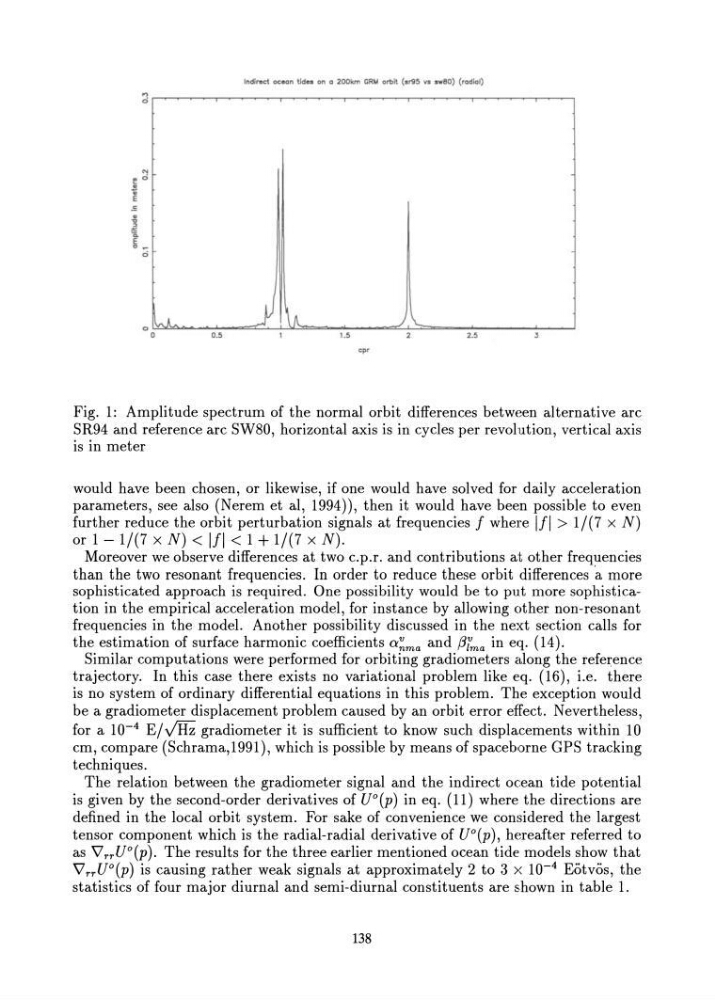
Fig. 1: Amplitude spectrum of the normal orbit differences between alternative arc
SR94 and reference arc SW80, horizontal axis is in cycles per revolution, vertical axis
is in meter
would have been chosen, or likewise, if one would have solved for daily acceleration
parameters, see also (Nerem et aI, 1994)), then it would have been possible to even
further reduce the orbit perturbation signals at frequencies f where If I > 1/(7 x N)
or 1 - 1/(7 x N) < If I < 1 + 1/(7 x N).
Moreover we observe differences at two c.p.r. and contributions at other frequencies
than the two resonant frequencies . In order to reduce these orbit differences ' a more
sophisticated approach is required. One possibility would be to put more sophistication in the empirical acceleration model, for instance by allowing other non-resonant
frequencies in the model. Another possibility discussed in the next section calls for
the estimation of surface harmonic coefficients a~ma and f3 lm a in eq. (14).
Similar computations were performed for orbiting gradiometers along the refeI:ence
trajectory. In this case there exists no variational problem like eq. (16), i.e. there
is no system of ordinary differential equations in this problem. The exception would
be a gradiometer displacement problem caused by an orbit error effect. Nevertheless,
for a 10- 4 E/VRz gradiometer it is sufficient to know such displacements within 10
cm, compare (Schrama,1991), which is possible by means of spaceborne GPS tracking
techniques.
The relation between the gradiometer signal and the indirect ocean tide potential
is given by the second-order derivatives of UO (p) in eq. (11) where the directions are
defined in the local orbit system. For sake of convenience we considered the largest
tensor component which is the radial-radial derivative of UO(p), hereafter referred to
as \l rrUo (p). The results for the three earlier mentioned ocean tide models show that
\l rrUo (p) is causing rather weak signals at approximately 2 to 3 >~ 10- 4 Eotvos, the
statistics of four major diurnal and semi-diurnal constituents are shown in table 1.
138
o
0.5
Indirect ocean tid •• on a 200km CRt.! orbit (1<95 .1 ow80) (radial)
.J\
1.5
2
2.5
cpr
Fig. 1: Amplitude spectrum of the normal orbit differences between alternative arc
SR94 and reference arc SW80, horizontal axis is in cycles per revolution, vertical axis
is in meter
would have been chosen, or likewise, if one would have solved for daily acceleration
parameters, see also (Nerem et aI, 1994)), then it would have been possible to even
further reduce the orbit perturbation signals at frequencies f where If I > 1/(7 x N)
or 1 - 1/(7 x N) < If I < 1 + 1/(7 x N).
Moreover we observe differences at two c.p.r. and contributions at other frequencies
than the two resonant frequencies . In order to reduce these orbit differences ' a more
sophisticated approach is required. One possibility would be to put more sophistication in the empirical acceleration model, for instance by allowing other non-resonant
frequencies in the model. Another possibility discussed in the next section calls for
the estimation of surface harmonic coefficients a~ma and f3 lm a in eq. (14).
Similar computations were performed for orbiting gradiometers along the refeI:ence
trajectory. In this case there exists no variational problem like eq. (16), i.e. there
is no system of ordinary differential equations in this problem. The exception would
be a gradiometer displacement problem caused by an orbit error effect. Nevertheless,
for a 10- 4 E/VRz gradiometer it is sufficient to know such displacements within 10
cm, compare (Schrama,1991), which is possible by means of spaceborne GPS tracking
techniques.
The relation between the gradiometer signal and the indirect ocean tide potential
is given by the second-order derivatives of UO (p) in eq. (11) where the directions are
defined in the local orbit system. For sake of convenience we considered the largest
tensor component which is the radial-radial derivative of UO(p), hereafter referred to
as \l rrUo (p). The results for the three earlier mentioned ocean tide models show that
\l rrUo (p) is causing rather weak signals at approximately 2 to 3 >~ 10- 4 Eotvos, the
statistics of four major diurnal and semi-diurnal constituents are shown in table 1.
138