

It was noted by Bettadpur and Eanes (1994) that ocean tides do leave their signature
on the orbit. Their findings suggest that the effect on T /P is on the one centimeter
level and that the orbit effect is partly in-phase with the ocean tides themselves. In
order to draw the analogy with a GRM we will repeat similar orbit simulations on an
idealized mission for which we have chosen the following configuration: 1) The orbital
height is 200 km in order to gain as much sensitivity as possible with respect to the
gravity field but to remain outside the Earth's atmosphere whose density rapidly
increases below this altitude, 2) A sun-synchronous inclination of 96.327° is chosen to
minimize thermal variations inside the spacecraft as a result of eclipsing, 3) The right
ascension of the ascending node and start time are chosen corresponding to a dawndusk configuration also in order to prevent eclipsing, 4) The length of the nominal
arc is one week.
These constraints have led to the following initial conditions: 1) Initial elements are
a = 6578137 [m], e = 0.0, I = 96.327°, n = 90°, w = 0°, M = 0°, orbit starts at
92/3/21 Ohr UT and stops at 92/3/28 Ohr UT, Adams/Moulton/Bashforth 12th order
integration method, 30 sec stepsize, 2) Empirical acceleration parameters solved for
during data reduction consist of cross-track, radial and along-track accelerations at
zero frequency and one cycle per revolution including six initial state vector components, 3) JPL's Planetary ephemeris set DE200/LE200 is used for the computation
of the direct and indirect solid earth tide effects, all Love numbers are chosen as
recommended in the IERS standards (cf. McCarthy,1992), 4) In total we considered
three ocean tide models in our computations. The first model is a pure hydrodynamical model developed by Schwiderski (1980), hereafter SW80. The second is a global
ocean tide model that resulted from the processing of Geosat data by Cartwright and
Ray (1990) hereafter referred to as CR90. Finally we used a model, hereafter SR94,
that was made out of 2 years of Topex/Poseidon data, cf. (Schrama and Ray, 1994),
5) Inertial coordinate system during orbit integration is J2000, IAU 1980 precession
and nutation series are used, Earth rotation parameters come from IERS bulletin-B
final values, 6) Gravity model is JGM-2, (Nerem et aI, 1994) up to degree and order
70.
For the GRM configuration described above we simulated three arcs each with a
different ocean tide model. The first arc, hereafter called a reference arc, was found
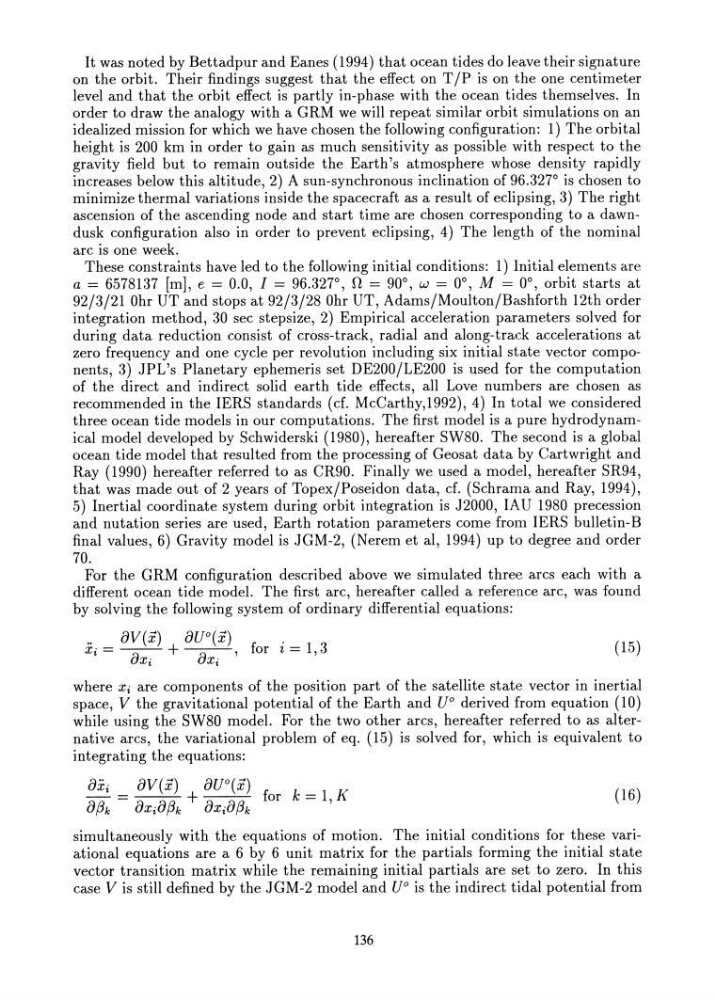
by solving the following system of ordinary differential equations:
..
aV(i) aUa(i) £ . 1 3
Xi = a + a ,or ~ = ,
Xi
Xi
(15)
where Xi are components of the position part of the satellite state vector in inertial
space, V the gravitational potential of the Earth and U a derived from equation (10)
while using the SW80 model. For the two other arcs, hereafter referred to as alternative arcs, the variational problem of eq. (15) is solved for, which is equivalent to
integrating the equations:
(16)
simultaneously with the equations of motion. The initial conditions for these variational equations are a 6 by 6 unit matrix for the partials forming the initial state
vector transition matrix while the remaining initial partials are set to zero. In this
case V is still defined by the JGM-2 model and U a is the indirect tidal potential from
136
on the orbit. Their findings suggest that the effect on T /P is on the one centimeter
level and that the orbit effect is partly in-phase with the ocean tides themselves. In
order to draw the analogy with a GRM we will repeat similar orbit simulations on an
idealized mission for which we have chosen the following configuration: 1) The orbital
height is 200 km in order to gain as much sensitivity as possible with respect to the
gravity field but to remain outside the Earth's atmosphere whose density rapidly
increases below this altitude, 2) A sun-synchronous inclination of 96.327° is chosen to
minimize thermal variations inside the spacecraft as a result of eclipsing, 3) The right
ascension of the ascending node and start time are chosen corresponding to a dawndusk configuration also in order to prevent eclipsing, 4) The length of the nominal
arc is one week.
These constraints have led to the following initial conditions: 1) Initial elements are
a = 6578137 [m], e = 0.0, I = 96.327°, n = 90°, w = 0°, M = 0°, orbit starts at
92/3/21 Ohr UT and stops at 92/3/28 Ohr UT, Adams/Moulton/Bashforth 12th order
integration method, 30 sec stepsize, 2) Empirical acceleration parameters solved for
during data reduction consist of cross-track, radial and along-track accelerations at
zero frequency and one cycle per revolution including six initial state vector components, 3) JPL's Planetary ephemeris set DE200/LE200 is used for the computation
of the direct and indirect solid earth tide effects, all Love numbers are chosen as
recommended in the IERS standards (cf. McCarthy,1992), 4) In total we considered
three ocean tide models in our computations. The first model is a pure hydrodynamical model developed by Schwiderski (1980), hereafter SW80. The second is a global
ocean tide model that resulted from the processing of Geosat data by Cartwright and
Ray (1990) hereafter referred to as CR90. Finally we used a model, hereafter SR94,
that was made out of 2 years of Topex/Poseidon data, cf. (Schrama and Ray, 1994),
5) Inertial coordinate system during orbit integration is J2000, IAU 1980 precession
and nutation series are used, Earth rotation parameters come from IERS bulletin-B
final values, 6) Gravity model is JGM-2, (Nerem et aI, 1994) up to degree and order
70.
For the GRM configuration described above we simulated three arcs each with a
different ocean tide model. The first arc, hereafter called a reference arc, was found
by solving the following system of ordinary differential equations:
..
aV(i) aUa(i) £ . 1 3
Xi = a + a ,or ~ = ,
Xi
Xi
(15)
where Xi are components of the position part of the satellite state vector in inertial
space, V the gravitational potential of the Earth and U a derived from equation (10)
while using the SW80 model. For the two other arcs, hereafter referred to as alternative arcs, the variational problem of eq. (15) is solved for, which is equivalent to
integrating the equations:
(16)
simultaneously with the equations of motion. The initial conditions for these variational equations are a 6 by 6 unit matrix for the partials forming the initial state
vector transition matrix while the remaining initial partials are set to zero. In this
case V is still defined by the JGM-2 model and U a is the indirect tidal potential from
136