

calculate the tensor of second-order derivatives of Ua(p). Results obtained for a GRM
orbit, whose nominal characteristics are explained under the heading "simulations" in
this paper, show that the magnitude of the direct astronomical effect is around 10- 6 to
10- 7 m/8 2 and 10- 3 to 10- 4 Eotvos units respectively whereby the relative accuracy
is of the order of 10- 9 because well-determined astronomical variables determine the
outcome of eq. (1).
For some investigations it may be necessary to use a spectrum of tidal harmonics,
whose coefficients were computed originally by Cartwright, Tayler and Edden, hereafter referred to as the CTE series, cf. (Cartwright,1993). The CTE series are useful
in cases where it is necessary to study a response mechanism of e.g. the ocean tides
although a similar technique could be envisioned for studying loading effects caused
by ocean tides. For the calculation of the direct tidal effects mentioned above it is
not necessary to use the CTE series. Instead the effect may be computed directly
from equation (1) for which software capable of interpolating Chebyshev polynomial
coefficients stored on a DE-2DD ephemeris tape developed by (Newhall et al,1983), or
one of its more recent versions, is required.
The astronomical tide potential is known to cause a wide variety of deformations at
the Earth's surface and the oceans. The deformation of the solid Earth, also called the
Earth tide effect, is usually modeled according to Love's theory, cf. (Lambeck,1988).
These deformations result in an induced potential hereafter referred to as the indirect
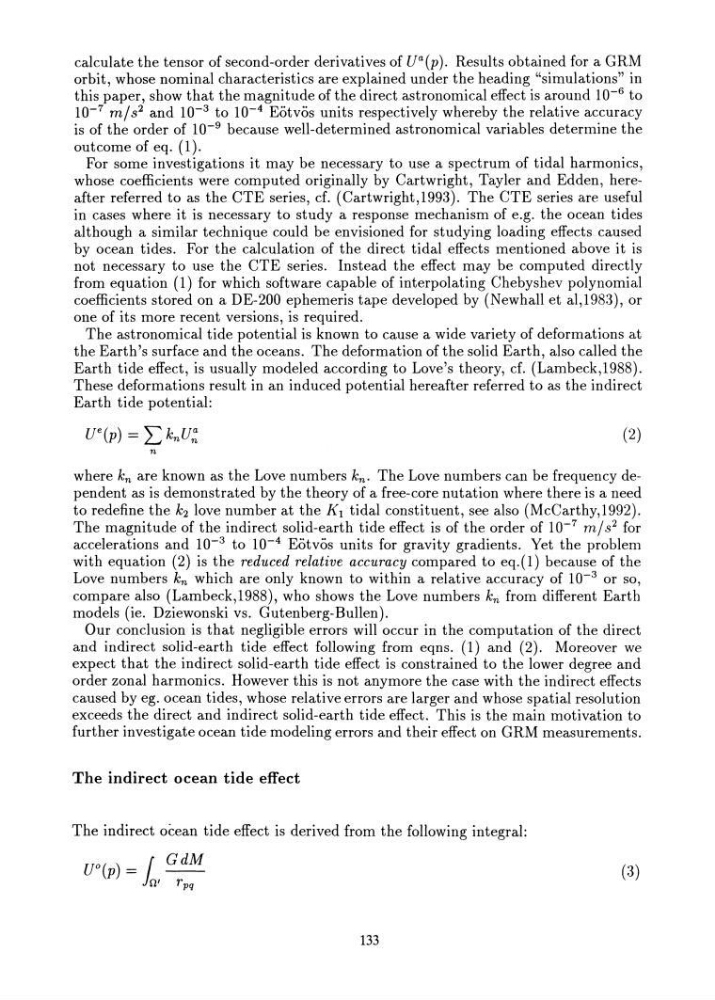
Earth tide potential:
(2)
n
where kn are known as the Love numbers kn • The Love numbers can be frequency dependent as is demonstrated by the theory of a free-core nutation where there is a need
to redefine the k2 love number at the Kl tidal constituent, see also (McCarthy,1992).
The magnitude of the indirect solid-earth tide effect is of the order of 10- 7 m/8 2 for
accelerations and 10- 3 to 10- 4 Eotvos units for gravity gradients. Yet the problem
with equation (2) is the reduced relative accuracy compared to eq.(1) because of the
Love numbers kn which are only known to within a relative accuracy of 10- 3 or so,
compare also (Lambeck,1988), who shows the Love numbers kn from different Earth
models (ie. Dziewonski vs. Gutenberg-Bullen).
Our conclusion is that negligible errors will occur in the computation of the direct
and indirect solid-earth tide effect following from eqns. (1) and (2). Moreover we
expect that the indirect solid-earth tide effect is constrained to the lower degree and
order zonal harmonics. However this is not anymore the case with the indirect effects
caused by ego ocean tides, whose relative errors are larger and whose spatial resolution
exceeds the direct and indirect solid-earth tide effect. This is the main motivation to
further investigate ocean tide modeling errors and their effect on GRM measurements.
The indirect ocean tide effect
The indirect ocean tide effect is derived from the following integral:
(3)
133
orbit, whose nominal characteristics are explained under the heading "simulations" in
this paper, show that the magnitude of the direct astronomical effect is around 10- 6 to
10- 7 m/8 2 and 10- 3 to 10- 4 Eotvos units respectively whereby the relative accuracy
is of the order of 10- 9 because well-determined astronomical variables determine the
outcome of eq. (1).
For some investigations it may be necessary to use a spectrum of tidal harmonics,
whose coefficients were computed originally by Cartwright, Tayler and Edden, hereafter referred to as the CTE series, cf. (Cartwright,1993). The CTE series are useful
in cases where it is necessary to study a response mechanism of e.g. the ocean tides
although a similar technique could be envisioned for studying loading effects caused
by ocean tides. For the calculation of the direct tidal effects mentioned above it is
not necessary to use the CTE series. Instead the effect may be computed directly
from equation (1) for which software capable of interpolating Chebyshev polynomial
coefficients stored on a DE-2DD ephemeris tape developed by (Newhall et al,1983), or
one of its more recent versions, is required.
The astronomical tide potential is known to cause a wide variety of deformations at
the Earth's surface and the oceans. The deformation of the solid Earth, also called the
Earth tide effect, is usually modeled according to Love's theory, cf. (Lambeck,1988).
These deformations result in an induced potential hereafter referred to as the indirect
Earth tide potential:
(2)
n
where kn are known as the Love numbers kn • The Love numbers can be frequency dependent as is demonstrated by the theory of a free-core nutation where there is a need
to redefine the k2 love number at the Kl tidal constituent, see also (McCarthy,1992).
The magnitude of the indirect solid-earth tide effect is of the order of 10- 7 m/8 2 for
accelerations and 10- 3 to 10- 4 Eotvos units for gravity gradients. Yet the problem
with equation (2) is the reduced relative accuracy compared to eq.(1) because of the
Love numbers kn which are only known to within a relative accuracy of 10- 3 or so,
compare also (Lambeck,1988), who shows the Love numbers kn from different Earth
models (ie. Dziewonski vs. Gutenberg-Bullen).
Our conclusion is that negligible errors will occur in the computation of the direct
and indirect solid-earth tide effect following from eqns. (1) and (2). Moreover we
expect that the indirect solid-earth tide effect is constrained to the lower degree and
order zonal harmonics. However this is not anymore the case with the indirect effects
caused by ego ocean tides, whose relative errors are larger and whose spatial resolution
exceeds the direct and indirect solid-earth tide effect. This is the main motivation to
further investigate ocean tide modeling errors and their effect on GRM measurements.
The indirect ocean tide effect
The indirect ocean tide effect is derived from the following integral:
(3)
133