

In the case of a gradiometer measuring only a few tensor components the situation is
less favorable whereby the requirements of gyroscopes and star-trackers increase.
Because of bandwidth limitations of the gradiometer and sun-synchronous inclinations leading to a partial coverage of the gravity field, tracking of a low Earth orbiter
will play an essential role for the proposed GRM's, cf. (Schrama,1991). Spaceborne
GPS has demonstrated that accurate orbits can be computed without requiring precise knowledge of dynamical models predicting forces on the spacecraft, cf. (Bertiger
et al,1994), who show that the GPS tracking experiment on Topex/Poseidon results
in radial orbit errors of less than 3 cm rms.
In addition to accurate continuous tracking, drag-free control was suggested for
STEP (Satellite Test of the Equivalence Principle), cf. (Blaser et al,1993). These
techniques may provide a possibility to reduce the level the non-gra.vitational perturbations on a spacecraft helping the modeling of terrestrial gravity field coefficients.
This bring us to the motivation for writing this paper in which we want to draw
your attention to the modeling of the gravitational effect of ocean tides which cause
additional orbit perturbations and whose relative accuracy is worse compared to other
tidal effects in the problem. These effects are of a gravitational origin and therefore
can't be removed by any drag free technique. Nevertheless, in order to be successful
one must always be able to distinguish between gravity and tides which is to some
degree questionable as will be discussed later on.
The outline of this paper is as follows. First, we will classify tidal effects and discuss
their relevance in the context of a GRM. Second, we will work out a formulation of the
indirect ocean tide potential. Third we will show the result of a number of simulations
and in the fourth part we will point out what could be done in a real world situation
to deal with the problem of tidal modeling.
Tidal effects, what is relevant and what is not
For modeling of tidal effects in the context of a GRM we need to distinguish between
direct and indirect tides. By direct tides we specifically refer to the gravitational
influence of bodies in the solar system; Sun and Moon are the largest contributors in
this process because of their relative mass and proximity to the observation point. For
modeling of direct effects a method is required to compute the so-called astronomical
tide potential whose gradient corresponds to the tidal forces as in Newton's Principia
(1687). Newton defined the tidal force as a difference between the gravitational force
f~ excerted by the Moon on observation point P and the gravitational lunar force f~
at the Earth's center. The potential whose gradient corresponds to the tidal force
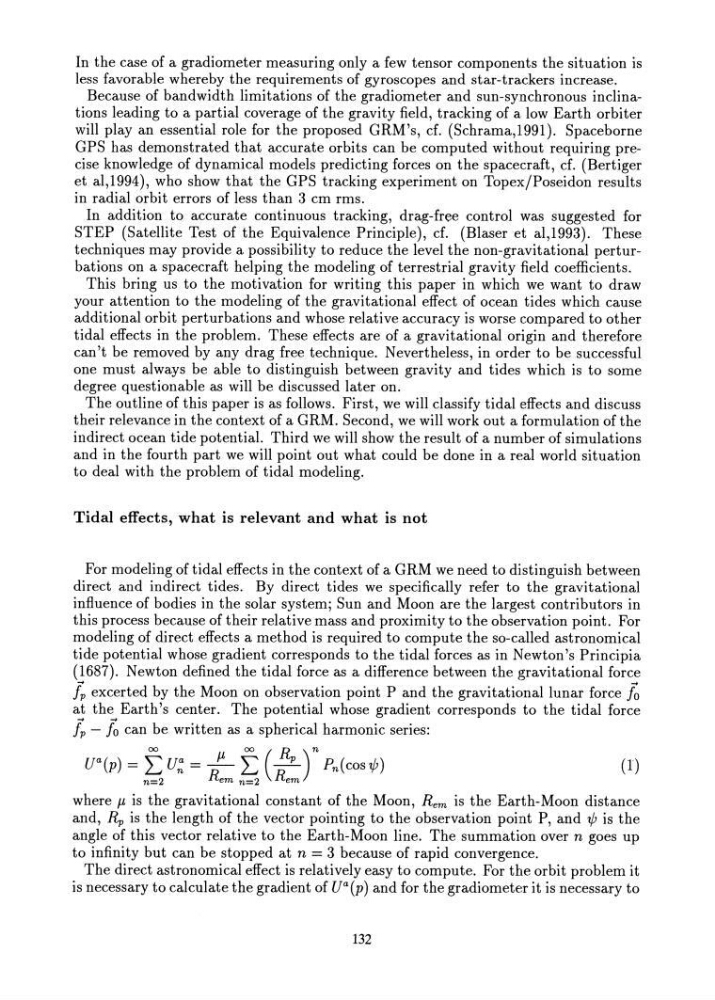
f~ - f~ can be written as a spherical harmonic series:
(1)
where J-l is the gravitational constant of the Moon, Rem is the Earth-Moon distance
and, Rp is the length of the vector pointing to the observation point P, and .,p is the
angle of this vector relative to the Earth-Moon line. The summation over n goes up
to infinity but can be stopped at n = 3 because of rapid convergence.
The direct astronomical effect is relatively easy to compute. For the orbit problem it
is necessary to calculate the gradient of Ua(p) and for the gradiometer it is necessary to
132
less favorable whereby the requirements of gyroscopes and star-trackers increase.
Because of bandwidth limitations of the gradiometer and sun-synchronous inclinations leading to a partial coverage of the gravity field, tracking of a low Earth orbiter
will play an essential role for the proposed GRM's, cf. (Schrama,1991). Spaceborne
GPS has demonstrated that accurate orbits can be computed without requiring precise knowledge of dynamical models predicting forces on the spacecraft, cf. (Bertiger
et al,1994), who show that the GPS tracking experiment on Topex/Poseidon results
in radial orbit errors of less than 3 cm rms.
In addition to accurate continuous tracking, drag-free control was suggested for
STEP (Satellite Test of the Equivalence Principle), cf. (Blaser et al,1993). These
techniques may provide a possibility to reduce the level the non-gra.vitational perturbations on a spacecraft helping the modeling of terrestrial gravity field coefficients.
This bring us to the motivation for writing this paper in which we want to draw
your attention to the modeling of the gravitational effect of ocean tides which cause
additional orbit perturbations and whose relative accuracy is worse compared to other
tidal effects in the problem. These effects are of a gravitational origin and therefore
can't be removed by any drag free technique. Nevertheless, in order to be successful
one must always be able to distinguish between gravity and tides which is to some
degree questionable as will be discussed later on.
The outline of this paper is as follows. First, we will classify tidal effects and discuss
their relevance in the context of a GRM. Second, we will work out a formulation of the
indirect ocean tide potential. Third we will show the result of a number of simulations
and in the fourth part we will point out what could be done in a real world situation
to deal with the problem of tidal modeling.
Tidal effects, what is relevant and what is not
For modeling of tidal effects in the context of a GRM we need to distinguish between
direct and indirect tides. By direct tides we specifically refer to the gravitational
influence of bodies in the solar system; Sun and Moon are the largest contributors in
this process because of their relative mass and proximity to the observation point. For
modeling of direct effects a method is required to compute the so-called astronomical
tide potential whose gradient corresponds to the tidal forces as in Newton's Principia
(1687). Newton defined the tidal force as a difference between the gravitational force
f~ excerted by the Moon on observation point P and the gravitational lunar force f~
at the Earth's center. The potential whose gradient corresponds to the tidal force
f~ - f~ can be written as a spherical harmonic series:
(1)
where J-l is the gravitational constant of the Moon, Rem is the Earth-Moon distance
and, Rp is the length of the vector pointing to the observation point P, and .,p is the
angle of this vector relative to the Earth-Moon line. The summation over n goes up
to infinity but can be stopped at n = 3 because of rapid convergence.
The direct astronomical effect is relatively easy to compute. For the orbit problem it
is necessary to calculate the gradient of Ua(p) and for the gradiometer it is necessary to
132