

notation (see Figure 1), 11Ym = 0, but 8Ym ;: 0. This means that there remains considerable
aliasing of the spectrum estimated by any method of harmonic analysis if the averaging is
performed over constant angular blocks. In fact, with a perfect angular block average (in
addition to being zero at frequencies higher ~an the Nyquist, Bk,m = 1 for Ikl < KJ2 and
Iml < iv1l2). equation (25) with (11) becomes I'j,m :::: I'j,m for any j if Iml < Mi2 . That is, the
spherical spectral region denoted by the region &y in Figure 1 is passed fully by this fIlter
and therefore represents an aliasing error.
A better fIlter is the so-called spherical cap average (Jekeli, 1981.). In this case (for
constant size caps, only!), the frequency response of the fIlter is formulated in terms of its
Legendre spectrum, ~n; and
=i _fl. ~J
.n,m - tJn IO ,m
(27)
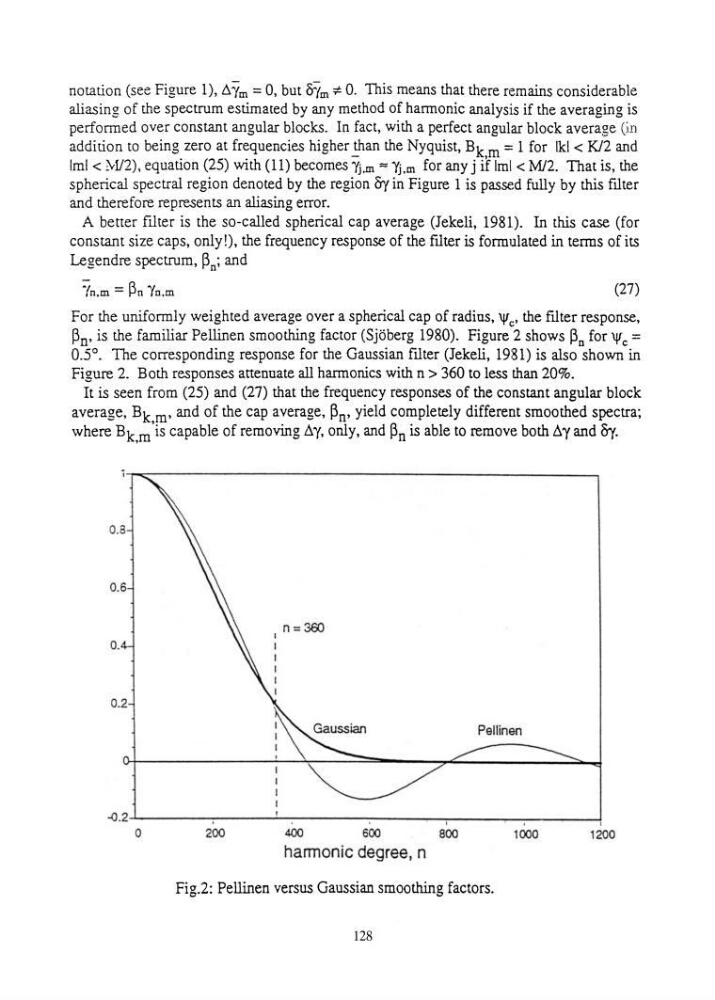
For the uniformly weighted average over a spherical cap of radius, 'V e , the fIlter response,
~n' is the familiar Pellinen smoothing factor (Sjoberg 1980). Figure 2 shows ~o for 'lie =
0.5°. The corresponding response for the Gaussian filter (Jekeli, 1981) is also shown in
Figure 2. Both responses attenuate all hannonics with n > 360 to less than 20%.
It is seen from (25) and (27) that the frequency responses of the constant angular block
average, Bk m' and of the cap average, ~n' yield completely different smoothed spectra;
where Bk,m'is capable of removing 111' , only, and ~n is able to remove both D.yand &yo
0.8
0.6
o.
0.2
Pellinen
~ . 2~------~------~--------~----~~----~----~--~,
o
200
400
600
800
1000
1200
harmonic degree, n
Fig.2: Pellinen versus Gaussian smoothing factors.
128
aliasing of the spectrum estimated by any method of harmonic analysis if the averaging is
performed over constant angular blocks. In fact, with a perfect angular block average (in
addition to being zero at frequencies higher ~an the Nyquist, Bk,m = 1 for Ikl < KJ2 and
Iml < iv1l2). equation (25) with (11) becomes I'j,m :::: I'j,m for any j if Iml < Mi2 . That is, the
spherical spectral region denoted by the region &y in Figure 1 is passed fully by this fIlter
and therefore represents an aliasing error.
A better fIlter is the so-called spherical cap average (Jekeli, 1981.). In this case (for
constant size caps, only!), the frequency response of the fIlter is formulated in terms of its
Legendre spectrum, ~n; and
=i _fl. ~J
.n,m - tJn IO ,m
(27)
For the uniformly weighted average over a spherical cap of radius, 'V e , the fIlter response,
~n' is the familiar Pellinen smoothing factor (Sjoberg 1980). Figure 2 shows ~o for 'lie =
0.5°. The corresponding response for the Gaussian filter (Jekeli, 1981) is also shown in
Figure 2. Both responses attenuate all hannonics with n > 360 to less than 20%.
It is seen from (25) and (27) that the frequency responses of the constant angular block
average, Bk m' and of the cap average, ~n' yield completely different smoothed spectra;
where Bk,m'is capable of removing 111' , only, and ~n is able to remove both D.yand &yo
0.8
0.6
o.
0.2
Pellinen
~ . 2~------~------~--------~----~~----~----~--~,
o
200
400
600
800
1000
1200
harmonic degree, n
Fig.2: Pellinen versus Gaussian smoothing factors.
128