

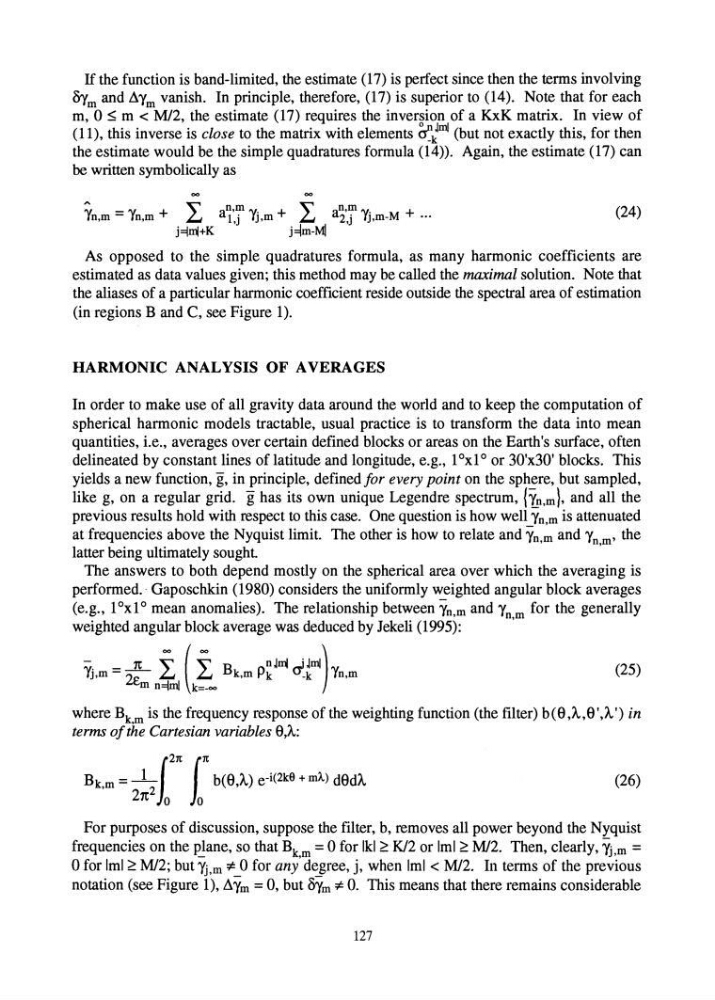
If the function is band-limited, the estimate (17) is perfect since then the terms involving
arm and A"{m vanish. In principle, therefore, (17) is superior to (14). Note that for each
m, 0 S m < Ml2, the estimate (17) requires the inversion of a KxK matrix. In view of
(11), this inverse is close to the matrix with elements ~~mI (but not exactly this, for then
the estimate would be the simple quadratures formula (14». Again, the estimate (17) can
be written symbolically as
00
00
"{n,m = "{n,m + L a~',j Yi,m + L a~',j Yi,m-M + ...
j9~+K
j=Jm-Mi
(24)
As opposed to the simple quadratures formula, as many harmonic coefficients are
estimated as data values given; this method may be called the maximal solution. Note that
the aliases of a particular harmonic coefficient reside outside the spectral area of estimation
(in regions Band C, see Figure 1).
HARMONIC ANALYSIS OF AVERAGES
In order to make use of all gravity data around the world and to keep the computation of
spherical harmonic models tractable, usual practice is to transform the data into mean
quantities, i.e., averages over certain defined blocks or areas on the Earth's surface, often
delineated by constant lines of latitude and longitude, e.g., I °xl 0 or 30'x30' blocks. This
yields a new function, g, in principle, defined for every point on the sphere, but sampled,
like g, on a regular grid. g has its own unique Legendre spectrum, {t,m}, and all the
previous results hold with respect to this case. One question is how well "{n,m is attenuated
at frequencies above the Nyquist limit. The other is how to relate and Yn,m and "{n,m' the
latter being ultimately sought.
The answers to both depend mostly on the spherical area over which the averaging is
performed.· Gaposchkin (1980) considers the uniformly weighted angular block averages
(e.g., 1 °xl 0 mean anomalies). The relationship between Yn,m and "{n,m for the generally
weighted angular block average was deduced by Iekeli (1995):
00
(
00
)
-. - --1L
B
nJ~ ai JmI
"{J,m - 2£ L L k,m Pk -k "{n,m
m n9ml k=-oo
(25)
where Bk,m is the frequency response of the weighting function (the filter) b(e,A,e',A') in
terms of the Cartesian variables e,A:
Bk,m = ~121t 11t b(e,A) e-i(2k9 + mA.) dedI..
21t 0
0
(26)
For purposes of discussion, suppose the filter, b, removes all power beyond the Nyquist
frequencies on the plane, so that Bk,m = 0 for Ikl ~ KJ2 or Iml ~ Ml2. Then, clearly, Yi,m =
o for Iml ~ Ml2; but Yi,m ¢ 0 for any degree, j, when Iml < Ml2. In terms of the previous
notation (see Figure 1), AYm = 0, but 81m ¢ O. This means that there remains considerable
127
arm and A"{m vanish. In principle, therefore, (17) is superior to (14). Note that for each
m, 0 S m < Ml2, the estimate (17) requires the inversion of a KxK matrix. In view of
(11), this inverse is close to the matrix with elements ~~mI (but not exactly this, for then
the estimate would be the simple quadratures formula (14». Again, the estimate (17) can
be written symbolically as
00
00
"{n,m = "{n,m + L a~',j Yi,m + L a~',j Yi,m-M + ...
j9~+K
j=Jm-Mi
(24)
As opposed to the simple quadratures formula, as many harmonic coefficients are
estimated as data values given; this method may be called the maximal solution. Note that
the aliases of a particular harmonic coefficient reside outside the spectral area of estimation
(in regions Band C, see Figure 1).
HARMONIC ANALYSIS OF AVERAGES
In order to make use of all gravity data around the world and to keep the computation of
spherical harmonic models tractable, usual practice is to transform the data into mean
quantities, i.e., averages over certain defined blocks or areas on the Earth's surface, often
delineated by constant lines of latitude and longitude, e.g., I °xl 0 or 30'x30' blocks. This
yields a new function, g, in principle, defined for every point on the sphere, but sampled,
like g, on a regular grid. g has its own unique Legendre spectrum, {t,m}, and all the
previous results hold with respect to this case. One question is how well "{n,m is attenuated
at frequencies above the Nyquist limit. The other is how to relate and Yn,m and "{n,m' the
latter being ultimately sought.
The answers to both depend mostly on the spherical area over which the averaging is
performed.· Gaposchkin (1980) considers the uniformly weighted angular block averages
(e.g., 1 °xl 0 mean anomalies). The relationship between Yn,m and "{n,m for the generally
weighted angular block average was deduced by Iekeli (1995):
00
(
00
)
-. - --1L
B
nJ~ ai JmI
"{J,m - 2£ L L k,m Pk -k "{n,m
m n9ml k=-oo
(25)
where Bk,m is the frequency response of the weighting function (the filter) b(e,A,e',A') in
terms of the Cartesian variables e,A:
Bk,m = ~121t 11t b(e,A) e-i(2k9 + mA.) dedI..
21t 0
0
(26)
For purposes of discussion, suppose the filter, b, removes all power beyond the Nyquist
frequencies on the plane, so that Bk,m = 0 for Ikl ~ KJ2 or Iml ~ Ml2. Then, clearly, Yi,m =
o for Iml ~ Ml2; but Yi,m ¢ 0 for any degree, j, when Iml < Ml2. In terms of the previous
notation (see Figure 1), AYm = 0, but 81m ¢ O. This means that there remains considerable
127