

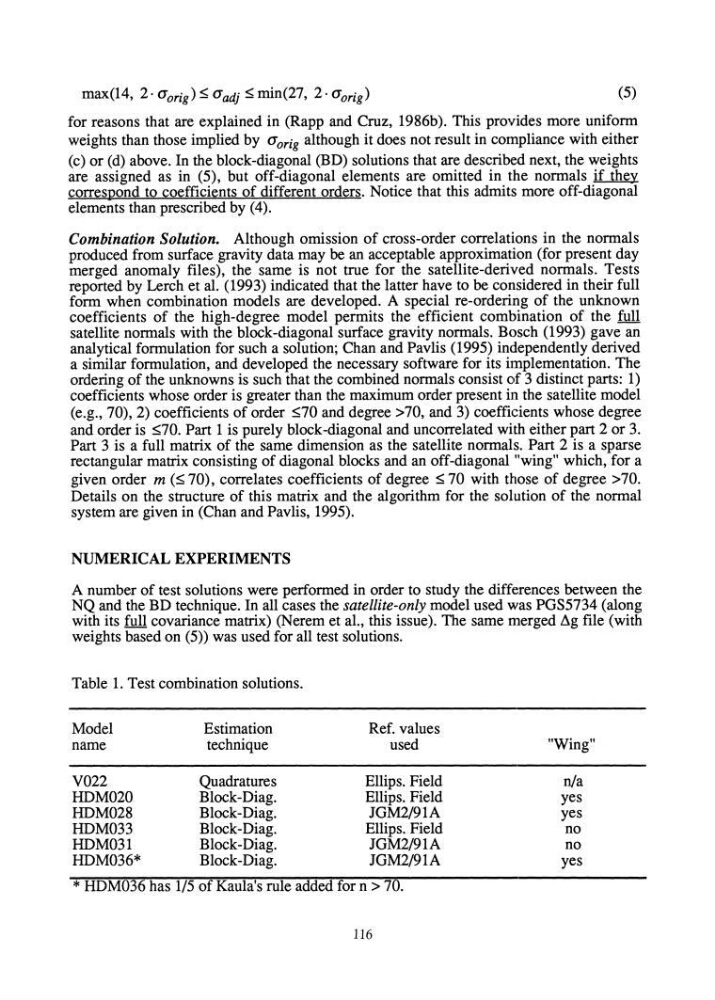
(5)
for reasons that are explained in (Rapp and Cruz, 1986b). This provides more uniform
weights than those implied by CJorig although it does not result in compliance with either
(c) or (d) above. In the block-diagonal (BD) solutions that are described next, the weights
are assigned as in (5), but off-diagonal elements are omitted in the normals if they
correspond to coefficients of different orders. Notice that this admits more off-diagonal
elements than prescribed by (4).
Combination Solution. Although omission of cross-order correlations in the normals
produced from surface gravity data may be an acceptable approximation (for present day
merged anomaly files), the same is not true for the satellite-derived normals. Tests
reported by Lerch et al. (1993) indicated that the latter have to be considered in their full
form when combination models are developed. A special re-ordering of the unknown
coefficients of the high-degree model permits .the efficient combination of the full
satellite normals with the block-diagonal surface gravity normals. Bosch (1993) gave an
analytical formulation for such a solution; Chan and Pavlis (1995) independently derived
a similar formulation, and developed the necessary software for its implementation. The
ordering of the unknowns is such that the combined normals consist of 3 distinct parts: 1)
coefficients whose order is greater than the maximum order present in the satellite model
(e.g., 70), 2) coefficients of order S70 and degree >70, and 3) coefficients whose degree
and order is S70. Part 1 is purely block-diagonal and uncorrelated with either part 2 or 3.
Part 3 is a full matrix of the same dimension as the satellite normals. Part 2 is a sparse
rectangular matrix consisting of diagonal blocks and an off-diagonal "wing" which, for a
given order m (S 70), correlates coefficients of degree S 70 with those of degree >70.
Details on the structure of this matrix and the algorithm for the solution of the normal
system are given in (Chan and Pavlis, 1995).
NUMERICAL EXPERIMENTS
A number of test solutions were performed in order to study the differences between the
NQ and the BD technique. In all cases the satellite-only model used was PGS5734 (along
with its full covariance matrix) (Nerem et aI., this issue). The same merged ~g file (with
weights based on (5» was used for all test solutions.
Table 1. Test combination solutions.
Model
name
V022
HDM020
HDM028
HDM033
HDM031
HDM036*
Estimation
technique
Quadratures
Block-Diag.
Block-Diag.
Block-Diag.
Block-Diag.
Block-Diag.
Ref. values
used
Ellips. Field
Ellips. Field
JGM2/91A
Ellips. Field
JGM2/91A
JGM2/91A
* HDM036 has 1/5 of Kaula's rule added for n > 70.
116
"Wing"
n/a
yes
yes
no
no
yes
for reasons that are explained in (Rapp and Cruz, 1986b). This provides more uniform
weights than those implied by CJorig although it does not result in compliance with either
(c) or (d) above. In the block-diagonal (BD) solutions that are described next, the weights
are assigned as in (5), but off-diagonal elements are omitted in the normals if they
correspond to coefficients of different orders. Notice that this admits more off-diagonal
elements than prescribed by (4).
Combination Solution. Although omission of cross-order correlations in the normals
produced from surface gravity data may be an acceptable approximation (for present day
merged anomaly files), the same is not true for the satellite-derived normals. Tests
reported by Lerch et al. (1993) indicated that the latter have to be considered in their full
form when combination models are developed. A special re-ordering of the unknown
coefficients of the high-degree model permits .the efficient combination of the full
satellite normals with the block-diagonal surface gravity normals. Bosch (1993) gave an
analytical formulation for such a solution; Chan and Pavlis (1995) independently derived
a similar formulation, and developed the necessary software for its implementation. The
ordering of the unknowns is such that the combined normals consist of 3 distinct parts: 1)
coefficients whose order is greater than the maximum order present in the satellite model
(e.g., 70), 2) coefficients of order S70 and degree >70, and 3) coefficients whose degree
and order is S70. Part 1 is purely block-diagonal and uncorrelated with either part 2 or 3.
Part 3 is a full matrix of the same dimension as the satellite normals. Part 2 is a sparse
rectangular matrix consisting of diagonal blocks and an off-diagonal "wing" which, for a
given order m (S 70), correlates coefficients of degree S 70 with those of degree >70.
Details on the structure of this matrix and the algorithm for the solution of the normal
system are given in (Chan and Pavlis, 1995).
NUMERICAL EXPERIMENTS
A number of test solutions were performed in order to study the differences between the
NQ and the BD technique. In all cases the satellite-only model used was PGS5734 (along
with its full covariance matrix) (Nerem et aI., this issue). The same merged ~g file (with
weights based on (5» was used for all test solutions.
Table 1. Test combination solutions.
Model
name
V022
HDM020
HDM028
HDM033
HDM031
HDM036*
Estimation
technique
Quadratures
Block-Diag.
Block-Diag.
Block-Diag.
Block-Diag.
Block-Diag.
Ref. values
used
Ellips. Field
Ellips. Field
JGM2/91A
Ellips. Field
JGM2/91A
JGM2/91A
* HDM036 has 1/5 of Kaula's rule added for n > 70.
116
"Wing"
n/a
yes
yes
no
no
yes