

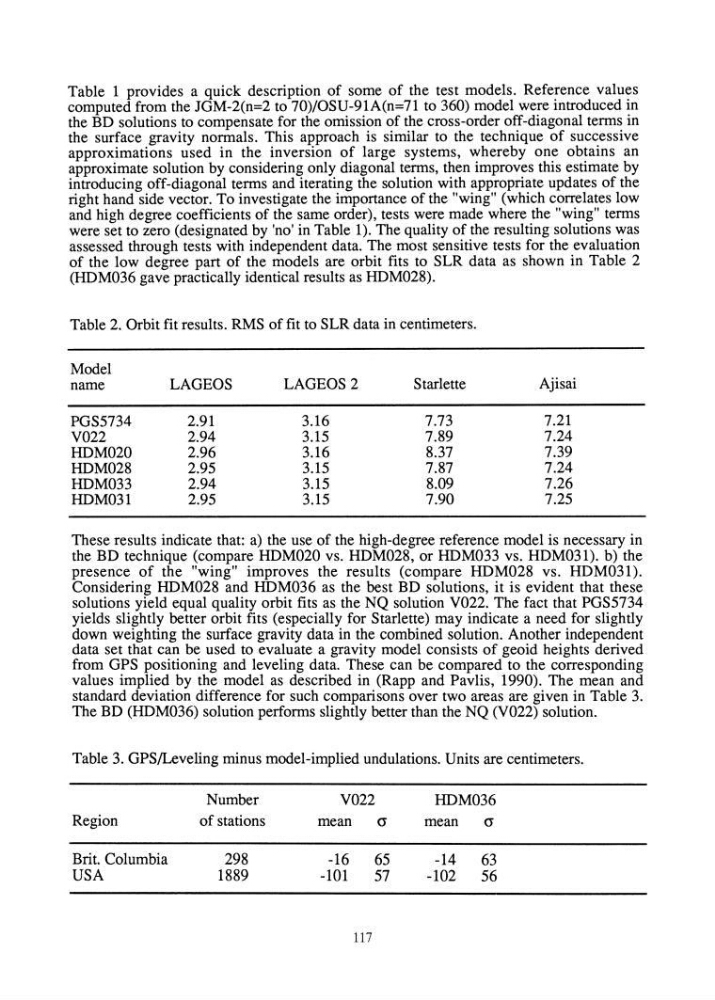
Table 1 provides a quick description of some of the test models. Reference values
computed from the JGM-2(n=2 to 70)/OSU-91A(n=71 to 360) model were introduced in
the BD solutions to compensate for the omission of the cross-order off-diagonal terms in
the surface gravity normals. This approach is similar to the technique of successive
approximations used in the inversion of large systems, whereby one obtains an
approximate solution by considering only diagonal terms, then improves this estimate by
introducing off-diagonal terms and iterating the solution with appropriate updates of the
right hand side vector. To investigate the importance of the "wing" (which correlates low
and high degree coefficients of the same order), tests were made where the "wing" terms
were set to zero (designated by 'no' in Table 1). The quality of the resulting solutions was
assessed through tests with independent data. The most sensitive tests for the evaluation
of the low degree part of the models are orbit fits to SLR data as shown in Table 2
(HDM036 gave practically identical results as HDM028).
Table 2. Orbit fit results. RMS of fit to SLR data in centimeters.
Model
name
LAGEOS
LAGEOS2
Starlette
Ajisai
PGS5734
2.91
3.16
7.73
7.21
V022
2.94
3.15
7.89
7.24
HDM020
2.96
3.16
8.37
7.39
HDM028
2.95
3.15
7.87
7.24
HDM033
2.94
3.15
8.09
7.26
HDM031
2.95
3.15
7.90
7.25
These results indicate that: a) the use of the high-degree reference model is necessary in
the BD technique (compare HDM020 vs. HDM028, or HDM033 vs. HDM031). b) the
presence of the "wing" improves the results (compare HDM028 vs. HDM031).
Considering HDM028 and HDM036 as the best BD solutions, it is evident that these
solutions yield equal quality orbit fits as the NQ solution V022. The fact that PGS5734
yields slightly better orbit fits (especially for Starlette) may indicate a need for slightly
down weighting the surface gravity data in the combined solution. Another independent
data set that can be used to evaluate a gravity model consists of geoid heights derived
from GPS positioning and leveling data. These can be compared to the corresponding
values implied by the model as described in (Rapp and Pavlis, 1990). The mean and
standard deviation difference for such comparisons over two areas are given in Table 3.
The BD (HDM036) solution performs slightly better than the NQ (V022) solution.
Table 3. GPS!Leveling minus model-implied undulations. Units are centimeters.
Number
V022
HDM036
Region
of stations
mean
cr
mean
cr
Brit. Columbia
298
-16
65
-14
63
USA
1889
-101
57
-102
56
117
computed from the JGM-2(n=2 to 70)/OSU-91A(n=71 to 360) model were introduced in
the BD solutions to compensate for the omission of the cross-order off-diagonal terms in
the surface gravity normals. This approach is similar to the technique of successive
approximations used in the inversion of large systems, whereby one obtains an
approximate solution by considering only diagonal terms, then improves this estimate by
introducing off-diagonal terms and iterating the solution with appropriate updates of the
right hand side vector. To investigate the importance of the "wing" (which correlates low
and high degree coefficients of the same order), tests were made where the "wing" terms
were set to zero (designated by 'no' in Table 1). The quality of the resulting solutions was
assessed through tests with independent data. The most sensitive tests for the evaluation
of the low degree part of the models are orbit fits to SLR data as shown in Table 2
(HDM036 gave practically identical results as HDM028).
Table 2. Orbit fit results. RMS of fit to SLR data in centimeters.
Model
name
LAGEOS
LAGEOS2
Starlette
Ajisai
PGS5734
2.91
3.16
7.73
7.21
V022
2.94
3.15
7.89
7.24
HDM020
2.96
3.16
8.37
7.39
HDM028
2.95
3.15
7.87
7.24
HDM033
2.94
3.15
8.09
7.26
HDM031
2.95
3.15
7.90
7.25
These results indicate that: a) the use of the high-degree reference model is necessary in
the BD technique (compare HDM020 vs. HDM028, or HDM033 vs. HDM031). b) the
presence of the "wing" improves the results (compare HDM028 vs. HDM031).
Considering HDM028 and HDM036 as the best BD solutions, it is evident that these
solutions yield equal quality orbit fits as the NQ solution V022. The fact that PGS5734
yields slightly better orbit fits (especially for Starlette) may indicate a need for slightly
down weighting the surface gravity data in the combined solution. Another independent
data set that can be used to evaluate a gravity model consists of geoid heights derived
from GPS positioning and leveling data. These can be compared to the corresponding
values implied by the model as described in (Rapp and Pavlis, 1990). The mean and
standard deviation difference for such comparisons over two areas are given in Table 3.
The BD (HDM036) solution performs slightly better than the NQ (V022) solution.
Table 3. GPS!Leveling minus model-implied undulations. Units are centimeters.
Number
V022
HDM036
Region
of stations
mean
cr
mean
cr
Brit. Columbia
298
-16
65
-14
63
USA
1889
-101
57
-102
56
117