

- i
.
-
_
1 N~l e f
Lnmk
IP n-2k,lml
2~-1 ~ {IC}]
Cnm - - - £.J ri £.J
i
£.J ilgij
41r a r i=O k=O Sn-2k,lml (bl E) (n - 2k -1)qn-2k j=O
IS m
m;;:::O
m < 0 (1)
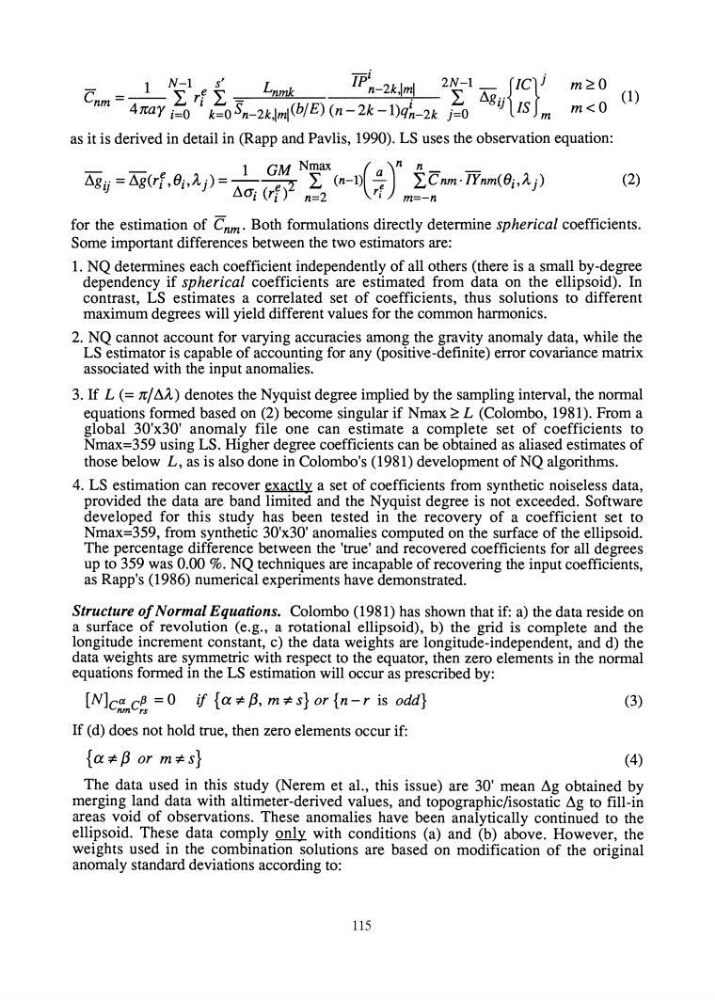
as it is derived in detail in (Rapp and Pavlis, 1990). LS uses the observation equation:
_ _ e
1 GM Nmax
( a)n n _ -
8.gij = 8.g(ri ,9 i ,Aj) = - . ~ :2. (n-l) r~ :2.Cnm ·/Ynm(9i ,Aj)
8.0", (ri) n=2
I
m=-n
(2)
for the estimation of C nm . Both formulations directly determine spherical coefficients.
Some important differences between the two estimators are:
1. NQ determines each coefficient independently of all others (there is a small by-degree
dependency if spherical coefficients are estimated from data on the ellipsoid). In
contrast, LS estimates a correlated set of coefficients, thus solutions to different
maximum degrees will yield different values for the common harmonics.
2. NQ cannot account for varying accuracies among the gravity anomaly data, while the
LS estimator is capable of accounting for any (positive-definite) error covariance matrix
associated with the input anomalies.
3. If L (= 1r/8.A) denotes the Nyquist degree implied by the sampling interval, the normal
equations formed based on (2) become singular if Nmax;;::: L (Colombo, 1981). From a
global 30'x30' anomaly file one can estimate a complete set of coefficients to
Nmax=359 using LS. Higher degree coefficients can be obtained as aliased estimates of
those below L, as is also done in Colombo's (1981) development ofNQ algorithms.
4. LS estimation can recover exactly a set of coefficients from synthetic noiseless data,
provided the data are band limited and the Nyquist degree is not exceeded. Software
developed for this study has been tested in the recovery of a coefficient set to
Nmax=359, from synthetic 30'x30' anomalies computed on the surface of the ellipsoid.
The percentage difference between the 'true' and recovered coefficients for all degrees
up to 359 was 0.00 %. NQ techniques are incapable of recovering the input coefficients,
as Rapp's (1986) numerical experiments have demonstrated.
Structure of Normal Equations. Colombo (1981) has shown that if: a) the data reside on
a surface of revolution (e.g., a rotational ellipsoid), b) the grid is complete and the
longitude increment constant, c) the data weights are longitude-independent, and d) the
data weights are symmetric with respect to the equator, then zero elements in the normal
equations formed in the LS estimation will occur as prescribed by:
[N]ca cP = 0 if {a * /3, m * s} or {n - r is odd}
(3)
nm rs
If (d) does not hold true, then zero elements occur if:
{ a * /3 or m * s}
(4)
The data used in this study (Nerem et aI., this issue) are 30' mean 8.g obtained by
merging land data with altimeter-derived values, and topographic/isostatic 8.g to fill-in
areas void of observations. These anomalies have been analytically continued to the
ellipsoid. These data comply only with conditions (a) and (b) above. However, the
weights used in the combination solutions are based on modification of the original
anomaly standard deviations according to:
115
.
-
_
1 N~l e f
Lnmk
IP n-2k,lml
2~-1 ~ {IC}]
Cnm - - - £.J ri £.J
i
£.J ilgij
41r a r i=O k=O Sn-2k,lml (bl E) (n - 2k -1)qn-2k j=O
IS m
m;;:::O
m < 0 (1)
as it is derived in detail in (Rapp and Pavlis, 1990). LS uses the observation equation:
_ _ e
1 GM Nmax
( a)n n _ -
8.gij = 8.g(ri ,9 i ,Aj) = - . ~ :2. (n-l) r~ :2.Cnm ·/Ynm(9i ,Aj)
8.0", (ri) n=2
I
m=-n
(2)
for the estimation of C nm . Both formulations directly determine spherical coefficients.
Some important differences between the two estimators are:
1. NQ determines each coefficient independently of all others (there is a small by-degree
dependency if spherical coefficients are estimated from data on the ellipsoid). In
contrast, LS estimates a correlated set of coefficients, thus solutions to different
maximum degrees will yield different values for the common harmonics.
2. NQ cannot account for varying accuracies among the gravity anomaly data, while the
LS estimator is capable of accounting for any (positive-definite) error covariance matrix
associated with the input anomalies.
3. If L (= 1r/8.A) denotes the Nyquist degree implied by the sampling interval, the normal
equations formed based on (2) become singular if Nmax;;::: L (Colombo, 1981). From a
global 30'x30' anomaly file one can estimate a complete set of coefficients to
Nmax=359 using LS. Higher degree coefficients can be obtained as aliased estimates of
those below L, as is also done in Colombo's (1981) development ofNQ algorithms.
4. LS estimation can recover exactly a set of coefficients from synthetic noiseless data,
provided the data are band limited and the Nyquist degree is not exceeded. Software
developed for this study has been tested in the recovery of a coefficient set to
Nmax=359, from synthetic 30'x30' anomalies computed on the surface of the ellipsoid.
The percentage difference between the 'true' and recovered coefficients for all degrees
up to 359 was 0.00 %. NQ techniques are incapable of recovering the input coefficients,
as Rapp's (1986) numerical experiments have demonstrated.
Structure of Normal Equations. Colombo (1981) has shown that if: a) the data reside on
a surface of revolution (e.g., a rotational ellipsoid), b) the grid is complete and the
longitude increment constant, c) the data weights are longitude-independent, and d) the
data weights are symmetric with respect to the equator, then zero elements in the normal
equations formed in the LS estimation will occur as prescribed by:
[N]ca cP = 0 if {a * /3, m * s} or {n - r is odd}
(3)
nm rs
If (d) does not hold true, then zero elements occur if:
{ a * /3 or m * s}
(4)
The data used in this study (Nerem et aI., this issue) are 30' mean 8.g obtained by
merging land data with altimeter-derived values, and topographic/isostatic 8.g to fill-in
areas void of observations. These anomalies have been analytically continued to the
ellipsoid. These data comply only with conditions (a) and (b) above. However, the
weights used in the combination solutions are based on modification of the original
anomaly standard deviations according to:
115