

68
Land·Ocean Systems in the Siberian Arctic: Dynamics and History
distribution of artificial radionuclide concentration in the Laptev Sea. Thus, more cold and salt
waters correspond to the higher concentration of 137Cs (Figure 5). The coefficient of
correlation between the water salinty and 137Cs concentration is equal to 0.95.
Very cold bottom water with high salinity was observed in the south-western part of the
Laptev Sea and main reason of its formation is the inflow of the waters from the north into the
shallow coastal zone during wintertime (Timokhov and Churun, 1994). The same water with
temperature -1.766 °c and salinity of 34.338 was observed in the bottom layer on the CTDstation in the south-western part of the sea in summer 1993. Measurements on this station have
shown the increase of 137Cs concentration from 6.7 at the surface up to 16.4 Bq/m3 at the
bottom.
a
n
(
Atmospheric Dry and Wet Precipitation
Sediments
L
a
~
river n
ron-off d
)
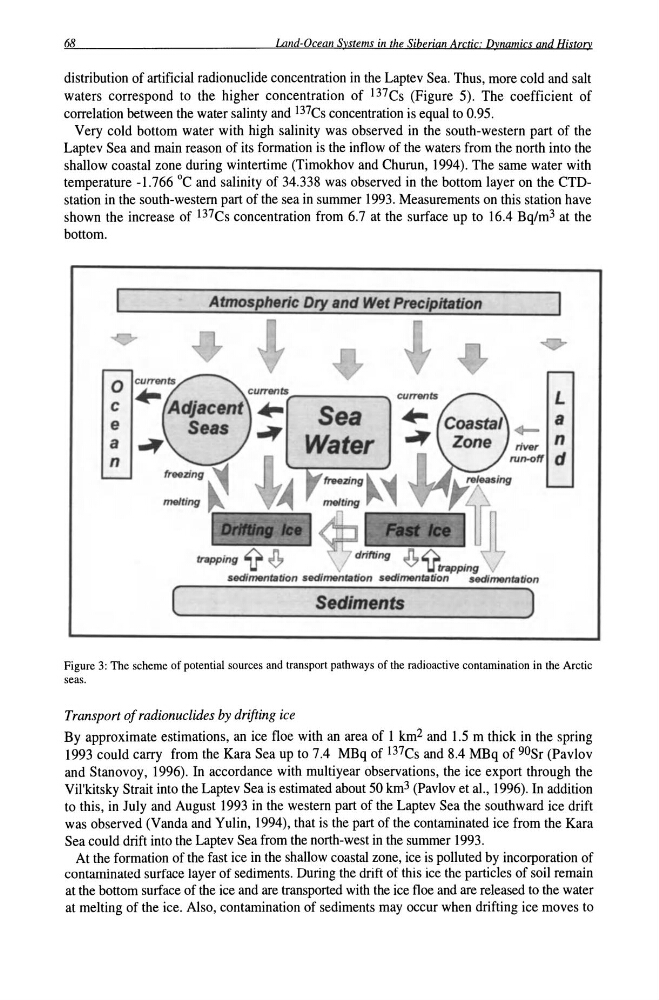
Figure 3: The scheme of potential sources and transport pathways of the radioactive contamination in the Arctic
seas.
Transport of radionuclides by drifting ice
By approximate estimations, an ice floe with an area of 1 km 2 and 1.5 m thick in the spring
1993 could carry from the Kara Sea up to 7.4 MBq of 137Cs and 8.4 MBq of 90Sr (Pavlov
and Stanovoy, 1996). In accordance with multiyear observations, the ice export through the
Vil'kitsky Strait into the Laptev Sea is estimated about 50 km 3 (Pavlov et a!., 1996). In addition
to this, in July and August 1993 in the western part of the Laptev Sea the southward ice drift
was observed (Vanda and Yulin, 1994), that is the part of the contaminated ice from the Kara
Sea could drift into the Laptev Sea from the north-west in the summer 1993.
At the formation of the fast ice in the shallow coastal zone, ice is polluted by incorporation of
contaminated surface layer of sediments. During the drift of this ice the particles of soil remain
at the bottom surface of the ice and are transported with the ice floe and are released to the water
at melting of the ice. Also, contamination of sediments may occur when drifting ice moves to
Land·Ocean Systems in the Siberian Arctic: Dynamics and History
distribution of artificial radionuclide concentration in the Laptev Sea. Thus, more cold and salt
waters correspond to the higher concentration of 137Cs (Figure 5). The coefficient of
correlation between the water salinty and 137Cs concentration is equal to 0.95.
Very cold bottom water with high salinity was observed in the south-western part of the
Laptev Sea and main reason of its formation is the inflow of the waters from the north into the
shallow coastal zone during wintertime (Timokhov and Churun, 1994). The same water with
temperature -1.766 °c and salinity of 34.338 was observed in the bottom layer on the CTDstation in the south-western part of the sea in summer 1993. Measurements on this station have
shown the increase of 137Cs concentration from 6.7 at the surface up to 16.4 Bq/m3 at the
bottom.
a
n
(
Atmospheric Dry and Wet Precipitation
Sediments
L
a
~
river n
ron-off d
)
Figure 3: The scheme of potential sources and transport pathways of the radioactive contamination in the Arctic
seas.
Transport of radionuclides by drifting ice
By approximate estimations, an ice floe with an area of 1 km 2 and 1.5 m thick in the spring
1993 could carry from the Kara Sea up to 7.4 MBq of 137Cs and 8.4 MBq of 90Sr (Pavlov
and Stanovoy, 1996). In accordance with multiyear observations, the ice export through the
Vil'kitsky Strait into the Laptev Sea is estimated about 50 km 3 (Pavlov et a!., 1996). In addition
to this, in July and August 1993 in the western part of the Laptev Sea the southward ice drift
was observed (Vanda and Yulin, 1994), that is the part of the contaminated ice from the Kara
Sea could drift into the Laptev Sea from the north-west in the summer 1993.
At the formation of the fast ice in the shallow coastal zone, ice is polluted by incorporation of
contaminated surface layer of sediments. During the drift of this ice the particles of soil remain
at the bottom surface of the ice and are transported with the ice floe and are released to the water
at melting of the ice. Also, contamination of sediments may occur when drifting ice moves to