

Pavlov et at.: Possible Causes ofradioactive Contamination in the Laptev Sea
67
Transport by currents from the Kara Sea and the Arctic Basin
Currents transport radionuclides and at the same time there were the processes of mixing,
diffusion and sedimentation of the radionuclides. Certainly, the advective transport of pollutants
is the most important.
Results from the joint Russian-Norwegian expedition during the summer of 1992 to the Kara
Sea show that 137Cs and 90Sr concentrations in the surface water range from 3-8 Bq/m3 and 312 Bq/m3 respectively. Thus, the observed values of 137Cs and 90Sr concentration in the
surface water of the Laptev Sea in summer 1993 are at the same order, as in the Kara Sea in
summer 1992.
Similar levels of radionuclide concentrations in the Kara and the Laptev Seas are in agreement
with the possibility of advective transport of the radioactive contaminants from the Kara Sea.
The resulting water exchange between the Kara and the Laptev Seas through the Vil'kitsky
Strait is directed to the east and is estimated from 4,900 km3/year (0.16 Sv) up to 11,000
km3/year (0.3 Sv) (Pavlov et aI., 1996). In addition a significant flow of water from the Kara
Sea exists in the north-western part of the Laptev Sea, with is confirmed by model results
(Pavlov, 1996; Figure 4).
289
•
Siberia
426 404
• •
50
•
839
•
366
• 391
•
239 50
4\3 •
• 348
•
30
•
117
•
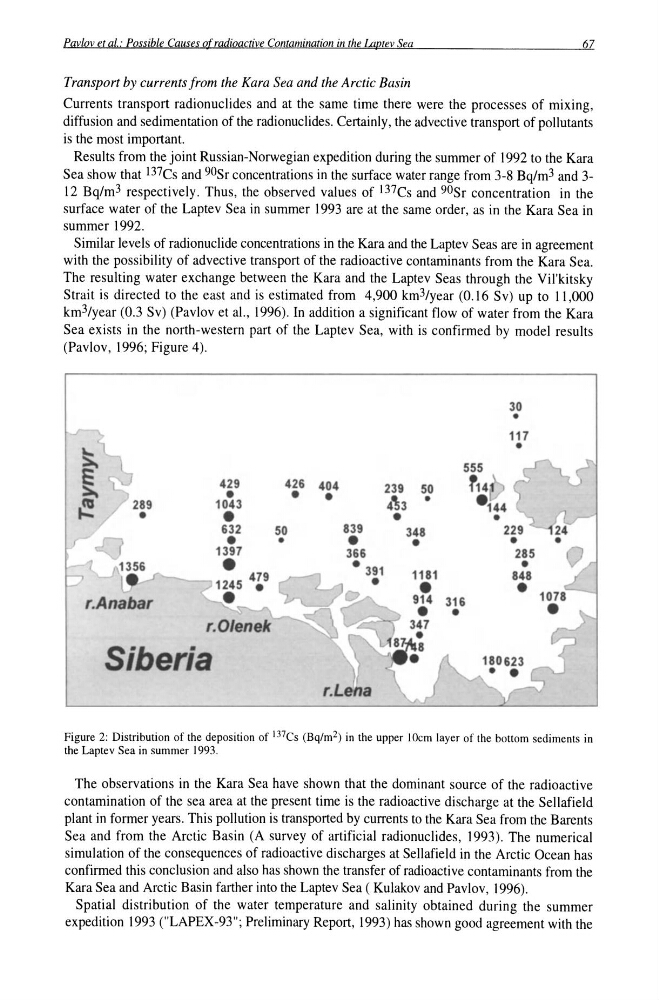
Figure 2: Distribution of the deposition of 137Cs (Bq/m2) in the upper !Oem layer of the bottom sediments in
the Laptev Sea in summer 1993.
The observations in the Kara Sea have shown that the dominant source of the radioactive
contamination of the sea area at the present time is the radioactive discharge at the Sellafield
plant in former years. This pollution is transported by currents to the Kara Sea from the Barents
Sea and from the Arctic Basin (A survey of artificial radionuclides, 1993). The numerical
simulation of the consequences of radioactive discharges at Sellafield in the Arctic Ocean has
confirmed this conclusion and also has shown the transfer of radioactive contaminants from the
Kara Sea and Arctic Basin farther into the Laptev Sea ( Kulakov and Pavlov, 1996).
Spatial distribution of the water temperature and salinity obtained during the summer
expedition 1993 ("LAPEX-93"; Preliminary Report, 1993) has shown good agreement with the
67
Transport by currents from the Kara Sea and the Arctic Basin
Currents transport radionuclides and at the same time there were the processes of mixing,
diffusion and sedimentation of the radionuclides. Certainly, the advective transport of pollutants
is the most important.
Results from the joint Russian-Norwegian expedition during the summer of 1992 to the Kara
Sea show that 137Cs and 90Sr concentrations in the surface water range from 3-8 Bq/m3 and 312 Bq/m3 respectively. Thus, the observed values of 137Cs and 90Sr concentration in the
surface water of the Laptev Sea in summer 1993 are at the same order, as in the Kara Sea in
summer 1992.
Similar levels of radionuclide concentrations in the Kara and the Laptev Seas are in agreement
with the possibility of advective transport of the radioactive contaminants from the Kara Sea.
The resulting water exchange between the Kara and the Laptev Seas through the Vil'kitsky
Strait is directed to the east and is estimated from 4,900 km3/year (0.16 Sv) up to 11,000
km3/year (0.3 Sv) (Pavlov et aI., 1996). In addition a significant flow of water from the Kara
Sea exists in the north-western part of the Laptev Sea, with is confirmed by model results
(Pavlov, 1996; Figure 4).
289
•
Siberia
426 404
• •
50
•
839
•
366
• 391
•
239 50
4\3 •
• 348
•
30
•
117
•
Figure 2: Distribution of the deposition of 137Cs (Bq/m2) in the upper !Oem layer of the bottom sediments in
the Laptev Sea in summer 1993.
The observations in the Kara Sea have shown that the dominant source of the radioactive
contamination of the sea area at the present time is the radioactive discharge at the Sellafield
plant in former years. This pollution is transported by currents to the Kara Sea from the Barents
Sea and from the Arctic Basin (A survey of artificial radionuclides, 1993). The numerical
simulation of the consequences of radioactive discharges at Sellafield in the Arctic Ocean has
confirmed this conclusion and also has shown the transfer of radioactive contaminants from the
Kara Sea and Arctic Basin farther into the Laptev Sea ( Kulakov and Pavlov, 1996).
Spatial distribution of the water temperature and salinity obtained during the summer
expedition 1993 ("LAPEX-93"; Preliminary Report, 1993) has shown good agreement with the