

Ivanov: New Data on Sea-Ice Albedo in the Lartev and Barents Seas
61
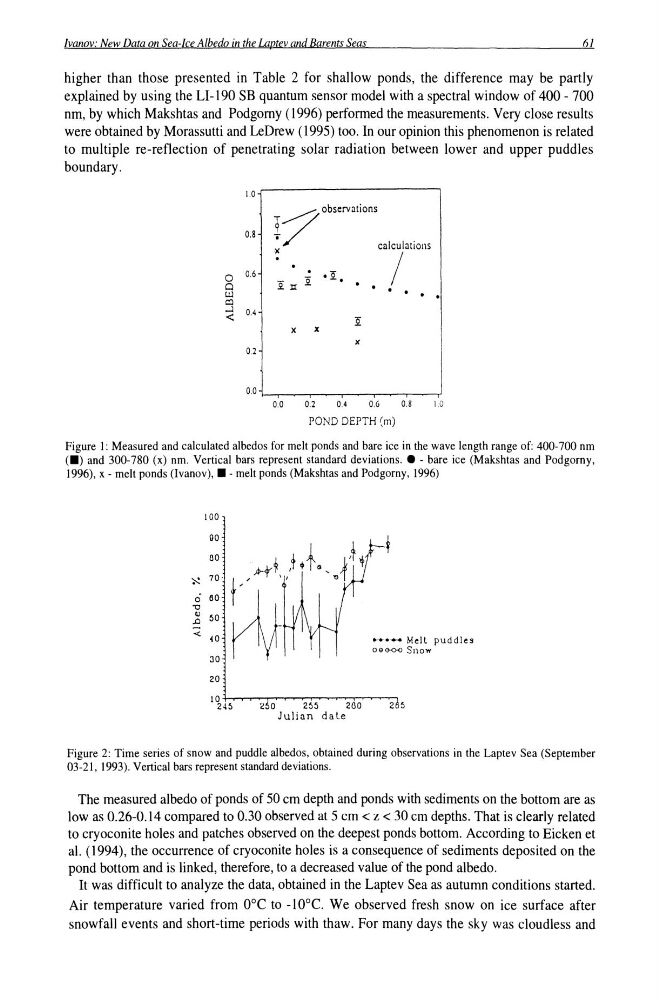
higher than those presented in Table 2 for shallow ponds, the difference may be partly
explained by using the LI -190 SB quantum sensor model with a spectral window of 400 - 700
nm, by which Makshtas and Podgorny (1996) performed the measurements. Very close results
were obtained by Morassutti and LeDrew (1995) too. In our opinion this phenomenon is related
to multiple re-reflection of penetrating solar radiation between lower and upper puddles
boundary.
1.0
~ observations
0.8
!7 calculations
x
/
.
0.6
. • :£ •
0
:£
a
£I!
. .
I.!.l
. .
c:l
...l
0.4
<
:£
x
x
x
0.2
00
0.0
0.2
0.4
0.6
0.8
1.0
POND DEPTH (m)
Figure I: Measured and calculated albedos for melt ponds and bare ice in the wave length range of: 400-700 nm
(_) and 300-780 (x) nm. Vertical bars represent standard deviations .• - bare ice (Makshtas and Podgorny,
1996), x - melt ponds (Ivanov), _ - melt ponds (Makshtas and Podgorny, 1996)
100
00
00
::-: 70·
0 60
"0
., 50
.0
:;: 40
30
20
10
2.5
2 0
255
Julian dale
200
........... Melt puddles
ooG-oo Snow
285
Figure 2: Time series of snow and puddle albedos, obtained during observations in the Laptev Sea (September
03-21, 1993). Vertical bars represent standard deviations.
The measured albedo of ponds of 50 cm depth and ponds with sediments on the bottom are as
low as 0.26-0.14 compared to 0.30 observed at 5 cm < z < 30 cm depths. That is clearly related
to cryoconite holes and patches observed on the deepest ponds bottom. According to Eicken et
al. (1994), the occurrence of cryoconite holes is a consequence of sediments deposited on the
pond bottom and is linked, therefore, to a decreased value of the pond albedo.
It was difficult to analyze the data, obtained in the Laptev Sea as autumn conditions started.
Air temperature varied from O°C to -IO°C. We observed fresh snow on ice surface after
snowfall events and short-time periods with thaw. For many days the sky was cloudless and
61
higher than those presented in Table 2 for shallow ponds, the difference may be partly
explained by using the LI -190 SB quantum sensor model with a spectral window of 400 - 700
nm, by which Makshtas and Podgorny (1996) performed the measurements. Very close results
were obtained by Morassutti and LeDrew (1995) too. In our opinion this phenomenon is related
to multiple re-reflection of penetrating solar radiation between lower and upper puddles
boundary.
1.0
~ observations
0.8
!7 calculations
x
/
.
0.6
. • :£ •
0
:£
a
£I!
. .
I.!.l
. .
c:l
...l
0.4
<
:£
x
x
x
0.2
00
0.0
0.2
0.4
0.6
0.8
1.0
POND DEPTH (m)
Figure I: Measured and calculated albedos for melt ponds and bare ice in the wave length range of: 400-700 nm
(_) and 300-780 (x) nm. Vertical bars represent standard deviations .• - bare ice (Makshtas and Podgorny,
1996), x - melt ponds (Ivanov), _ - melt ponds (Makshtas and Podgorny, 1996)
100
00
00
::-: 70·
0 60
"0
., 50
.0
:;: 40
30
20
10
2.5
2 0
255
Julian dale
200
........... Melt puddles
ooG-oo Snow
285
Figure 2: Time series of snow and puddle albedos, obtained during observations in the Laptev Sea (September
03-21, 1993). Vertical bars represent standard deviations.
The measured albedo of ponds of 50 cm depth and ponds with sediments on the bottom are as
low as 0.26-0.14 compared to 0.30 observed at 5 cm < z < 30 cm depths. That is clearly related
to cryoconite holes and patches observed on the deepest ponds bottom. According to Eicken et
al. (1994), the occurrence of cryoconite holes is a consequence of sediments deposited on the
pond bottom and is linked, therefore, to a decreased value of the pond albedo.
It was difficult to analyze the data, obtained in the Laptev Sea as autumn conditions started.
Air temperature varied from O°C to -IO°C. We observed fresh snow on ice surface after
snowfall events and short-time periods with thaw. For many days the sky was cloudless and