

62
Land-Ocean Systems in the Siberian Arctic: Dynamics and History
incoming short-wave radiation exceeded 300 W/m2, but during the nights the long-wave
balance amounted to more than 70 W/m 2 . Therefore, during the day we observed the radiation
melting on the surface, and during the night-radiation freezing. Ice-cover albedo is a
complicated function of this process. As an example of that we show a time series of snow and
puddle albedos during our observations in the Laptev Sea region (within the period from
September 03 to September 21, 1993) in Figure 2. The difference between puddle and snow
albedos was practically constant (20-30 %) for the period from 3 to 15 of September, 1993
before ice thickness becomes approximately equal 20 cm over freezing puddles (Table 3). In
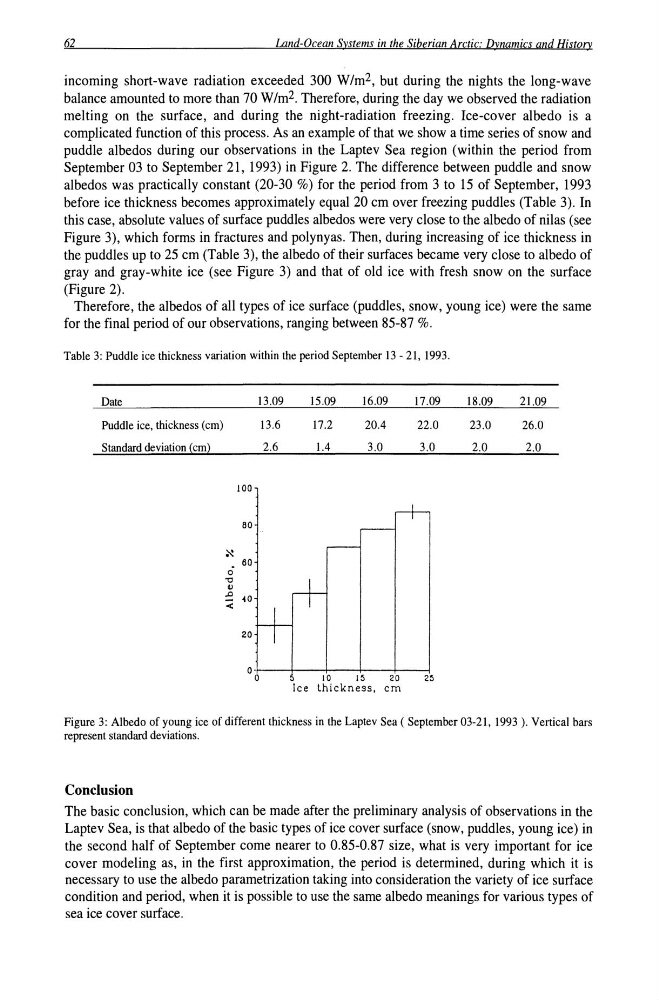
this case, absolute values of surface puddles albedos were very close to the albedo of nilas (see
Figure 3), which forms in fractures and polynyas. Then, during increasing of ice thickness in
the puddles up to 25 cm (Table 3), the albedo of their surfaces became very close to albedo of
gray and gray-white ice (see Figure 3) and that of old ice with fresh snow on the surface
(Figure 2).
Therefore, the albedos of all types of ice surface (puddles, snow, young ice) were the same
for the final period of our observations, ranging between 85-87 %.
Table 3: Puddle ice thickness variation within the period September 13 - 21, 1993.
Date
Puddle ice, thickness (cm)
Standard deviation (cm)
:-:
<5
" 4J
,e,
"<
13.09
13.6
2.6
100
80
60
~o
20
o·
a
Ice
15.09
16.09
17.09
17.2
20.4
22.0
1.4
3.0
3.0
10
15
20
25
lhickness, em
18.09
21.09
23.0
26.0
2.0
2.0
Figure 3: Albedo of young ice of different thickness in the Laptev Sea ( September 03-21, 1993 ). Vertical bars
represent standard deviations.
Conclusion
The basic conclusion, which can be made after the preliminary analysis of observations in the
Laptev Sea, is that albedo of the basic types of ice cover surface (snow, puddles, young ice) in
the second half of September come nearer to 0.85-0.87 size, what is very important for ice
cover modeling as, in the first approximation, the period is determined, during which it is
necessary to use the albedo parametrization taking into consideration the variety of ice surface
condition and period, when it is possible to use the same albedo meanings for various types of
sea ice cover surface.
Land-Ocean Systems in the Siberian Arctic: Dynamics and History
incoming short-wave radiation exceeded 300 W/m2, but during the nights the long-wave
balance amounted to more than 70 W/m 2 . Therefore, during the day we observed the radiation
melting on the surface, and during the night-radiation freezing. Ice-cover albedo is a
complicated function of this process. As an example of that we show a time series of snow and
puddle albedos during our observations in the Laptev Sea region (within the period from
September 03 to September 21, 1993) in Figure 2. The difference between puddle and snow
albedos was practically constant (20-30 %) for the period from 3 to 15 of September, 1993
before ice thickness becomes approximately equal 20 cm over freezing puddles (Table 3). In
this case, absolute values of surface puddles albedos were very close to the albedo of nilas (see
Figure 3), which forms in fractures and polynyas. Then, during increasing of ice thickness in
the puddles up to 25 cm (Table 3), the albedo of their surfaces became very close to albedo of
gray and gray-white ice (see Figure 3) and that of old ice with fresh snow on the surface
(Figure 2).
Therefore, the albedos of all types of ice surface (puddles, snow, young ice) were the same
for the final period of our observations, ranging between 85-87 %.
Table 3: Puddle ice thickness variation within the period September 13 - 21, 1993.
Date
Puddle ice, thickness (cm)
Standard deviation (cm)
:-:
<5
" 4J
,e,
"<
13.09
13.6
2.6
100
80
60
~o
20
o·
a
Ice
15.09
16.09
17.09
17.2
20.4
22.0
1.4
3.0
3.0
10
15
20
25
lhickness, em
18.09
21.09
23.0
26.0
2.0
2.0
Figure 3: Albedo of young ice of different thickness in the Laptev Sea ( September 03-21, 1993 ). Vertical bars
represent standard deviations.
Conclusion
The basic conclusion, which can be made after the preliminary analysis of observations in the
Laptev Sea, is that albedo of the basic types of ice cover surface (snow, puddles, young ice) in
the second half of September come nearer to 0.85-0.87 size, what is very important for ice
cover modeling as, in the first approximation, the period is determined, during which it is
necessary to use the albedo parametrization taking into consideration the variety of ice surface
condition and period, when it is possible to use the same albedo meanings for various types of
sea ice cover surface.