

624
Land-Ocean Systems in the Siberian Arctic: Dynamics and History
00
Il.l
~
1:l
&.l
~
!;:
Ci
E
~
~
t
-8
~
S
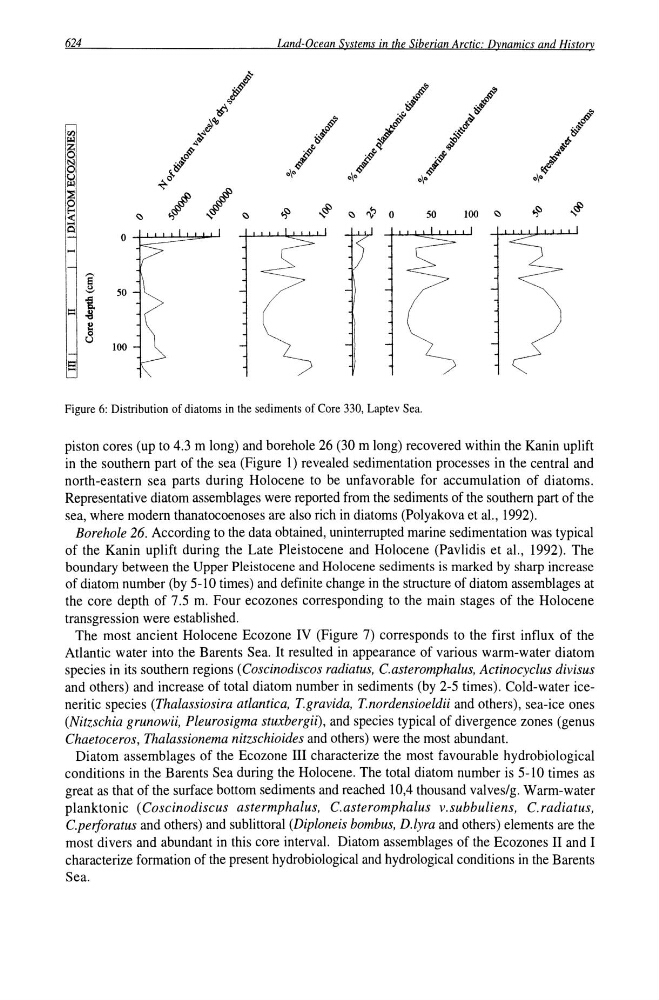
Figure 6: Distribution of diatoms in the sediments of Core 330, Laptev Sea.
piston cores (up to 4.3 m long) and borehole 26 (30 m long) recovered within the Kanin uplift
in the southern part of the sea (Figure 1) revealed sedimentation processes in the central and
north-eastern sea parts during Holocene to be unfavorable for accumulation of diatoms.
Representative diatom assemblages were reported from the sediments of the southern part of the
sea, where modem thanatocoenoses are also rich in diatoms (Polyakova et aI., 1992).
Borehole 26. According to the data obtained, uninterrupted marine sedimentation was typical
of the Kanin uplift during the Late Pleistocene and Holocene (Pavlidis et aI., 1992). The
boundary between the Upper Pleistocene and Holocene sediments is marked by sharp increase
of diatom number (by 5-10 times) and definite change in the structure of diatom assemblages at
the core depth of 7.5 m. Four ecozones corresponding to the main stages of the Holocene
transgression were established.
The most ancient Holocene Ecozone IV (Figure 7) corresponds to the first influx of the
Atlantic water into the Barents Sea. It resulted in appearance of various warm-water diatom
species in its southern regions (Coscinodiscos radiatus, c.asteromphalus, Actinocyclus divisus
and others) and increase of total diatom number in sediments (by 2-5 times). Cold-water iceneritic species (Thalassiosira atlantica, T.gravida, T.nordensioeldii and others), sea-ice ones
(Nitzschia grunowii, Pleurosigma stuxbergii), and species typical of divergence zones (genus
Chaetoceros, Thalassionema nitzschioides and others) were the most abundant.
Diatom assemblages of the Ecozone III characterize the most favourable hydrobiological
conditions in the Barents Sea during the Holocene. The total diatom number is 5- JO times as
great as that of the surface bottom sediments and reached 10,4 thousand valves/g. Warm-water
planktonic (Coscinodiscus astermphalus, c.asteromphalus v.subbuliens, C.radiatus,
c.perforatus and others) and sublittoral (Diploneis bombus, D.lyra and others) elements are the
most divers and abundant in this core interval. Diatom assemblages of the Ecozones II and I
characterize formation of the present hydrobiological and hydrological conditions in the Barents
Sea.
Land-Ocean Systems in the Siberian Arctic: Dynamics and History
00
Il.l
~
1:l
&.l
~
!;:
Ci
E
~
~
t
-8
~
S
Figure 6: Distribution of diatoms in the sediments of Core 330, Laptev Sea.
piston cores (up to 4.3 m long) and borehole 26 (30 m long) recovered within the Kanin uplift
in the southern part of the sea (Figure 1) revealed sedimentation processes in the central and
north-eastern sea parts during Holocene to be unfavorable for accumulation of diatoms.
Representative diatom assemblages were reported from the sediments of the southern part of the
sea, where modem thanatocoenoses are also rich in diatoms (Polyakova et aI., 1992).
Borehole 26. According to the data obtained, uninterrupted marine sedimentation was typical
of the Kanin uplift during the Late Pleistocene and Holocene (Pavlidis et aI., 1992). The
boundary between the Upper Pleistocene and Holocene sediments is marked by sharp increase
of diatom number (by 5-10 times) and definite change in the structure of diatom assemblages at
the core depth of 7.5 m. Four ecozones corresponding to the main stages of the Holocene
transgression were established.
The most ancient Holocene Ecozone IV (Figure 7) corresponds to the first influx of the
Atlantic water into the Barents Sea. It resulted in appearance of various warm-water diatom
species in its southern regions (Coscinodiscos radiatus, c.asteromphalus, Actinocyclus divisus
and others) and increase of total diatom number in sediments (by 2-5 times). Cold-water iceneritic species (Thalassiosira atlantica, T.gravida, T.nordensioeldii and others), sea-ice ones
(Nitzschia grunowii, Pleurosigma stuxbergii), and species typical of divergence zones (genus
Chaetoceros, Thalassionema nitzschioides and others) were the most abundant.
Diatom assemblages of the Ecozone III characterize the most favourable hydrobiological
conditions in the Barents Sea during the Holocene. The total diatom number is 5- JO times as
great as that of the surface bottom sediments and reached 10,4 thousand valves/g. Warm-water
planktonic (Coscinodiscus astermphalus, c.asteromphalus v.subbuliens, C.radiatus,
c.perforatus and others) and sublittoral (Diploneis bombus, D.lyra and others) elements are the
most divers and abundant in this core interval. Diatom assemblages of the Ecozones II and I
characterize formation of the present hydrobiological and hydrological conditions in the Barents
Sea.