

Polyakova: Holocene Diatom Strati~raDhy and Paleoceanography
625
rn
III
~
~
~
::i 1
0
!(
<;:,
l~
0
100
200
1
I !
300
s
1=1
~
I- t
400
!
"
'"
I I
i!!
500
0
u
11
'> /
<
600
700
l >i
800
_.J
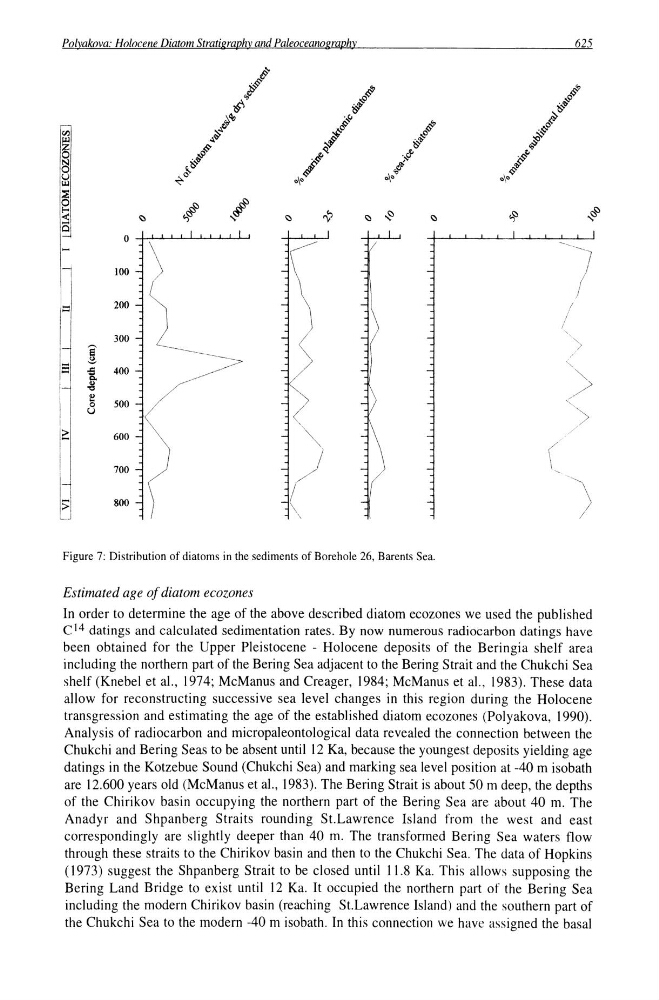
Figure 7: Distribution of diatoms in the sediments of Borehole 26, Barents Sea.
Estimated age of diatom ecozones
In order to determine the age of the above described diatom ecozones we used the published
c J4 datings and calculated sedimentation rates. By now numerous radiocarbon datings have
been obtained for the Upper Pleistocene - Holocene deposits of the Beringia shelf area
including the northern part of the Bering Sea adjacent to the Bering Strait and the Chukchi Sea
shelf (Knebel et aI., 1974; McManus and Creager, 1984; McManus et aI., 1983). These data
allow for reconstructing successive sea level changes in this region during the Holocene
transgression and estimating the age of the established diatom ecozones (Polyakova, 1990).
Analysis of radiocarbon and micropaleontological data revealed the connection between the
Chukchi and Bering Seas to be absent until 12 Ka, because the youngest deposits yielding age
datings in the Kotzebue Sound (Chukchi Sea) and marking sea level position at -40 m isobath
are 12.600 years old (McManus et aI., 1983). The Bering Strait is about 50 m deep, the depths
of the Chirikov basin occupying the northern part of the Bering Sea are about 40 ill. The
Anadyr and Shpanberg Straits rounding St.Lawrence Island from the west and east
correspondingly are slightly deeper than 40 m. The transformed Bering Sea waters flow
through these straits to the Chirikov basin and then to the Chukchi Sea. The data of Hopkins
(1973) suggest the Shpanberg Strait to be closed until 11.8 Ka. This allows supposing the
Bering Land Bridge to exist until 12 Ka. It occupied the northern part of the Bering Sea
including the modern Chirikov basin (reaching St.Lawrence Island) and the southern part of
the Chukchi Sea to the modern -40 m isobath. In this connection we have assigned the basal
625
rn
III
~
~
~
::i 1
0
!(
<;:,
l~
0
100
200
1
I !
300
s
1=1
~
I- t
400
!
"
'"
I I
i!!
500
0
u
11
'> /
<
600
700
l >i
800
_.J
Figure 7: Distribution of diatoms in the sediments of Borehole 26, Barents Sea.
Estimated age of diatom ecozones
In order to determine the age of the above described diatom ecozones we used the published
c J4 datings and calculated sedimentation rates. By now numerous radiocarbon datings have
been obtained for the Upper Pleistocene - Holocene deposits of the Beringia shelf area
including the northern part of the Bering Sea adjacent to the Bering Strait and the Chukchi Sea
shelf (Knebel et aI., 1974; McManus and Creager, 1984; McManus et aI., 1983). These data
allow for reconstructing successive sea level changes in this region during the Holocene
transgression and estimating the age of the established diatom ecozones (Polyakova, 1990).
Analysis of radiocarbon and micropaleontological data revealed the connection between the
Chukchi and Bering Seas to be absent until 12 Ka, because the youngest deposits yielding age
datings in the Kotzebue Sound (Chukchi Sea) and marking sea level position at -40 m isobath
are 12.600 years old (McManus et aI., 1983). The Bering Strait is about 50 m deep, the depths
of the Chirikov basin occupying the northern part of the Bering Sea are about 40 ill. The
Anadyr and Shpanberg Straits rounding St.Lawrence Island from the west and east
correspondingly are slightly deeper than 40 m. The transformed Bering Sea waters flow
through these straits to the Chirikov basin and then to the Chukchi Sea. The data of Hopkins
(1973) suggest the Shpanberg Strait to be closed until 11.8 Ka. This allows supposing the
Bering Land Bridge to exist until 12 Ka. It occupied the northern part of the Bering Sea
including the modern Chirikov basin (reaching St.Lawrence Island) and the southern part of
the Chukchi Sea to the modern -40 m isobath. In this connection we have assigned the basal