

Polyakova: Holocene Diatom StratigraphY and Paleoceanography
623
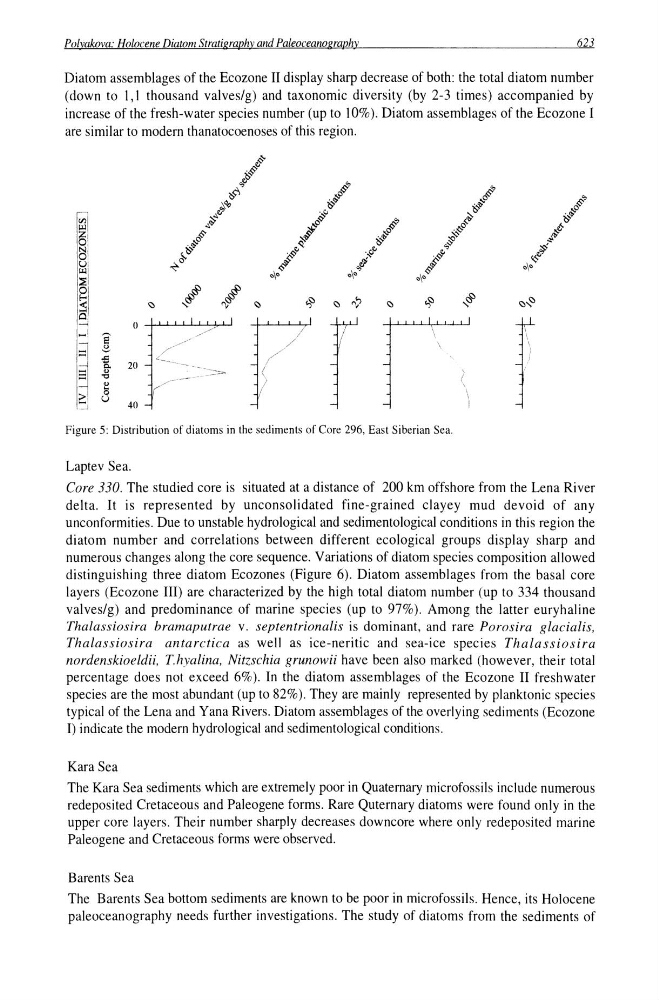
Diatom assemblages of the Ecozone II display sharp decrease of both: the total diatom number
(down to I, I thousand valves/g) and taxonomic diversity (by 2-3 times) accompanied by
increase of the fresh-water species number (up to 10%). Diatom assemblages of the Ecozone I
are similar to modern thanatocoenoses of this region.
Figure 5: Distribution of diatoms in the sediments of Core 296, East Siberian Sea.
Laptev Sea.
Core 330. The studied core is situated at a distance of 200 km offshore from the Lena River
delta. It is represented by unconsolidated fine-grained clayey mud devoid of any
unconformities. Due to unstable hydrological and sedimentological conditions in this region the
diatom number and correlations between different ecological groups display sharp and
numerous changes along the core sequence. Variations of diatom species composition allowed
distinguishing three diatom Ecozones (Figure 6). Diatom assemblages from the basal core
layers (Ecozone III) are characterized by the high total diatom number (up to 334 thousand
valves/g) and predominance of marine species (up to 97%). Among the latter euryhaline
Thalassiosira bramaputrae v. septentrionalis is dominant, and rare Porosira glacialis,
Thalassiosira antarctica as well as ice-neritic and sea-ice species Thalassiosira
nordenskioeldii, T.hyalina, Nitzschia grunowii have been also marked (however, their total
percentage does not exceed 6%). In the diatom assemblages of the Ecozone II freshwater
species are the most abundant (up to 82%). They are mainly represented by planktonic species
typical of the Lena and Yana Rivers. Diatom assemblages of the overlying sediments (Ecozone
I) indicate the modern hydrological and sedimentological conditions.
Kara Sea
The Kara Sea sediments which are extremely poor in Quaternary microfossils include numerous
redeposited Cretaceous and Paleogene forms. Rare Quternary diatoms were found only in the
upper core layers. Their number sharply decreases downcore where only redeposited marine
Paleogene and Cretaceous forms were observed.
Barents Sea
The Barents Sea bottom sediments are known to be poor in microfossils. Hence, its Holocene
paleoceanography needs further investigations. The study of diatoms from the sediments of
623
Diatom assemblages of the Ecozone II display sharp decrease of both: the total diatom number
(down to I, I thousand valves/g) and taxonomic diversity (by 2-3 times) accompanied by
increase of the fresh-water species number (up to 10%). Diatom assemblages of the Ecozone I
are similar to modern thanatocoenoses of this region.
Figure 5: Distribution of diatoms in the sediments of Core 296, East Siberian Sea.
Laptev Sea.
Core 330. The studied core is situated at a distance of 200 km offshore from the Lena River
delta. It is represented by unconsolidated fine-grained clayey mud devoid of any
unconformities. Due to unstable hydrological and sedimentological conditions in this region the
diatom number and correlations between different ecological groups display sharp and
numerous changes along the core sequence. Variations of diatom species composition allowed
distinguishing three diatom Ecozones (Figure 6). Diatom assemblages from the basal core
layers (Ecozone III) are characterized by the high total diatom number (up to 334 thousand
valves/g) and predominance of marine species (up to 97%). Among the latter euryhaline
Thalassiosira bramaputrae v. septentrionalis is dominant, and rare Porosira glacialis,
Thalassiosira antarctica as well as ice-neritic and sea-ice species Thalassiosira
nordenskioeldii, T.hyalina, Nitzschia grunowii have been also marked (however, their total
percentage does not exceed 6%). In the diatom assemblages of the Ecozone II freshwater
species are the most abundant (up to 82%). They are mainly represented by planktonic species
typical of the Lena and Yana Rivers. Diatom assemblages of the overlying sediments (Ecozone
I) indicate the modern hydrological and sedimentological conditions.
Kara Sea
The Kara Sea sediments which are extremely poor in Quaternary microfossils include numerous
redeposited Cretaceous and Paleogene forms. Rare Quternary diatoms were found only in the
upper core layers. Their number sharply decreases downcore where only redeposited marine
Paleogene and Cretaceous forms were observed.
Barents Sea
The Barents Sea bottom sediments are known to be poor in microfossils. Hence, its Holocene
paleoceanography needs further investigations. The study of diatoms from the sediments of