

604
Land-Ocean Systems in the Siberian Arctic: Dynamics and History
Faunal counts were carried out in two separate size-fractions (125-250 /lm, and 250-500 /lm).
In order not to miss any small-sized species, which do occur in high-latitude glacial and
interglacial sediments below the lower limit of the used mesh size (Kellogg, 1984; Bauch,
1994; Hebbeln et aI., 1994), the size-fraction 63-125 /lm was also carefully checked.
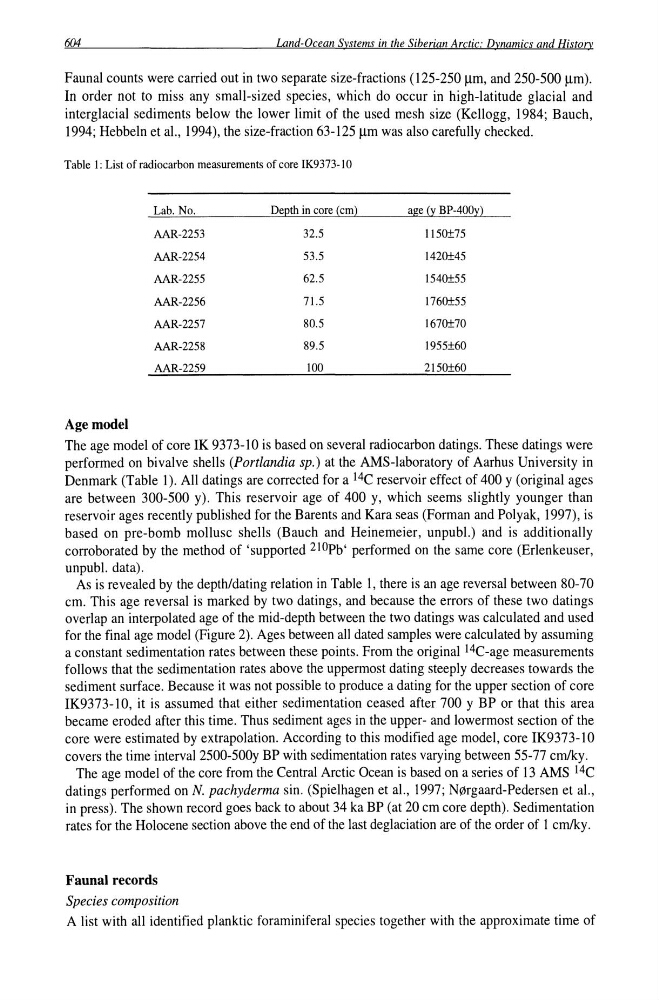
Table 1: List ofradiocarbon measurements of core IK9373-10
Lab. No.
Deptb in core (cm)
age (y BP-400y)
AAR-2253
32.5
I 150±75
AAR-2254
53.5
1420±45
AAR-2255
62.5
1540±55
AAR-2256
71.5
1760±55
AAR-2257
80.5
1670±70
AAR-2258
89.5
1955±60
AAR-2259
100
2150±60
Age model
The age model of core IK 9373-10 is based on several radiocarbon datings. These datings were
performed on bivalve shells (Portlandia sp.) at the AMS-Iaboratory of Aarhus University in
Denmark (Table 1). All datings are corrected for a 14C reservoir effect of 400 y (original ages
are between 300-500 y). This reservoir age of 400 y, which seems slightly younger than
reservoir ages recently published for the Barents and Kara seas (Forman and Polyak, 1997), is
based on pre-bomb mollusc sheJls (Bauch and Heinemeier, unpubl.) and is additionally
corroborated by the method of 'supported 21OPb' performed on the same core (Erlenkeuser,
unpub\. data).
As is revealed by the depth/dating relation in Table 1, there is an age reversal between 80-70
cm. This age reversal is marked by two datings, and because the errors of these two datings
overlap an interpolated age of the mid-depth between the two datings was calculated and used
for the final age model (Figure 2). Ages between all dated samples were calculated by assuming
a constant sedimentation rates between these points. From the original 14C-age measurements
follows that the sedimentation rates above the uppermost dating steeply decreases towards the
sediment surface. Because it was not possible to produce a dating for the upper section of core
IK9373-1O, it is assumed that either sedimentation ceased after 700 y BP or that this area
became eroded after this time. Thus sediment ages in the upper- and lowermost section of the
core were estimated by extrapolation. According to this modified age model, core IK9373-10
covers the time interval 2500-500y BP with sedimentation rates varying between 55-77 cm/ky.
The age model of the core from the Central Arctic Ocean is based on a series of 13 AMS l4C
datings performed on N. pachyderma sin. (Spielhagen et aI., 1997; N¢rgaard-Pedersen et aI.,
in press). The shown record goes back to about 34 ka BP (at 20 cm core depth). Sedimentation
rates for the Holocene section above the end of the last deglaciation are of the order of 1 cm/ky.
Faunal records
Species composition
A list with all identified planktic foraminiferal species together with the approximate time of
Land-Ocean Systems in the Siberian Arctic: Dynamics and History
Faunal counts were carried out in two separate size-fractions (125-250 /lm, and 250-500 /lm).
In order not to miss any small-sized species, which do occur in high-latitude glacial and
interglacial sediments below the lower limit of the used mesh size (Kellogg, 1984; Bauch,
1994; Hebbeln et aI., 1994), the size-fraction 63-125 /lm was also carefully checked.
Table 1: List ofradiocarbon measurements of core IK9373-10
Lab. No.
Deptb in core (cm)
age (y BP-400y)
AAR-2253
32.5
I 150±75
AAR-2254
53.5
1420±45
AAR-2255
62.5
1540±55
AAR-2256
71.5
1760±55
AAR-2257
80.5
1670±70
AAR-2258
89.5
1955±60
AAR-2259
100
2150±60
Age model
The age model of core IK 9373-10 is based on several radiocarbon datings. These datings were
performed on bivalve shells (Portlandia sp.) at the AMS-Iaboratory of Aarhus University in
Denmark (Table 1). All datings are corrected for a 14C reservoir effect of 400 y (original ages
are between 300-500 y). This reservoir age of 400 y, which seems slightly younger than
reservoir ages recently published for the Barents and Kara seas (Forman and Polyak, 1997), is
based on pre-bomb mollusc sheJls (Bauch and Heinemeier, unpubl.) and is additionally
corroborated by the method of 'supported 21OPb' performed on the same core (Erlenkeuser,
unpub\. data).
As is revealed by the depth/dating relation in Table 1, there is an age reversal between 80-70
cm. This age reversal is marked by two datings, and because the errors of these two datings
overlap an interpolated age of the mid-depth between the two datings was calculated and used
for the final age model (Figure 2). Ages between all dated samples were calculated by assuming
a constant sedimentation rates between these points. From the original 14C-age measurements
follows that the sedimentation rates above the uppermost dating steeply decreases towards the
sediment surface. Because it was not possible to produce a dating for the upper section of core
IK9373-1O, it is assumed that either sedimentation ceased after 700 y BP or that this area
became eroded after this time. Thus sediment ages in the upper- and lowermost section of the
core were estimated by extrapolation. According to this modified age model, core IK9373-10
covers the time interval 2500-500y BP with sedimentation rates varying between 55-77 cm/ky.
The age model of the core from the Central Arctic Ocean is based on a series of 13 AMS l4C
datings performed on N. pachyderma sin. (Spielhagen et aI., 1997; N¢rgaard-Pedersen et aI.,
in press). The shown record goes back to about 34 ka BP (at 20 cm core depth). Sedimentation
rates for the Holocene section above the end of the last deglaciation are of the order of 1 cm/ky.
Faunal records
Species composition
A list with all identified planktic foraminiferal species together with the approximate time of