

Bauch: Planktic Foraminifera in Holocene Sediments from Laptev Sea
605
Core IK9373-10
Age (y BP)
0
500
1000
1500
2000
2500
0
E 20 a)
~
(J)
40
'0
0 60
c
..c 80
Q.
(J) 100
0
2150y±60y
120
0
- E 20 b)
~
~ 40
0
0 60
c
..c 80
Q.
~ 100
120
0
500
1000
1500
2000
2500
Age (y BP)
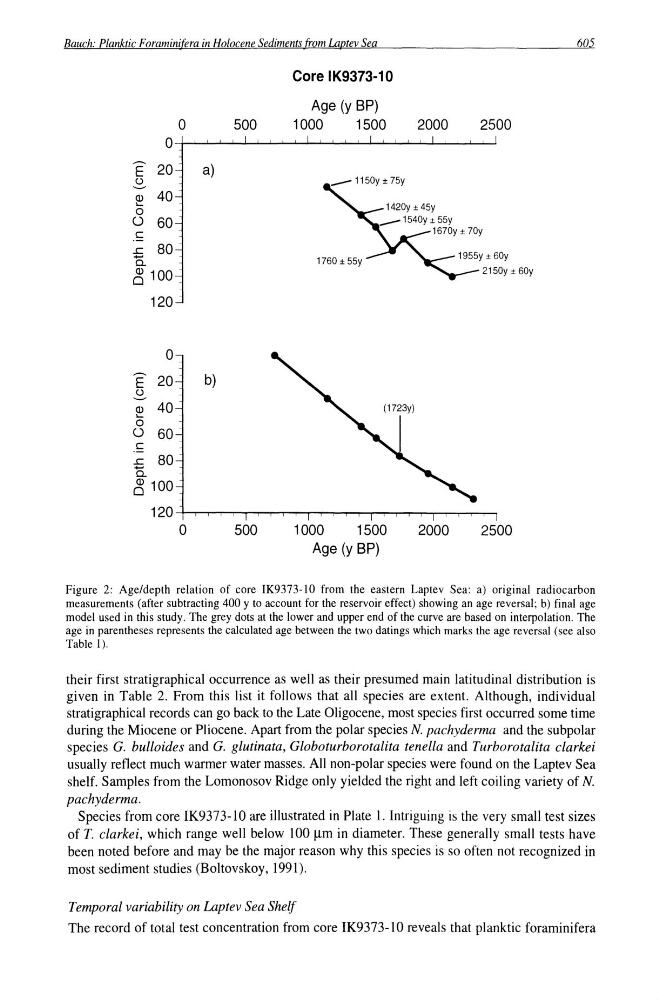
Figure 2: Age/depth relation of core IK9373-10 from the eastern Laptev Sea: a) original radiocarbon
measurements (after subtracting 400 y to account for the reservoir effect) showing an age reversal; b) final age
model used in this study. The grey dots at the lower and upper end of the curve are based on interpolation. The
age in parentheses represents the calculated age between the two datings which marks the age reversal (see also
Table I).
their first stratigraphical occurrence as well as their presumed main latitudinal distribution is
given in Table 2. From this list it follows that all species are extent. Although, individual
stratigraphical records can go back to the Late Oligocene, most species first occurred some time
during the Miocene or Pliocene. Apart from the polar species N. pachyderma and the subpolar
species G. bulloides and G. glutinata, Globoturborotalita tenella and Turborotalita clarkei
usually reflect much warmer water masses. All non-polar species were found on the Laptev Sea
shelf. Samples from the Lomonosov Ridge only yielded the right and left coiling variety of N.
pachyderma.
Species from core IK9373-1O are illustrated in Plate 1. Intriguing is the very small test sizes
of T. clarkei, which range well below 100 11m in diameter. These generally small tests have
been noted before and may be the major reason why this species is so often not recognized in
most sediment studies (Boltovskoy, 1991).
Temporal variability on Laptev Sea Shelf
The record of total test concentration from core IK9373-1 0 reveals that planktic foraminifera
605
Core IK9373-10
Age (y BP)
0
500
1000
1500
2000
2500
0
E 20 a)
~
(J)
40
'0
0 60
c
..c 80
Q.
(J) 100
0
2150y±60y
120
0
- E 20 b)
~
~ 40
0
0 60
c
..c 80
Q.
~ 100
120
0
500
1000
1500
2000
2500
Age (y BP)
Figure 2: Age/depth relation of core IK9373-10 from the eastern Laptev Sea: a) original radiocarbon
measurements (after subtracting 400 y to account for the reservoir effect) showing an age reversal; b) final age
model used in this study. The grey dots at the lower and upper end of the curve are based on interpolation. The
age in parentheses represents the calculated age between the two datings which marks the age reversal (see also
Table I).
their first stratigraphical occurrence as well as their presumed main latitudinal distribution is
given in Table 2. From this list it follows that all species are extent. Although, individual
stratigraphical records can go back to the Late Oligocene, most species first occurred some time
during the Miocene or Pliocene. Apart from the polar species N. pachyderma and the subpolar
species G. bulloides and G. glutinata, Globoturborotalita tenella and Turborotalita clarkei
usually reflect much warmer water masses. All non-polar species were found on the Laptev Sea
shelf. Samples from the Lomonosov Ridge only yielded the right and left coiling variety of N.
pachyderma.
Species from core IK9373-1O are illustrated in Plate 1. Intriguing is the very small test sizes
of T. clarkei, which range well below 100 11m in diameter. These generally small tests have
been noted before and may be the major reason why this species is so often not recognized in
most sediment studies (Boltovskoy, 1991).
Temporal variability on Laptev Sea Shelf
The record of total test concentration from core IK9373-1 0 reveals that planktic foraminifera