

Bauch: Planktic Foraminifera in Holocene Sediments from Laptev Sea
603
150
120
120
90
90
60
60
!
30 W
o
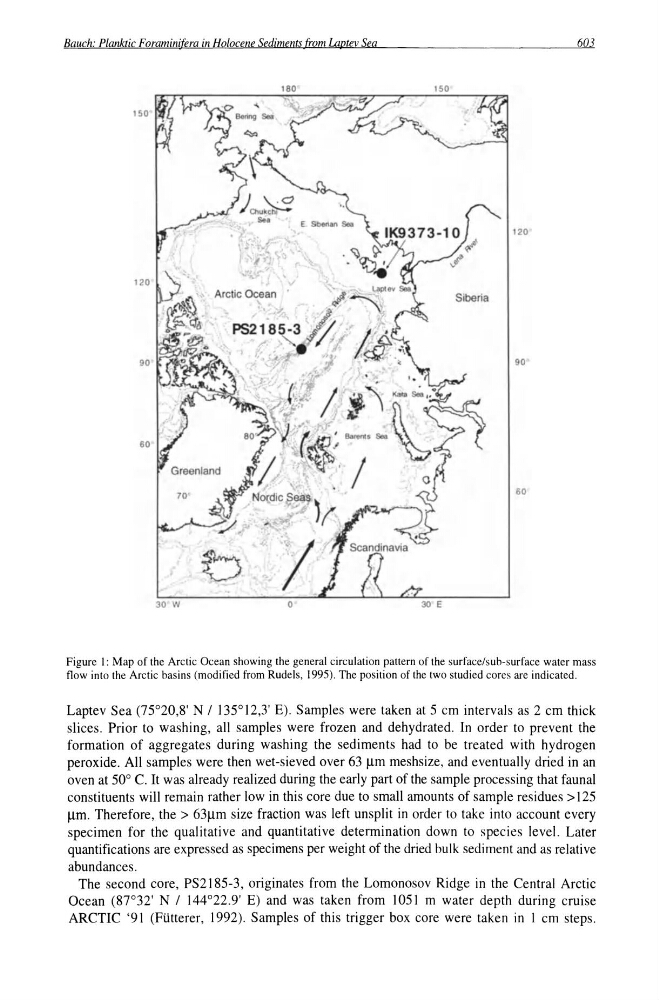
Figure I: Map of the Arctic Ocean showing the general circulation pattern of the surface/sub-surface water mass
flow into the Arctic basins (modified from Rudels, 1995). The position of the two studied cores are indicated.
Laptev Sea (75°20,8' N / 135° 12,3' E). Samples were taken at 5 cm intervals as 2 cm thick
slices. Prior to washing, all samples were frozen and dehydrated. In order to prevent the
formation of aggregates during washing the sediments had to be treated with hydrogen
peroxide. All samples were then wet-sieved over 63 /-Lm meshsize, and eventually dried in an
oven at 50° C. It was already realized during the early part of the sample processing that faunal
constituents will remain rather low in this core due to small amounts of sample residues> 125
/-Lm. Therefore, the> 63/-Lm size fraction was left unsplit in order to take into account every
specimen for the qualitative and quantitative determination down to species level. Later
quantifications are expressed as specimens per weight of the dried bulk sediment and as relative
abundances.
The second core, PS2185-3, originates from the Lomonosov Ridge in the Central Arctic
Ocean (87°32' N / 144°22.9' E) and was taken from 1051 m water depth during cruise
ARCTIC '9\ (Fiitterer, 1992). Samples of this trigger box core were taken in \ cm steps.
603
150
120
120
90
90
60
60
!
30 W
o
Figure I: Map of the Arctic Ocean showing the general circulation pattern of the surface/sub-surface water mass
flow into the Arctic basins (modified from Rudels, 1995). The position of the two studied cores are indicated.
Laptev Sea (75°20,8' N / 135° 12,3' E). Samples were taken at 5 cm intervals as 2 cm thick
slices. Prior to washing, all samples were frozen and dehydrated. In order to prevent the
formation of aggregates during washing the sediments had to be treated with hydrogen
peroxide. All samples were then wet-sieved over 63 /-Lm meshsize, and eventually dried in an
oven at 50° C. It was already realized during the early part of the sample processing that faunal
constituents will remain rather low in this core due to small amounts of sample residues> 125
/-Lm. Therefore, the> 63/-Lm size fraction was left unsplit in order to take into account every
specimen for the qualitative and quantitative determination down to species level. Later
quantifications are expressed as specimens per weight of the dried bulk sediment and as relative
abundances.
The second core, PS2185-3, originates from the Lomonosov Ridge in the Central Arctic
Ocean (87°32' N / 144°22.9' E) and was taken from 1051 m water depth during cruise
ARCTIC '9\ (Fiitterer, 1992). Samples of this trigger box core were taken in \ cm steps.