

Rossak et al.: Clav Mineral Distribution in Surface Sediments ofthe Laptev Sea
597
For the Putoran Plateau flood basalts drained by the Anabar and Khatanga rivers the
development of soils including the formation of smectite and possibly even of kaolinite
therefore is probable during Mesozoic and Cenozoic periods. Erosion of these smectite-bearing
remnants of paleosols explain the high concentrations of smectite in western Laptev Sea
sediments. Since the Putoran Plateau is also drained by the Jenissej river, smectite
concentrations of the Kara sea should also be high. In fact, concentrations of smectite even
reach values of up to 70 % off the Jenissej river mouth (Wahsner and Shelekhova, 1994).
Since kaolinite cannot form under a polar climate, it has to be of detrital origin in Laptev Sea
surface sediments, too. According to Darby (1975), kaolinite in Amerasian Arctic Ocean deep
sea sediments is derived from reworked deposits and from relict soils of northern Alaska and
Canada. Particularly in Mesozoic series kaolinitization is the most common weathering process
indicating a warm and humid climate during this period (e.g., Charnley, 1987; Sigleo and
Reinhardt, 1988, and Weaver, 1989). In addition to volcanic origin, kaolinite enrichment in
western Laptev Sea surface sediments can therefore be explained by the erosion of kaolinitebearing Jurassic and Cretaceous clastic series of the Siberian Platform and of the JenissejKhatanga basin acting as the drainage area of Olenek, Anabar, and Khatanga rivers.
105 e
110
115
120"
125
130'
135'
140"
14s' e
78 N
-
-
78"N
I (~)
C· Chiolile
I
I
1·III,te
K • Kaolinite
n
I nI
76
75
74
73
b
72
72'
71 N 1
I
71 N
L....J 05 E
110
115
120
125
130'
135
140"
145 E
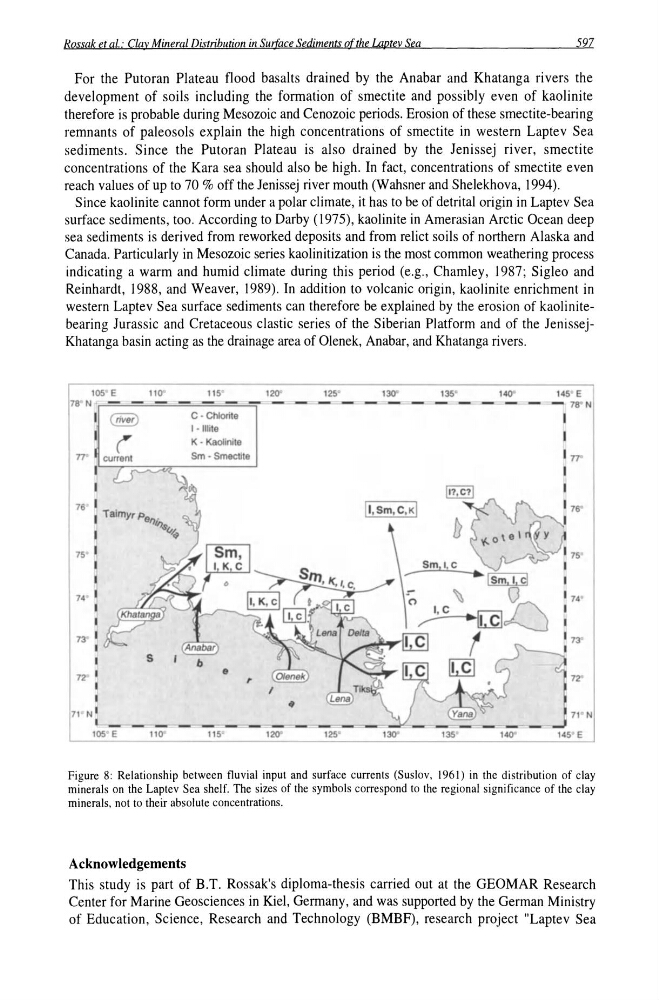
Figure 8: Relationship between fluvi al input and surface currents (Suslov. 1961) in the distribution of clay
minerals on the Laptev Sea shelf. The sizes of the symbols correspond to the regional significance of the clay
minerals, not to their absolute concentrations.
Acknowledgements
This study is part of B.T. Rossak's diploma-thesis carried out at the GEOMAR Research
Center for Marine Geosciences in Kiel, Germany, and was supported by the German Ministry
of Education, Science, Research and Technology (BMBF), research project "Laptev Sea
597
For the Putoran Plateau flood basalts drained by the Anabar and Khatanga rivers the
development of soils including the formation of smectite and possibly even of kaolinite
therefore is probable during Mesozoic and Cenozoic periods. Erosion of these smectite-bearing
remnants of paleosols explain the high concentrations of smectite in western Laptev Sea
sediments. Since the Putoran Plateau is also drained by the Jenissej river, smectite
concentrations of the Kara sea should also be high. In fact, concentrations of smectite even
reach values of up to 70 % off the Jenissej river mouth (Wahsner and Shelekhova, 1994).
Since kaolinite cannot form under a polar climate, it has to be of detrital origin in Laptev Sea
surface sediments, too. According to Darby (1975), kaolinite in Amerasian Arctic Ocean deep
sea sediments is derived from reworked deposits and from relict soils of northern Alaska and
Canada. Particularly in Mesozoic series kaolinitization is the most common weathering process
indicating a warm and humid climate during this period (e.g., Charnley, 1987; Sigleo and
Reinhardt, 1988, and Weaver, 1989). In addition to volcanic origin, kaolinite enrichment in
western Laptev Sea surface sediments can therefore be explained by the erosion of kaolinitebearing Jurassic and Cretaceous clastic series of the Siberian Platform and of the JenissejKhatanga basin acting as the drainage area of Olenek, Anabar, and Khatanga rivers.
105 e
110
115
120"
125
130'
135'
140"
14s' e
78 N
-
-
78"N
I (~)
C· Chiolile
I
I
1·III,te
K • Kaolinite
n
I nI
76
75
74
73
b
72
72'
71 N 1
I
71 N
L....J 05 E
110
115
120
125
130'
135
140"
145 E
Figure 8: Relationship between fluvi al input and surface currents (Suslov. 1961) in the distribution of clay
minerals on the Laptev Sea shelf. The sizes of the symbols correspond to the regional significance of the clay
minerals, not to their absolute concentrations.
Acknowledgements
This study is part of B.T. Rossak's diploma-thesis carried out at the GEOMAR Research
Center for Marine Geosciences in Kiel, Germany, and was supported by the German Ministry
of Education, Science, Research and Technology (BMBF), research project "Laptev Sea