

596
Land-Ocean Systems in the Siberian Arctic: Dynamics and History
Smectite and kaolinite
Smectite and kaolinite can basically form by alteration of volcanic glass, feldspars, micas, and
various FeMg (alumo-) silicates (Weaver, 1989)_ For the formation of smectite a warmtemperate and humid climate is necessary with lower drainage and rainfall and with lower
temperatures than are necessary for kaolinite formation (Charnley, 1987 and Weaver, 1989).
Today smectite is present in all soils of warm-temperate regions and is also abundant in
Mesozoic and Tertiary sedimentary rocks, (Weaver, 1989).
Therefore, low concentrations of smectite in sediments of the Laptev Sea shelf could be
derived from the erosion of Jurassic and Cretaceous sediments which are widespread in the
foreland basin of the Werchojansk-Fold-Zone drained by the Lena river, and in the JenissejKhatanga basin drained by the Anabar and Khatanga rivers. The high smectite concentrations of
the western Laptev Sea sediments, however, require a further source of smectite in the Siberian
hinterland, namely volcanic rocks. Exposed to a temperate-humid climate the weathering of
basaltic rocks may lead to the formation of smectite (e.g., Charnley, 1987 and Weaver, 1989).
With increasing soil development under a tropical climate smectite formed on basaltic substrate
transforms gradually into kaolin minerals (Caroll and Hathaway, 1963).
The existence of a warmer, non-polar climate in Arctic regions during Mesozoic and Cenozoic
periods permitting intensive chemical weathering is prooved by several studies: Spicer (1987)
for instance infered from late Cretaceous vegetation of northern Alaska a mean annual air
temperature of 10°C between 75° and 85° N corresponding to a temperate climate. Nilsen and
Kerr (1978) document a warm and humid climate during early Tertiary period throughout the
North Atlantic region and into the Arctic Ocean region: on a plateau basalt of the Iceland-Faeroe
Ridge a laterite soil containing smectite at the bottom and kaolinite at the top of its profile (see
CaroII and Hathaway, 1963) developed during early Tertiary period.
105 e
110
115
120"
125
78 N r--"=---='------"=--='--'=--='-'=--"""--=-..., -
n
76
75
74
110
Kaolinite [%]
• Stations of the expedition
TRANSDRIFT I, 1993
I
"
115
120
125
130"
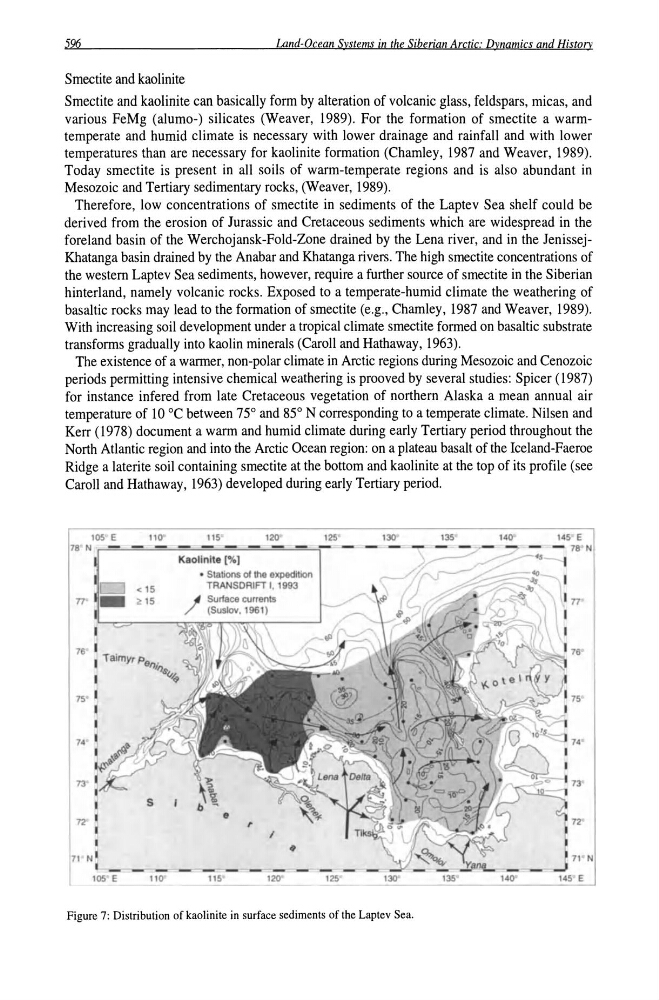
Figure 7: Distribution of kaolinite in surface sediments of the Laptev Sea.
135
140'
145 e
75
72
71 N
Land-Ocean Systems in the Siberian Arctic: Dynamics and History
Smectite and kaolinite
Smectite and kaolinite can basically form by alteration of volcanic glass, feldspars, micas, and
various FeMg (alumo-) silicates (Weaver, 1989)_ For the formation of smectite a warmtemperate and humid climate is necessary with lower drainage and rainfall and with lower
temperatures than are necessary for kaolinite formation (Charnley, 1987 and Weaver, 1989).
Today smectite is present in all soils of warm-temperate regions and is also abundant in
Mesozoic and Tertiary sedimentary rocks, (Weaver, 1989).
Therefore, low concentrations of smectite in sediments of the Laptev Sea shelf could be
derived from the erosion of Jurassic and Cretaceous sediments which are widespread in the
foreland basin of the Werchojansk-Fold-Zone drained by the Lena river, and in the JenissejKhatanga basin drained by the Anabar and Khatanga rivers. The high smectite concentrations of
the western Laptev Sea sediments, however, require a further source of smectite in the Siberian
hinterland, namely volcanic rocks. Exposed to a temperate-humid climate the weathering of
basaltic rocks may lead to the formation of smectite (e.g., Charnley, 1987 and Weaver, 1989).
With increasing soil development under a tropical climate smectite formed on basaltic substrate
transforms gradually into kaolin minerals (Caroll and Hathaway, 1963).
The existence of a warmer, non-polar climate in Arctic regions during Mesozoic and Cenozoic
periods permitting intensive chemical weathering is prooved by several studies: Spicer (1987)
for instance infered from late Cretaceous vegetation of northern Alaska a mean annual air
temperature of 10°C between 75° and 85° N corresponding to a temperate climate. Nilsen and
Kerr (1978) document a warm and humid climate during early Tertiary period throughout the
North Atlantic region and into the Arctic Ocean region: on a plateau basalt of the Iceland-Faeroe
Ridge a laterite soil containing smectite at the bottom and kaolinite at the top of its profile (see
CaroII and Hathaway, 1963) developed during early Tertiary period.
105 e
110
115
120"
125
78 N r--"=---='------"=--='--'=--='-'=--"""--=-..., -
n
76
75
74
110
Kaolinite [%]
• Stations of the expedition
TRANSDRIFT I, 1993
I
"
115
120
125
130"
Figure 7: Distribution of kaolinite in surface sediments of the Laptev Sea.
135
140'
145 e
75
72
71 N