

Rossak et al.: Clay Mineral Distribution in Suiface Sediments of the Laptev Sea
ttO
lIS
120
125
78 N ,..==--='--'=--='--'=---"""---'=---="---=--,77
76
75
74
73
72
71 N '
•
105 E
s
110
Chlorite [°0 ]
• StatIOns of the expedItIon
TRANSDRIFT 1.1993
I
liS
120
125'
130
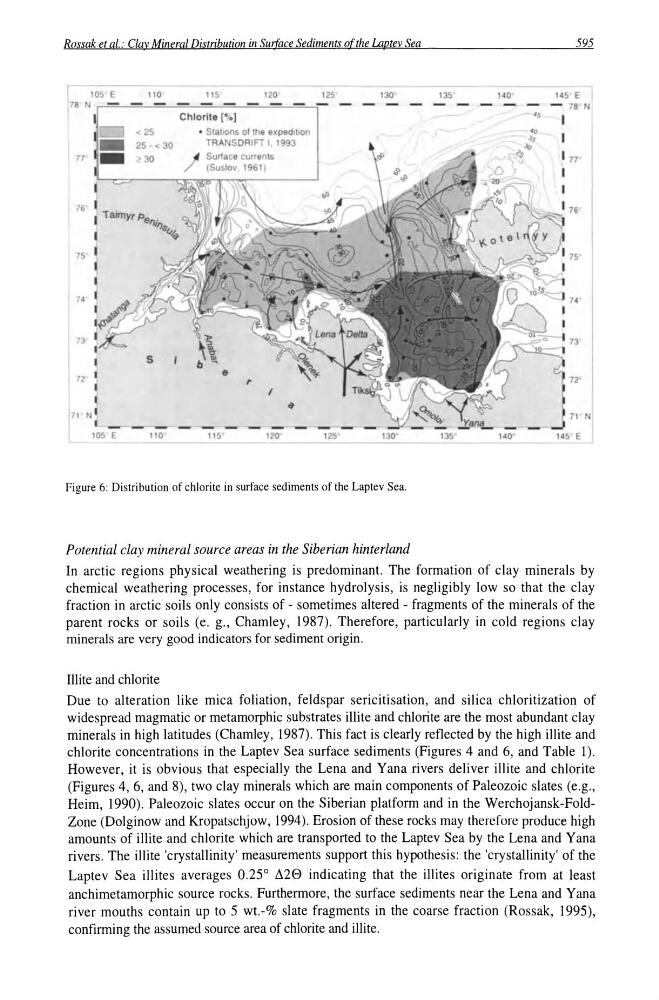
Figure 6: Distribution of chlorite in surface sediments of the Laptev Sea.
Potential clay mineral source areas in the Siberian hinterland
135
140
'$
595
145 E
-
78 N
72
71 N
In arctic regions physical weathering is predominant. The formation of clay minerals by
chemical weathering processes, for instance hydrolysis, is negligibly low so that the clay
fraction in arctic soils only consists of - sometimes altered - fragments of the minerals of the
parent rocks or soils (e. g., Charnley, 1987). Therefore, particularly in cold regions clay
minerals are very good indicators for sediment origin.
Illite and chlorite
Due to alteration like mica foliation, feldspar sericitisation, and silica chloritization of
widespread magmatic or metamorphic substrates illite and chlorite are the most abundant clay
minerals in high latitudes (Charnley, 1987). This fact is clearly reflected by the high illite and
chlorite concentrations in the Laptev Sea surface sediments (Figures 4 and 6, and Table I).
However, it is obvious that especially the Lena and Yana rivers deliver illite and chlorite
(Figures 4, 6, and 8), two clay minerals which are main components of Paleozoic slates (e.g.,
Heim, 1990). Paleozoic slates occur on the Siberian platform and in the Werchojansk-FoldZone (Dolginow and Kropatschjow, 1994). Erosion of these rocks may therefore produce high
amounts of illite and chlorite which are transported to the Laptev Sea by the Lena and Yana
rivers. The illite 'crystallinity' measurements support this hypothesis: the 'crystallinity' of the
Laptev Sea illites averages 0.25° ~2e indicating that the illites originate from at least
anchimetamorphic source rocks. Furthermore, the surface sediments near the Lena and Yana
river mouths contain up to 5 wt.-% slate fragments in the coarse fraction (Rossak, 1995),
confirming the assumed source area of chlorite and illite.
ttO
lIS
120
125
78 N ,..==--='--'=--='--'=---"""---'=---="---=--,77
76
75
74
73
72
71 N '
•
105 E
s
110
Chlorite [°0 ]
• StatIOns of the expedItIon
TRANSDRIFT 1.1993
I
liS
120
125'
130
Figure 6: Distribution of chlorite in surface sediments of the Laptev Sea.
Potential clay mineral source areas in the Siberian hinterland
135
140
'$
595
145 E
-
78 N
72
71 N
In arctic regions physical weathering is predominant. The formation of clay minerals by
chemical weathering processes, for instance hydrolysis, is negligibly low so that the clay
fraction in arctic soils only consists of - sometimes altered - fragments of the minerals of the
parent rocks or soils (e. g., Charnley, 1987). Therefore, particularly in cold regions clay
minerals are very good indicators for sediment origin.
Illite and chlorite
Due to alteration like mica foliation, feldspar sericitisation, and silica chloritization of
widespread magmatic or metamorphic substrates illite and chlorite are the most abundant clay
minerals in high latitudes (Charnley, 1987). This fact is clearly reflected by the high illite and
chlorite concentrations in the Laptev Sea surface sediments (Figures 4 and 6, and Table I).
However, it is obvious that especially the Lena and Yana rivers deliver illite and chlorite
(Figures 4, 6, and 8), two clay minerals which are main components of Paleozoic slates (e.g.,
Heim, 1990). Paleozoic slates occur on the Siberian platform and in the Werchojansk-FoldZone (Dolginow and Kropatschjow, 1994). Erosion of these rocks may therefore produce high
amounts of illite and chlorite which are transported to the Laptev Sea by the Lena and Yana
rivers. The illite 'crystallinity' measurements support this hypothesis: the 'crystallinity' of the
Laptev Sea illites averages 0.25° ~2e indicating that the illites originate from at least
anchimetamorphic source rocks. Furthermore, the surface sediments near the Lena and Yana
river mouths contain up to 5 wt.-% slate fragments in the coarse fraction (Rossak, 1995),
confirming the assumed source area of chlorite and illite.