

Naidina and Bauch: Distribution of Pollen and Spores in Surface Sediments
579
typical for recent sediments of the high latitude regions of the Arctic (Kupriyanova, 1951).
Among the arboreal plants, the pollen of spruce Picea, pine Pinus sibirica. cedar pine Pinus
pumila. larch Larix. willow Salix. alder Alnus. and birch Betula sect. Nanae (Betula exilis. B.
middendo~ffii, B. nana) were recorded. From the herbaceous plants, the pollen of Ericaceae,
Gramineae, Cyperaceae, Asteraceae, Rosaceae, Saxifragaceae, Ranunculaceae,
Caryophyllaceae were present. The spore plants were represented by green mosses Brvales,
sphagnum Sphagnales and the fern Polypodiaceae.
70
~
rc:<:
3 lU.LUll.L.J1f ~S ~6 ~
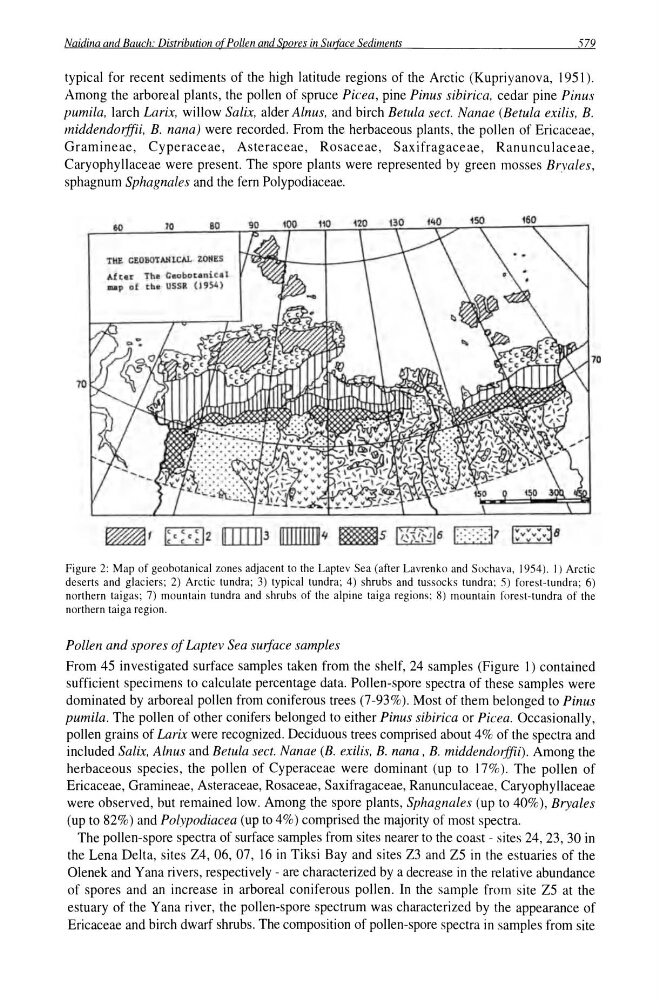
Figure 2: Map of geobotanical zones adjacent to the Laptev Sea (after Lavrenko and Sochava, 1954). 1) Arctic
deserts and glaciers; 2) Arctic tundra; 3) typical tundra; 4) shrubs and tussocks tundra; 5) forest-tundra; 6)
northern taigas; 7) mountain tundra and shrubs of the alpine taiga regions; 8) mountain forest-tundra of the
northern taiga region.
Pollen and spores of Laptev Sea surface samples
From 45 investigated surface samples taken from the shelf, 24 samples (Figure I) contained
sufficient specimens to calculate percentage data. Pollen-spore spectra of these samples were
dominated by arboreal pollen from coniferous trees (7-93%). Most of them belonged to Pinus
pumila. The pollen of other conifers belonged to either Pinus sibirica or Picea. Occasionally,
pollen grains of Larix were recognized. Deciduous trees comprised about 4% of the spectra and
included Salix, Alnus and Betula sect. Nanae (B. exilis, B. nana . B. middendorffii). Among the
herbaceous species, the pollen of Cyperaceae were dominant (up to 17%). The pollen of
Ericaceae, Gramineae, Asteraceae, Rosaceae, Saxifragaceae, Ranunculaceae, Caryophyllaceae
were observed, but remained low. Among the spore plants, Sphagnales (up to 40%), Bryales
(up to 82%) and Polypodiacea (up to 4%) comprised the majority of most spectra.
The pollen-spore spectra of surface samples from sites nearer to the coast - sites 24, 23, 30 in
the Lena Delta, sites Z4, 06, 07, 16 in Tiksi Bay and sites Z3 and Z5 in the estuaries of the
Olenek and Yana rivers, respectively - are characterized by a decrease in the relative abundance
of spores and an increase in arboreal coniferous pollen. In the sample from site Z5 at the
estuary of the Yana river, the pollen-spore spectrum was characterized by the appearance of
Ericaceae and birch dwarf shrubs. The composition of pollen-spore spectra in samples from site
579
typical for recent sediments of the high latitude regions of the Arctic (Kupriyanova, 1951).
Among the arboreal plants, the pollen of spruce Picea, pine Pinus sibirica. cedar pine Pinus
pumila. larch Larix. willow Salix. alder Alnus. and birch Betula sect. Nanae (Betula exilis. B.
middendo~ffii, B. nana) were recorded. From the herbaceous plants, the pollen of Ericaceae,
Gramineae, Cyperaceae, Asteraceae, Rosaceae, Saxifragaceae, Ranunculaceae,
Caryophyllaceae were present. The spore plants were represented by green mosses Brvales,
sphagnum Sphagnales and the fern Polypodiaceae.
70
~
rc:<:
3 lU.LUll.L.J1f ~S ~6 ~
Figure 2: Map of geobotanical zones adjacent to the Laptev Sea (after Lavrenko and Sochava, 1954). 1) Arctic
deserts and glaciers; 2) Arctic tundra; 3) typical tundra; 4) shrubs and tussocks tundra; 5) forest-tundra; 6)
northern taigas; 7) mountain tundra and shrubs of the alpine taiga regions; 8) mountain forest-tundra of the
northern taiga region.
Pollen and spores of Laptev Sea surface samples
From 45 investigated surface samples taken from the shelf, 24 samples (Figure I) contained
sufficient specimens to calculate percentage data. Pollen-spore spectra of these samples were
dominated by arboreal pollen from coniferous trees (7-93%). Most of them belonged to Pinus
pumila. The pollen of other conifers belonged to either Pinus sibirica or Picea. Occasionally,
pollen grains of Larix were recognized. Deciduous trees comprised about 4% of the spectra and
included Salix, Alnus and Betula sect. Nanae (B. exilis, B. nana . B. middendorffii). Among the
herbaceous species, the pollen of Cyperaceae were dominant (up to 17%). The pollen of
Ericaceae, Gramineae, Asteraceae, Rosaceae, Saxifragaceae, Ranunculaceae, Caryophyllaceae
were observed, but remained low. Among the spore plants, Sphagnales (up to 40%), Bryales
(up to 82%) and Polypodiacea (up to 4%) comprised the majority of most spectra.
The pollen-spore spectra of surface samples from sites nearer to the coast - sites 24, 23, 30 in
the Lena Delta, sites Z4, 06, 07, 16 in Tiksi Bay and sites Z3 and Z5 in the estuaries of the
Olenek and Yana rivers, respectively - are characterized by a decrease in the relative abundance
of spores and an increase in arboreal coniferous pollen. In the sample from site Z5 at the
estuary of the Yana river, the pollen-spore spectrum was characterized by the appearance of
Ericaceae and birch dwarf shrubs. The composition of pollen-spore spectra in samples from site