

580
Land-Ocean SYstems in the Siberian Arctic: Dynamics and History
82 just north of the Lena Delta showed the greatest quantity of coniferous tree pollen whereas
the quantity of arboreal pollen was reduced in samples close to the coast of the Taymyr
Peninsula (sites 94, 99). Pollen-spore spectra in these samples were characterized by a
predominance of spores of the mosses Bryales and Sphagnales. The frequency of pollen grains
decreased with increasing distance from the coast. In general, the special morphological texture
of these pollen can be easily transported by wind and water. In the open sea, to the north of
Kote1nyy Island (i.e. samples from sites 84, 73A, Kl; Figure 1), pollen grains of pine are rare.
All 3 surface samples taken in the open sea (77°41' - 78°22' N; 125°00'-133°12' E) contain
only infrequent pollen grains of coniferous trees.
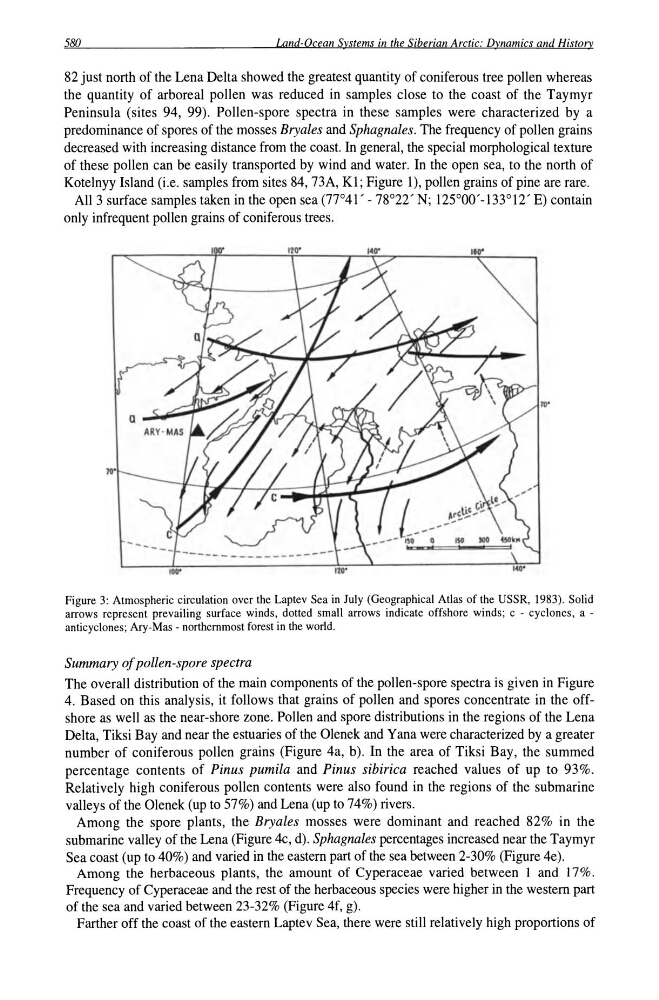
Figure 3: Atmospheric circulation over the Laptev Sea in July (Geographical Atlas of the USSR, 1983). Solid
arrows represent prevailing surface winds, dotted small arrows indicate offshore winds; c - cyclones, a -
anticyclones; Ary-Mas - northernmost forest in the world.
Summary of pollen-spore spectra
The overall distribution of the main components of the pollen-spore spectra is given in Figure
4. Based on this analysis, it follows that grains of pollen and spores concentrate in the offshore as well as the near-shore zone. Pollen and spore distributions in the regions of the Lena
Delta, Tiksi Bay and near the estuaries of the Olenek and Yana were characterized by a greater
number of coniferous pollen grains (Figure 4a, b). In the area of Tiksi Bay, the summed
percentage contents of Pinus pumila and Pinus sibirica reached values of up to 93%.
Relatively high coniferous pollen contents were also found in the regions of the submarine
valleys of the Olenek (up to 57%) and Lena (up to 74%) rivers.
Among the spore plants, the Bryales mosses were dominant and reached 82% in the
submarine valley of the Lena (Figure 4c, d). Sphagnales percentages increased near the Taymyr
Sea coast (up to 40%) and varied in the eastern part of the sea between 2-30% (Figure 4e).
Among the herbaceous plants, the amount of Cyperaceae varied between I and 17%.
Frequency of Cyperaceae and the rest of the herbaceous species were higher in the western part
of the sea and varied between 23-32% (Figure 4f, g).
Farther off the coast of the eastern Laptev Sea, there were still relatively high proportions of
Land-Ocean SYstems in the Siberian Arctic: Dynamics and History
82 just north of the Lena Delta showed the greatest quantity of coniferous tree pollen whereas
the quantity of arboreal pollen was reduced in samples close to the coast of the Taymyr
Peninsula (sites 94, 99). Pollen-spore spectra in these samples were characterized by a
predominance of spores of the mosses Bryales and Sphagnales. The frequency of pollen grains
decreased with increasing distance from the coast. In general, the special morphological texture
of these pollen can be easily transported by wind and water. In the open sea, to the north of
Kote1nyy Island (i.e. samples from sites 84, 73A, Kl; Figure 1), pollen grains of pine are rare.
All 3 surface samples taken in the open sea (77°41' - 78°22' N; 125°00'-133°12' E) contain
only infrequent pollen grains of coniferous trees.
Figure 3: Atmospheric circulation over the Laptev Sea in July (Geographical Atlas of the USSR, 1983). Solid
arrows represent prevailing surface winds, dotted small arrows indicate offshore winds; c - cyclones, a -
anticyclones; Ary-Mas - northernmost forest in the world.
Summary of pollen-spore spectra
The overall distribution of the main components of the pollen-spore spectra is given in Figure
4. Based on this analysis, it follows that grains of pollen and spores concentrate in the offshore as well as the near-shore zone. Pollen and spore distributions in the regions of the Lena
Delta, Tiksi Bay and near the estuaries of the Olenek and Yana were characterized by a greater
number of coniferous pollen grains (Figure 4a, b). In the area of Tiksi Bay, the summed
percentage contents of Pinus pumila and Pinus sibirica reached values of up to 93%.
Relatively high coniferous pollen contents were also found in the regions of the submarine
valleys of the Olenek (up to 57%) and Lena (up to 74%) rivers.
Among the spore plants, the Bryales mosses were dominant and reached 82% in the
submarine valley of the Lena (Figure 4c, d). Sphagnales percentages increased near the Taymyr
Sea coast (up to 40%) and varied in the eastern part of the sea between 2-30% (Figure 4e).
Among the herbaceous plants, the amount of Cyperaceae varied between I and 17%.
Frequency of Cyperaceae and the rest of the herbaceous species were higher in the western part
of the sea and varied between 23-32% (Figure 4f, g).
Farther off the coast of the eastern Laptev Sea, there were still relatively high proportions of