

578
Land-Ocean Systems in the Siberian Arctic: Dynamics and History
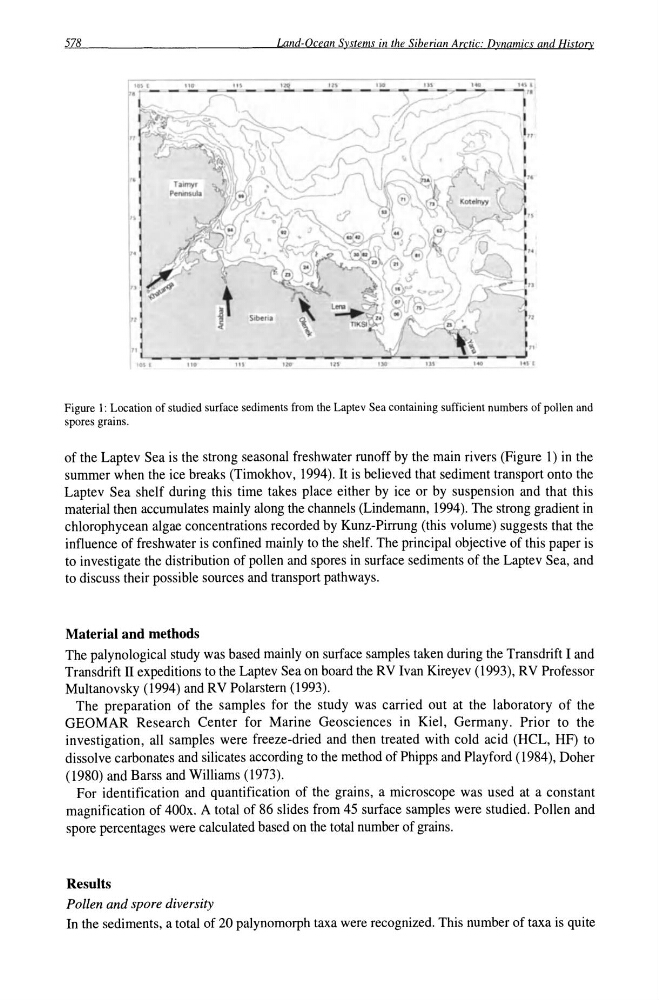
Figure 1: Location of studied surface sediments from the Laptev Sea containing sufficient numbers of pollen and
spores grains.
of the Laptev Sea is the strong seasonal freshwater runoff by the main rivers (Figure 1) in the
summer when the ice breaks (Timokhov, 1994). It is believed that sediment transport onto the
Laptev Sea shelf during this time takes place either by ice or by suspension and that this
material then accumulates mainly along the channels (Lindemann, 1994). The strong gradient in
chlorophycean algae concentrations recorded by Kunz-Pirrung (this volume) suggests that the
influence of freshwater is confined mainly to the shelf. The principal objective of this paper is
to investigate the distribution of pollen and spores in surface sediments of the Laptev Sea, and
to discuss their possible sources and transport pathways.
Material and methods
The palynological study was based mainly on surface samples taken during the Transdrift I and
Transdrift II expeditions to the Laptev Sea on board the RV Ivan Kireyev (1993), RV Professor
Multanovsky (1994) and RV Polarstem (1993).
The preparation of the samples for the study was carried out at the laboratory of the
GEOMAR Research Center for Marine Geosciences in Kiel, Germany. Prior to the
investigation, all samples were freeze-dried and then treated with cold acid (HCL, HF) to
dissolve carbonates and silicates according to the method of Phipps and Playford (1984), Doher
(1980) and Barss and Williams (1973).
For identification and quantification of the grains, a microscope was used at a constant
magnification of 400x. A total of 86 slides from 45 surface samples were studied. Pollen and
spore percentages were calculated based on the total number of grains.
Results
Pollen and spore diversity
In the sediments, a total of 20 palynomorph taxa were recognized. This number of taxa is quite
Land-Ocean Systems in the Siberian Arctic: Dynamics and History
Figure 1: Location of studied surface sediments from the Laptev Sea containing sufficient numbers of pollen and
spores grains.
of the Laptev Sea is the strong seasonal freshwater runoff by the main rivers (Figure 1) in the
summer when the ice breaks (Timokhov, 1994). It is believed that sediment transport onto the
Laptev Sea shelf during this time takes place either by ice or by suspension and that this
material then accumulates mainly along the channels (Lindemann, 1994). The strong gradient in
chlorophycean algae concentrations recorded by Kunz-Pirrung (this volume) suggests that the
influence of freshwater is confined mainly to the shelf. The principal objective of this paper is
to investigate the distribution of pollen and spores in surface sediments of the Laptev Sea, and
to discuss their possible sources and transport pathways.
Material and methods
The palynological study was based mainly on surface samples taken during the Transdrift I and
Transdrift II expeditions to the Laptev Sea on board the RV Ivan Kireyev (1993), RV Professor
Multanovsky (1994) and RV Polarstem (1993).
The preparation of the samples for the study was carried out at the laboratory of the
GEOMAR Research Center for Marine Geosciences in Kiel, Germany. Prior to the
investigation, all samples were freeze-dried and then treated with cold acid (HCL, HF) to
dissolve carbonates and silicates according to the method of Phipps and Playford (1984), Doher
(1980) and Barss and Williams (1973).
For identification and quantification of the grains, a microscope was used at a constant
magnification of 400x. A total of 86 slides from 45 surface samples were studied. Pollen and
spore percentages were calculated based on the total number of grains.
Results
Pollen and spore diversity
In the sediments, a total of 20 palynomorph taxa were recognized. This number of taxa is quite