

Zakharchuk: lntemfll Waves in the Laptev Sea
47
H - thickness of lower layer; !1p = P2 - PI, PI - density of upper layer;
P2 - density of lower layer; P- mean value of density; g - acceleration of gravity.
Dispersion relation for internal waves having lengths much more than a thickness of upper
ocean layer but essentially less then a thickness of lower layer assumed the following form:
c = ~g(f'..p/ p)h
(3)
The phase velocities of internal waves on the stations II, 14 and 16 were calculated by of
dispersion relation (2). The phase velocities of internal waves on the stations 42 and 80 were
calculated using of dispersion relation (3). Because we know periods of internal waves (n and
their the phase velocities (e), lengths of internal waves (A) may be calculate as A= c-T. The
calculated that parameters of intemal waves are given in the Table 1.
I, (Ol)
(cm 2 /s2 ).min
1000.0
100.0
10.0
1.0
0.1
~'-rT-''-,,-''-,,-''-,,-'~,,-r'-~-.-·~~-'-'~
0.0
0.5
1.0
1.5
2.0
2.5
3.0
Frequency. rad/min
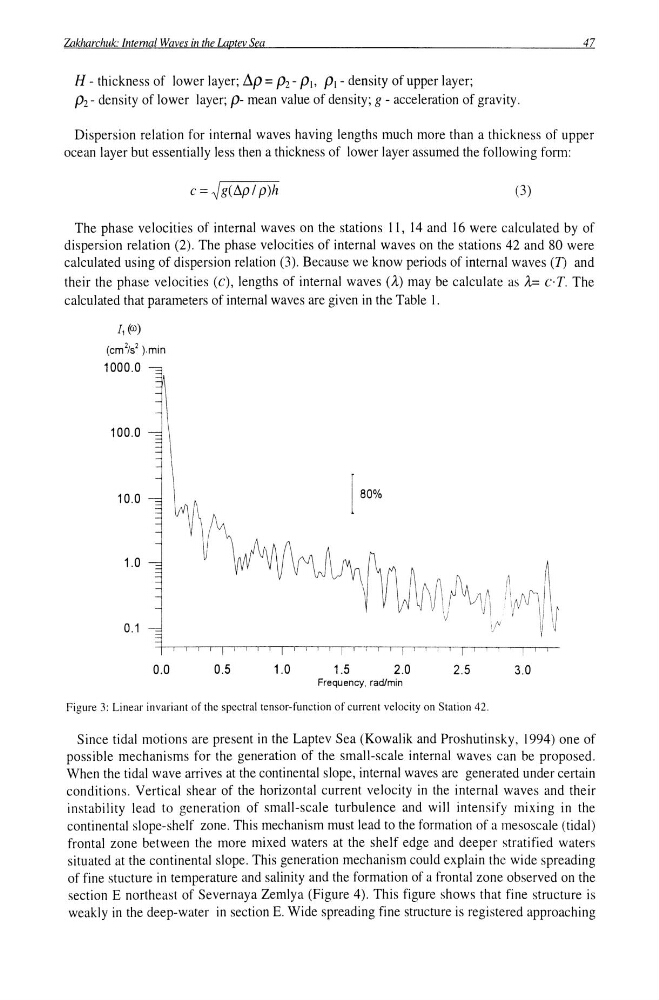
Figure 3: Linear invariant of the spectral tensor-function of current velocity on Station 42.
Since tidal motions are present in the Laptev Sea (Kowalik and Proshutinsky, 1994) one of
possible mechanisms for the generation of the small-scale internal waves can be proposed.
When the tidal wave arrives at the continental slope, internal waves are generated under certain
conditions. Vertical shear of the horizontal current velocity in the internal waves and their
instability lead to generation of small-scale turbulence and will intensify mixing in the
continental slope-shelf zone. This mechanism must lead to the formation of a mesoscale (tidal)
frontal zone between the more mixed waters at the shelf edge and deeper stratified waters
situated at the continental slope. This generation mechanism could explain the wide spreading
of fine stucture in temperature and salinity and the formation of a frontal zone observed on the
section E northeast of Severnaya Zemlya (Figure 4). This figure shows that fine structure is
weakly in the deep-water in section E. Wide spreading fine structure is registered approaching
47
H - thickness of lower layer; !1p = P2 - PI, PI - density of upper layer;
P2 - density of lower layer; P- mean value of density; g - acceleration of gravity.
Dispersion relation for internal waves having lengths much more than a thickness of upper
ocean layer but essentially less then a thickness of lower layer assumed the following form:
c = ~g(f'..p/ p)h
(3)
The phase velocities of internal waves on the stations II, 14 and 16 were calculated by of
dispersion relation (2). The phase velocities of internal waves on the stations 42 and 80 were
calculated using of dispersion relation (3). Because we know periods of internal waves (n and
their the phase velocities (e), lengths of internal waves (A) may be calculate as A= c-T. The
calculated that parameters of intemal waves are given in the Table 1.
I, (Ol)
(cm 2 /s2 ).min
1000.0
100.0
10.0
1.0
0.1
~'-rT-''-,,-''-,,-''-,,-'~,,-r'-~-.-·~~-'-'~
0.0
0.5
1.0
1.5
2.0
2.5
3.0
Frequency. rad/min
Figure 3: Linear invariant of the spectral tensor-function of current velocity on Station 42.
Since tidal motions are present in the Laptev Sea (Kowalik and Proshutinsky, 1994) one of
possible mechanisms for the generation of the small-scale internal waves can be proposed.
When the tidal wave arrives at the continental slope, internal waves are generated under certain
conditions. Vertical shear of the horizontal current velocity in the internal waves and their
instability lead to generation of small-scale turbulence and will intensify mixing in the
continental slope-shelf zone. This mechanism must lead to the formation of a mesoscale (tidal)
frontal zone between the more mixed waters at the shelf edge and deeper stratified waters
situated at the continental slope. This generation mechanism could explain the wide spreading
of fine stucture in temperature and salinity and the formation of a frontal zone observed on the
section E northeast of Severnaya Zemlya (Figure 4). This figure shows that fine structure is
weakly in the deep-water in section E. Wide spreading fine structure is registered approaching