

48
Land-Ocean Systems in the Siberian Arctic: Dynamics and History
to the continental slope and shelf. Temperature and salinity in the warm water core of the
Atlantic layer change from 2.7°C, 34.97 at station 27 to 0.7°C, 34.77 at station 33. The largest
horizontal gradients of the temperature and salinity are between stations 29 and 31. Weather
was fine at this time and long narrow bands of the brash ice were observed on the sea surface.
These bands appear to be connected with the surface manifestation of the high-frequency
internal waves. Distance between these bands was 150 - 200 m approximately. This distance
are close to lengths of high-frequency internal waves which were calculated using of dispersion
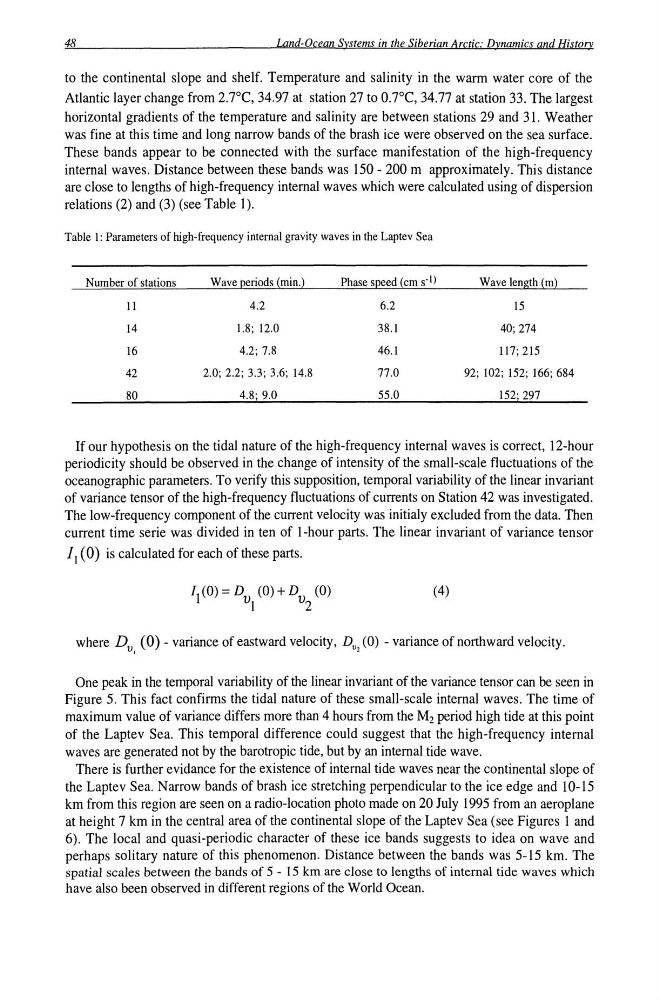
relations (2) and (3) (see Table 1).
Table 1: Parameters ofhigh-frequeney internal gravity waves in the Laptev Sea
Number of stations
Wave periods (min.)
Phase speed (em s-i)
Wave length (m)
11
4.2
6.2
15
14
1.8; 12.0
38.1
40;274
16
4.2; 7.8
46.1
117; 215
42
2.0; 2.2; 3.3; 3.6; 14.8
no
92; 102; 152; 166; 684
80
4.8; 9.0
55.0
152; 297
If our hypothesis on the tidal nature of the high-frequency internal waves is correct, 12-hour
periodicity should be observed in the change of intensity of the small-scale fluctuations of the
oceanographic parameters. To verify this supposition, temporal variability of the linear invariant
of variance tensor of the high-frequency fluctuations of currents on Station 42 was investigated.
The low-frequency component of the current velocity was initialy excluded from the data. Then
current time serie was divided in ten of I-hour parts. The linear invariant of variance tensor
1\ (0) is calculated for each of these parts.
/1(0) = D (0) + D (0)
VI
v 2
(4)
where D (0) - variance of eastward velocity, Dv (0) - variance of northward velocity.
v,
2
One peak in the temporal variability of the linear invariant of the variance tensor can be seen in
Figure 5. This fact confirms the tidal nature of these small-scale internal waves. The time of
maximum value of variance differs more than 4 hours from the M2 period high tide at this point
of the Laptev Sea. This temporal difference could suggest that the high-frequency internal
waves are generated not by the barotropic tide, but by an internal tide wave.
There is further evidance for the existence of internal tide waves near the continental slope of
the Laptev Sea. Narrow bands of brash ice stretching perpendicular to the ice edge and 10-15
km from this region are seen on a radio-location photo made on 20 July 1995 from an aeroplane
at height 7 km in the central area of the continental slope of the Laptev Sea (see Figures I and
6). The local and quasi-periodic character of these ice bands suggests to idea on wave and
perhaps solitary nature of this phenomenon. Distance between the bands was 5-15 km. The
spatial scales between the bands of 5 - 15 km are close to lengths of internal tide waves which
have also been observed in different regions of the World Ocean.
Land-Ocean Systems in the Siberian Arctic: Dynamics and History
to the continental slope and shelf. Temperature and salinity in the warm water core of the
Atlantic layer change from 2.7°C, 34.97 at station 27 to 0.7°C, 34.77 at station 33. The largest
horizontal gradients of the temperature and salinity are between stations 29 and 31. Weather
was fine at this time and long narrow bands of the brash ice were observed on the sea surface.
These bands appear to be connected with the surface manifestation of the high-frequency
internal waves. Distance between these bands was 150 - 200 m approximately. This distance
are close to lengths of high-frequency internal waves which were calculated using of dispersion
relations (2) and (3) (see Table 1).
Table 1: Parameters ofhigh-frequeney internal gravity waves in the Laptev Sea
Number of stations
Wave periods (min.)
Phase speed (em s-i)
Wave length (m)
11
4.2
6.2
15
14
1.8; 12.0
38.1
40;274
16
4.2; 7.8
46.1
117; 215
42
2.0; 2.2; 3.3; 3.6; 14.8
no
92; 102; 152; 166; 684
80
4.8; 9.0
55.0
152; 297
If our hypothesis on the tidal nature of the high-frequency internal waves is correct, 12-hour
periodicity should be observed in the change of intensity of the small-scale fluctuations of the
oceanographic parameters. To verify this supposition, temporal variability of the linear invariant
of variance tensor of the high-frequency fluctuations of currents on Station 42 was investigated.
The low-frequency component of the current velocity was initialy excluded from the data. Then
current time serie was divided in ten of I-hour parts. The linear invariant of variance tensor
1\ (0) is calculated for each of these parts.
/1(0) = D (0) + D (0)
VI
v 2
(4)
where D (0) - variance of eastward velocity, Dv (0) - variance of northward velocity.
v,
2
One peak in the temporal variability of the linear invariant of the variance tensor can be seen in
Figure 5. This fact confirms the tidal nature of these small-scale internal waves. The time of
maximum value of variance differs more than 4 hours from the M2 period high tide at this point
of the Laptev Sea. This temporal difference could suggest that the high-frequency internal
waves are generated not by the barotropic tide, but by an internal tide wave.
There is further evidance for the existence of internal tide waves near the continental slope of
the Laptev Sea. Narrow bands of brash ice stretching perpendicular to the ice edge and 10-15
km from this region are seen on a radio-location photo made on 20 July 1995 from an aeroplane
at height 7 km in the central area of the continental slope of the Laptev Sea (see Figures I and
6). The local and quasi-periodic character of these ice bands suggests to idea on wave and
perhaps solitary nature of this phenomenon. Distance between the bands was 5-15 km. The
spatial scales between the bands of 5 - 15 km are close to lengths of internal tide waves which
have also been observed in different regions of the World Ocean.