

568
Land-Ocean Systems in the Siberian Arctic: Dynamics and History
part of the shelf and on the continental slope Radiosperma corbiferum is rare. The zoomorph
group consists of foraminiferal test linings, ciliate cysts and tintinnid loricae. Foraminiferal test
linings are the inner organic layer of benthic calcareous foraminifers (e.g., De Vernal et aI.,
1992). The highest concentrations of foraminiferal test linings occur by water depth < 100 m on
the Laptev Sea shelf.
I Concen.mUon or chlorococcalean alga. I
80'
75'
N /-!=======OP=======""F=="",,===d...,_~ _ _ _ _ _ -+--1 70·
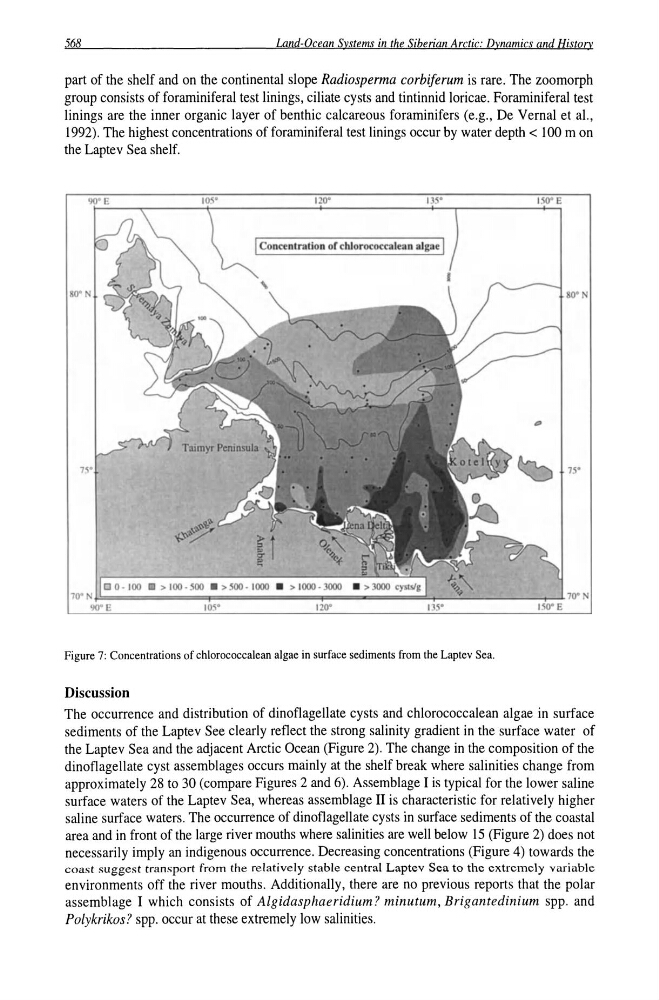
Figure 7: Concentrations of chlorococcalean algae in surface sediments from the Laptev Sea.
Discussion
The occurrence and distribution of dinoflagellate cysts and chlorococcalean algae in surface
sediments of the Laptev See clearly reflect the strong salinity gradient in the surface water of
the Laptev Sea and the adjacent Arctic Ocean (Figure 2). The change in the composition of the
dinoflagellate cyst assemblages occurs mainly at the shelf break where salinities change from
approximately 28 to 30 (compare Figures 2 and 6). Assemblage I is typical for the lower saline
surface waters of the Laptev Sea, whereas assemblage II is characteristic for relatively higher
saline surface waters. The occurrence of dinoflagellate cysts in surface sediments of the coastal
area and in front of the large river mouths where salinities are well below 15 (Figure 2) does not
necessarily imply an indigenous occurrence. Decreasing concentrations (Figure 4) towards the
coast suggest transport from the relatively stable central Laptev Sea to the extremely variable
environments off the river mouths. Additionally, there are no previous reports that the polar
assemblage I which consists of Algidasphaeridium? minutum, Brigantedinium spp. and
Polykrikos? spp. occur at these extremely low salinities.
Land-Ocean Systems in the Siberian Arctic: Dynamics and History
part of the shelf and on the continental slope Radiosperma corbiferum is rare. The zoomorph
group consists of foraminiferal test linings, ciliate cysts and tintinnid loricae. Foraminiferal test
linings are the inner organic layer of benthic calcareous foraminifers (e.g., De Vernal et aI.,
1992). The highest concentrations of foraminiferal test linings occur by water depth < 100 m on
the Laptev Sea shelf.
I Concen.mUon or chlorococcalean alga. I
80'
75'
N /-!=======OP=======""F=="",,===d...,_~ _ _ _ _ _ -+--1 70·
Figure 7: Concentrations of chlorococcalean algae in surface sediments from the Laptev Sea.
Discussion
The occurrence and distribution of dinoflagellate cysts and chlorococcalean algae in surface
sediments of the Laptev See clearly reflect the strong salinity gradient in the surface water of
the Laptev Sea and the adjacent Arctic Ocean (Figure 2). The change in the composition of the
dinoflagellate cyst assemblages occurs mainly at the shelf break where salinities change from
approximately 28 to 30 (compare Figures 2 and 6). Assemblage I is typical for the lower saline
surface waters of the Laptev Sea, whereas assemblage II is characteristic for relatively higher
saline surface waters. The occurrence of dinoflagellate cysts in surface sediments of the coastal
area and in front of the large river mouths where salinities are well below 15 (Figure 2) does not
necessarily imply an indigenous occurrence. Decreasing concentrations (Figure 4) towards the
coast suggest transport from the relatively stable central Laptev Sea to the extremely variable
environments off the river mouths. Additionally, there are no previous reports that the polar
assemblage I which consists of Algidasphaeridium? minutum, Brigantedinium spp. and
Polykrikos? spp. occur at these extremely low salinities.