

K unz-Pirrung: Distribution ofAguatic Palynomorphs in Sud ace Sediments
567
freshwater plumes that originate from the Anabar and Olenek rivers and in particular from the
Lena and Yana rivers.
I Dinonagtllalt cyst
80"
75" N
N ~============~~ __________ ~ ____ ~ ______ ~ __ ~ ________ ~-1 70" N
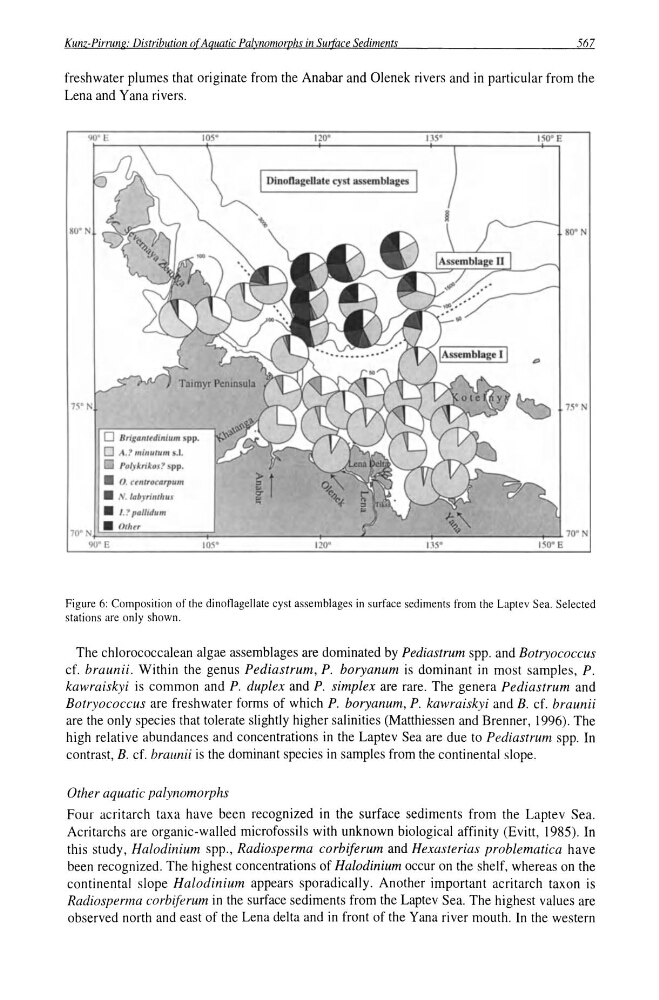
Figure 6: Composition of the dinoflagellate cyst assemblages in surface sediments from the Laptev Sea. Selected
stations are only shown.
The chlorococcalean algae assemblages are dominated by Pediastrum spp. and Botryococcus
cf. braunii. Within the genus Pediastrum, P. boryanum is dominant in most samples, P.
kawraiskyi is common and P. duplex and P. simplex are rare. The genera Pediastrum and
Botryococcus are freshwater forms of which P. boryanum, P. kawraiskyi and B. cf. braunii
are the only species that tolerate slightly higher salinities (Matthiessen and Brenner, 1996). The
high relative abundances and concentrations in the Laptev Sea are due to Pediastrum spp. In
contrast, B. cf. braunii is the dominant species in samples from the continental slope.
Other aquatic palynomorphs
Four acritarch taxa have been recognized in the surface sediments from the Laptev Sea.
Acritarchs are organic-walled microfossils with unknown biological affinity (Evitt, 1985). In
this study, Halodinium spp., Radiosperma corbiferum and Hexasterias problematica have
been recognized. The highest concentrations of Halodinium occur on the shelf, whereas on the
continental slope Halodinium appears sporadically. Another important acritarch taxon is
Radiosperma corbif(~rum in the surface sediments from the Laptev Sea. The highest values are
observed north and east of the Lena delta and in front of the Yana river mouth. In the western
567
freshwater plumes that originate from the Anabar and Olenek rivers and in particular from the
Lena and Yana rivers.
I Dinonagtllalt cyst
80"
75" N
N ~============~~ __________ ~ ____ ~ ______ ~ __ ~ ________ ~-1 70" N
Figure 6: Composition of the dinoflagellate cyst assemblages in surface sediments from the Laptev Sea. Selected
stations are only shown.
The chlorococcalean algae assemblages are dominated by Pediastrum spp. and Botryococcus
cf. braunii. Within the genus Pediastrum, P. boryanum is dominant in most samples, P.
kawraiskyi is common and P. duplex and P. simplex are rare. The genera Pediastrum and
Botryococcus are freshwater forms of which P. boryanum, P. kawraiskyi and B. cf. braunii
are the only species that tolerate slightly higher salinities (Matthiessen and Brenner, 1996). The
high relative abundances and concentrations in the Laptev Sea are due to Pediastrum spp. In
contrast, B. cf. braunii is the dominant species in samples from the continental slope.
Other aquatic palynomorphs
Four acritarch taxa have been recognized in the surface sediments from the Laptev Sea.
Acritarchs are organic-walled microfossils with unknown biological affinity (Evitt, 1985). In
this study, Halodinium spp., Radiosperma corbiferum and Hexasterias problematica have
been recognized. The highest concentrations of Halodinium occur on the shelf, whereas on the
continental slope Halodinium appears sporadically. Another important acritarch taxon is
Radiosperma corbif(~rum in the surface sediments from the Laptev Sea. The highest values are
observed north and east of the Lena delta and in front of the Yana river mouth. In the western