

566
Land-Ocean Systems in the Siberian Arctic: Dynamics and History
environments of the Arctic Ocean, the Labrador Sea, the Baffin Bay (Mudie, 1992), the Barents
Sea (Harland, 1982), and the East Greenland continental shelf and slope (Matthiessen, 1995).
However, assemblage I differs in having numerous morphotypes of Algidasphaeridium? and in
containing morphotypes tentatively referred to Polykrikos?
Dislribution pallem of dinonagellale cy I
80· N
75·
N ~======:::::"'_~ _____ ~_---1=-____ -+,"...:!."":"",--____ 1 1o·
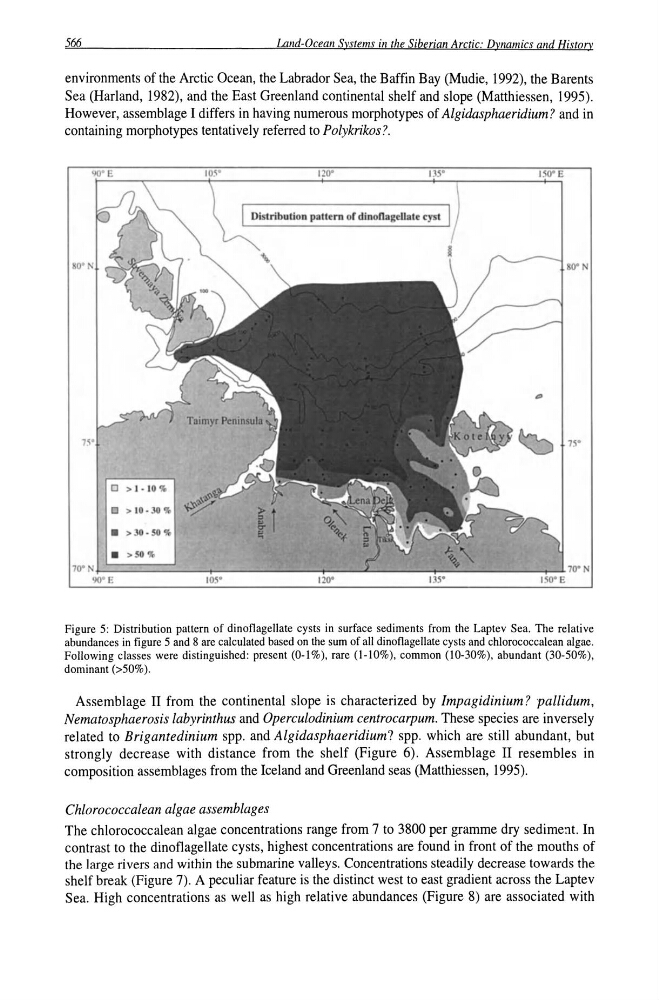
Figure 5: Distribution pattern of dinoflagellate cysts in surface sediments from the Laptev Sea. The relative
abundances in figure 5 and 8 are calculated based on the sum of all dinoflagellate cysts and chlorococcalean algae.
Following classes were distinguished: present (0-1%), rare 0-10%), common (10-30%), abundant (30-50%),
dominant (>50%).
Assemblage II from the continental slope is characterized by Impagidinium? pallidum,
Nematosphaerosis labyrinthus and Operculodinium centrocarpum. These species are inversely
related to Brigantedinium spp. and Algidasphaeridium? spp. which are still abundant, but
strongly decrease with distance from the shelf (Figure 6). Assemblage II resembles in
composition assemblages from the Iceland and Greenland seas (Matthies sen, 1995).
Chlorococcalean algae assemblages
The chlorococcalean algae concentrations range from 7 to 3800 per gramme dry sedime:lt. In
contrast to the dinoflagellate cysts, highest concentrations are found in front of the mouths of
the large rivers and within the submarine valleys. Concentrations steadily decrease towards the
shelf break (Figure 7). A peculiar feature is the distinct west to east gradient across the Laptev
Sea. High concentrations as well as high relative abundances (Figure 8) are associated with
Land-Ocean Systems in the Siberian Arctic: Dynamics and History
environments of the Arctic Ocean, the Labrador Sea, the Baffin Bay (Mudie, 1992), the Barents
Sea (Harland, 1982), and the East Greenland continental shelf and slope (Matthiessen, 1995).
However, assemblage I differs in having numerous morphotypes of Algidasphaeridium? and in
containing morphotypes tentatively referred to Polykrikos?
Dislribution pallem of dinonagellale cy I
80· N
75·
N ~======:::::"'_~ _____ ~_---1=-____ -+,"...:!."":"",--____ 1 1o·
Figure 5: Distribution pattern of dinoflagellate cysts in surface sediments from the Laptev Sea. The relative
abundances in figure 5 and 8 are calculated based on the sum of all dinoflagellate cysts and chlorococcalean algae.
Following classes were distinguished: present (0-1%), rare 0-10%), common (10-30%), abundant (30-50%),
dominant (>50%).
Assemblage II from the continental slope is characterized by Impagidinium? pallidum,
Nematosphaerosis labyrinthus and Operculodinium centrocarpum. These species are inversely
related to Brigantedinium spp. and Algidasphaeridium? spp. which are still abundant, but
strongly decrease with distance from the shelf (Figure 6). Assemblage II resembles in
composition assemblages from the Iceland and Greenland seas (Matthies sen, 1995).
Chlorococcalean algae assemblages
The chlorococcalean algae concentrations range from 7 to 3800 per gramme dry sedime:lt. In
contrast to the dinoflagellate cysts, highest concentrations are found in front of the mouths of
the large rivers and within the submarine valleys. Concentrations steadily decrease towards the
shelf break (Figure 7). A peculiar feature is the distinct west to east gradient across the Laptev
Sea. High concentrations as well as high relative abundances (Figure 8) are associated with