

Kunz-Pirrung: Distribution ofAQUlltic Palynomorphs in Suiface Sediments
565
groups show distinct distribution patterns which can be related to specific environmental
conditions. In contrast, knowledge about the ecological requirements of the recorded acritarchs
and zoomorph groups is relatively sparse and the distribution of most taxa in the Laptev Sea is
heterogeneous.
Dinoflagellate cyst assemblages
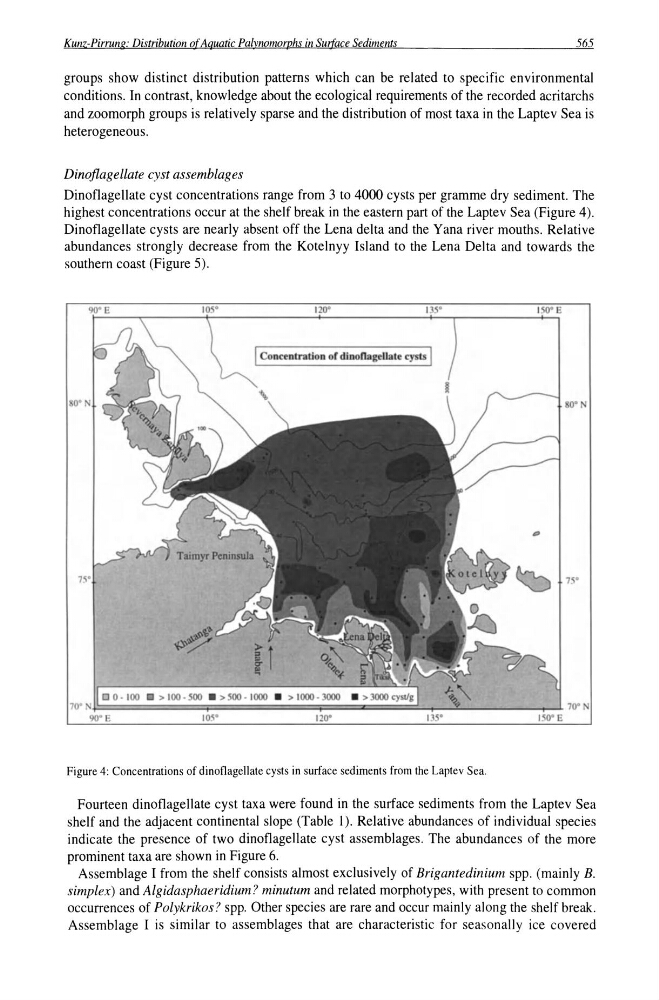
Dinoflagellate cyst concentrations range from 3 to 4000 cysts per gramme dry sediment. The
highest concentrations occur at the shelf break in the eastern part of the Laptev Sea (Figure 4).
Dinoflagellate cysts are nearly absent off the Lena delta and the Yana river mouths. Relative
abundances strongly decrease from the Kotelnyy Island to the Lena Delta and towards the
southern coast (Figure 5).
I ConC~lltnltion of dinoOagellate c
80"
15"
N ~============~============~===z======~ __ ~ ________ ~-1 10"N
Figure 4: Concentrations of dinoflagellate cysts in surface sediments from the Laptev Sea.
Fourteen dinoflagellate cyst taxa were found in the surface sediments from the Laptev Sea
shelf and the adjacent continental slope (Table I). Relative abundances of individual species
indicate the presence of two dinoflagellate cyst assemblages. The abundances of the more
prominent taxa are shown in Figure 6.
Assemblage I from the shelf consists almost exclusively of Brigantedinium spp. (mainly B.
simplex) and Algidasphaeridium? minutum and related morphotypes, with present to common
occurrences of Polykrikos? spp. Other species are rare and occur mainly along the shelf break.
Assemblage I is similar to assemblages that are characteristic for seasonally ice covered
565
groups show distinct distribution patterns which can be related to specific environmental
conditions. In contrast, knowledge about the ecological requirements of the recorded acritarchs
and zoomorph groups is relatively sparse and the distribution of most taxa in the Laptev Sea is
heterogeneous.
Dinoflagellate cyst assemblages
Dinoflagellate cyst concentrations range from 3 to 4000 cysts per gramme dry sediment. The
highest concentrations occur at the shelf break in the eastern part of the Laptev Sea (Figure 4).
Dinoflagellate cysts are nearly absent off the Lena delta and the Yana river mouths. Relative
abundances strongly decrease from the Kotelnyy Island to the Lena Delta and towards the
southern coast (Figure 5).
I ConC~lltnltion of dinoOagellate c
80"
15"
N ~============~============~===z======~ __ ~ ________ ~-1 10"N
Figure 4: Concentrations of dinoflagellate cysts in surface sediments from the Laptev Sea.
Fourteen dinoflagellate cyst taxa were found in the surface sediments from the Laptev Sea
shelf and the adjacent continental slope (Table I). Relative abundances of individual species
indicate the presence of two dinoflagellate cyst assemblages. The abundances of the more
prominent taxa are shown in Figure 6.
Assemblage I from the shelf consists almost exclusively of Brigantedinium spp. (mainly B.
simplex) and Algidasphaeridium? minutum and related morphotypes, with present to common
occurrences of Polykrikos? spp. Other species are rare and occur mainly along the shelf break.
Assemblage I is similar to assemblages that are characteristic for seasonally ice covered