

564
Land-Ocean Systems in the Siberian Arctic: Dynamics and History
A minimum of 100 dinoflagellate cysts was analysed and counted under the light microscope
using phase and differential interference contrasts. Taxa found in this study are listed in Table
1. Dinoflagellate cysts were classified according to the references cited in Lentin and Williams
(1993). The taxonomy of the chlorococcalean algae followed Parra Barrientos (1979) and
Matthiessen and Brenner (1996).
Distribution of assemblages
Palynomorph assemblages
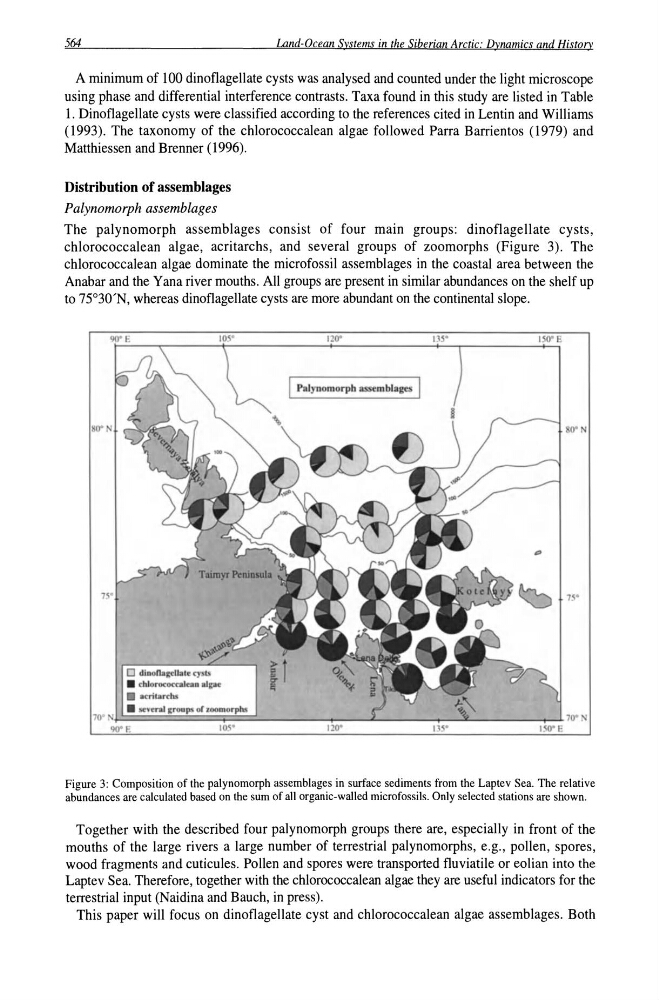
The palynomorph assemblages consist of four main groups: dinoflagellate cysts,
chlorococcalean algae, acritarchs, and several groups of zoomorphs (Figure 3). The
chlorococcalean algae dominate the microfossil assemblages in the coastal area between the
Anabar and the Yana river mouths. All groups are present in similar abundances on the shelf up
to 75°30'N, whereas dinoflagellate cysts are more abundant on the continental slope.
I Palynomorph
80'
75"
Figure 3: Composition of the palynomorph assemblages in surface sediments from the Laptev Sea. The relative
abundances are calculated based on the sum of all organic-walled microfossils. Only selected stations are shown.
Together with the described four palynomorph groups there are, especially in front of the
mouths of the large rivers a large number of terrestrial palynomorphs, e.g., pollen, spores,
wood fragments and cuticules. Pollen and spores were transported fluviatile or eolian into the
Laptev Sea. Therefore, together with the chlorococcalean algae they are useful indicators for the
terrestrial input (Naidina and Bauch, in press).
This paper will focus on dinoflagellate cyst and chlorococcalean algae assemblages. Both
Land-Ocean Systems in the Siberian Arctic: Dynamics and History
A minimum of 100 dinoflagellate cysts was analysed and counted under the light microscope
using phase and differential interference contrasts. Taxa found in this study are listed in Table
1. Dinoflagellate cysts were classified according to the references cited in Lentin and Williams
(1993). The taxonomy of the chlorococcalean algae followed Parra Barrientos (1979) and
Matthiessen and Brenner (1996).
Distribution of assemblages
Palynomorph assemblages
The palynomorph assemblages consist of four main groups: dinoflagellate cysts,
chlorococcalean algae, acritarchs, and several groups of zoomorphs (Figure 3). The
chlorococcalean algae dominate the microfossil assemblages in the coastal area between the
Anabar and the Yana river mouths. All groups are present in similar abundances on the shelf up
to 75°30'N, whereas dinoflagellate cysts are more abundant on the continental slope.
I Palynomorph
80'
75"
Figure 3: Composition of the palynomorph assemblages in surface sediments from the Laptev Sea. The relative
abundances are calculated based on the sum of all organic-walled microfossils. Only selected stations are shown.
Together with the described four palynomorph groups there are, especially in front of the
mouths of the large rivers a large number of terrestrial palynomorphs, e.g., pollen, spores,
wood fragments and cuticules. Pollen and spores were transported fluviatile or eolian into the
Laptev Sea. Therefore, together with the chlorococcalean algae they are useful indicators for the
terrestrial input (Naidina and Bauch, in press).
This paper will focus on dinoflagellate cyst and chlorococcalean algae assemblages. Both