

Cremer: Spatial Distribution of Diatom Suiface Sediment Assemblages
535
to a subdivision of the Laptev Sea shelf into a western and an eastern province (Rossak, 1995).
According to Ivanov and Piskun (1995), the annual sediment supply is 19 million tons (Lena
River), 4 million tons (Yana River), and 1.5 million tons (Olenek River).
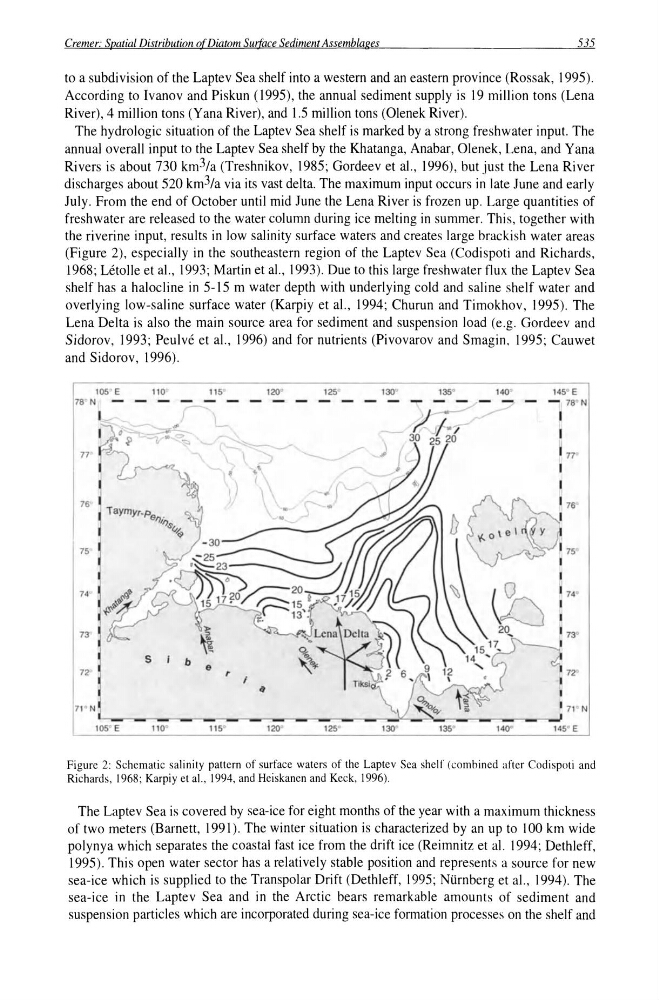
The hydrologic situation of the Laptev Sea shelf is marked by a strong freshwater input. The
annual overall input to the Laptev Sea shelf by the Khatanga, Anabar, Olenek, Lena, and Yana
Rivers is about 730 km 3 Ja (Treshnikov, 1985; Gordeev et aI., 1996), but just the Lena River
discharges about 520 km 3 Ja via its vast delta. The maximum input occurs in late June and early
July. From the end of October until mid June the Lena River is frozen up. Large quantities of
freshwater are released to the water column during ice melting in summer. This. together with
the riverine input, results in low salinity surface waters and creates large brackish water areas
(Figure 2), especially in the southeastern region of the Laptev Sea (Codispoti and Richards,
1968; Letolle et a!., 1993; Martin et a!., 1993). Due to this large freshwater flux the Laptev Sea
shelf has a halocline in 5-15 m water depth with underlying cold and saline shelf water and
overlying low-saline surface water (Karpiy et a!., 1994; Churun and Timokhov, 1995). The
Lena Delta is also the main source area for sediment and suspension load (e.g. Gordeev and
Sidorov, 1993; Peulve et a!., 1996) and for nutrients (Pivovarov and Smagin, 1995; Cauwet
and Sidorov, 1996).
lOS E
110
115
120'
78 N
77
76
75
74
73
s
b
72
105' [
110'
115
120
125
130"
136'
125'
130'
136'
140'
1400
145' E
-
78'N
I 74'
I
72'
1 71 N
145' E
Figure 2: Schematic salinity pattern of surface waters of the Laptev Sea shelf (comhined after Codispoti and
Richards, 1968; Karpiy et al.. 1994, and Heiskanen and Keck, 1996).
The Laptev Sea is covered by sea-ice for eight months of the year with a maximum thickness
of two meters (Barnett, 1991). The winter situation is characterized by an up to 100 km wide
polynya which separates the coastal fast ice from the drift ice (Reimnitz et a!. 1994; Dethleff,
1995). This open water sector has a relatively stable position and represents a source for new
sea-ice which is supplied to the Transpolar Drift (Dethleff, 1995; Niirnberg et a!., 1994). The
sea-ice in the Laptev Sea and in the Arctic bears remarkable amounts of sediment and
suspension particles which are incorporated during sea-ice formation processes on the shelf and
535
to a subdivision of the Laptev Sea shelf into a western and an eastern province (Rossak, 1995).
According to Ivanov and Piskun (1995), the annual sediment supply is 19 million tons (Lena
River), 4 million tons (Yana River), and 1.5 million tons (Olenek River).
The hydrologic situation of the Laptev Sea shelf is marked by a strong freshwater input. The
annual overall input to the Laptev Sea shelf by the Khatanga, Anabar, Olenek, Lena, and Yana
Rivers is about 730 km 3 Ja (Treshnikov, 1985; Gordeev et aI., 1996), but just the Lena River
discharges about 520 km 3 Ja via its vast delta. The maximum input occurs in late June and early
July. From the end of October until mid June the Lena River is frozen up. Large quantities of
freshwater are released to the water column during ice melting in summer. This. together with
the riverine input, results in low salinity surface waters and creates large brackish water areas
(Figure 2), especially in the southeastern region of the Laptev Sea (Codispoti and Richards,
1968; Letolle et a!., 1993; Martin et a!., 1993). Due to this large freshwater flux the Laptev Sea
shelf has a halocline in 5-15 m water depth with underlying cold and saline shelf water and
overlying low-saline surface water (Karpiy et a!., 1994; Churun and Timokhov, 1995). The
Lena Delta is also the main source area for sediment and suspension load (e.g. Gordeev and
Sidorov, 1993; Peulve et a!., 1996) and for nutrients (Pivovarov and Smagin, 1995; Cauwet
and Sidorov, 1996).
lOS E
110
115
120'
78 N
77
76
75
74
73
s
b
72
105' [
110'
115
120
125
130"
136'
125'
130'
136'
140'
1400
145' E
-
78'N
I 74'
I
72'
1 71 N
145' E
Figure 2: Schematic salinity pattern of surface waters of the Laptev Sea shelf (comhined after Codispoti and
Richards, 1968; Karpiy et al.. 1994, and Heiskanen and Keck, 1996).
The Laptev Sea is covered by sea-ice for eight months of the year with a maximum thickness
of two meters (Barnett, 1991). The winter situation is characterized by an up to 100 km wide
polynya which separates the coastal fast ice from the drift ice (Reimnitz et a!. 1994; Dethleff,
1995). This open water sector has a relatively stable position and represents a source for new
sea-ice which is supplied to the Transpolar Drift (Dethleff, 1995; Niirnberg et a!., 1994). The
sea-ice in the Laptev Sea and in the Arctic bears remarkable amounts of sediment and
suspension particles which are incorporated during sea-ice formation processes on the shelf and