

536
Land-Ocean Systems in the Siberian Arctic: Dynamics and History
are exported into the Arctic Ocean by the Transpolar Drift (Niimberg et aI., 1994; Eicken et aI.,
1997).
Materials and methods
Sediment material
Samples were recovered during the Transdrift I, II, and III expeditions which took place during
the summer months in 1993, 1994 and in autumn 1995. Surface sediment samples were
collected aboard Russian research vessels (1993, 1994) and the Russian icebreaker "Kapitan
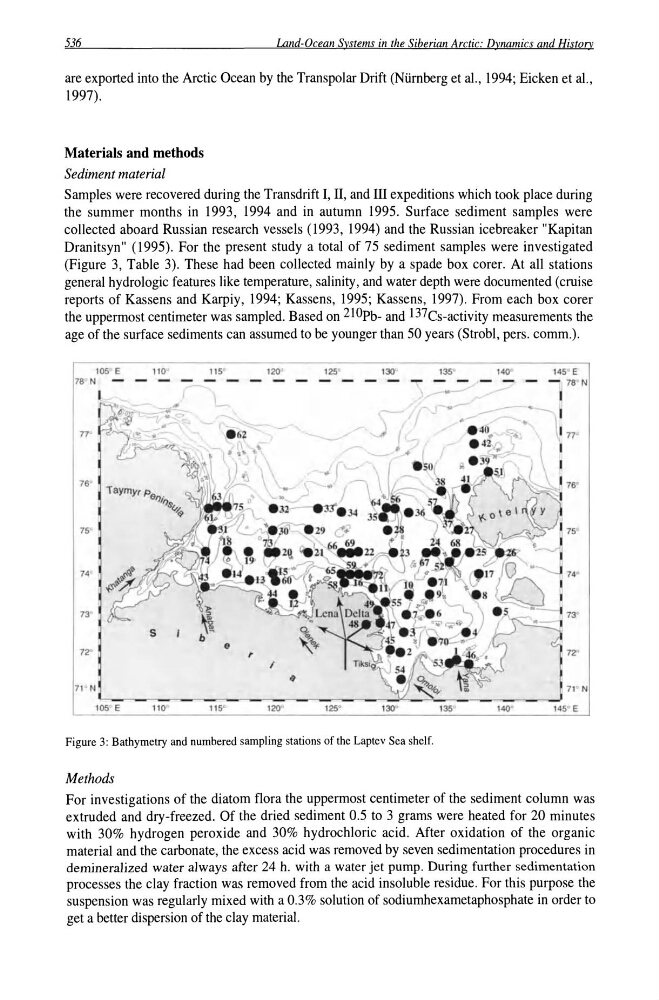
Dranitsyn" (1995). For the present study a total of 75 sediment samples were investigated
(Figure 3, Table 3). These had been collected mainly by a spade box corer. At all stations
general hydrologic features like temperature, salinity, and water depth were documented (cruise
reports of Kassens and Karpiy, 1994; Kassens, 1995; Kassens, 1997). From each box corer
the uppermost centimeter was sampled. Based on 21OPb_ and 137Cs-activity measurements the
age of the surface sediments can assumed to be younger than 50 years (Strobl, pers. comm.).
10S' E
78 N
77
76'
75'
7Y
72
71 N
105 E
110
110
liS'
120'
125
130
lIS'
120'
125'
130'
Figure 3: Bathymetry and numbered sampling stations of the Laptev Sea shelf.
Methods
135'
140'
135'
140'
145' E
-
78' N
74'
73'
72'
71 N
14S' E
For investigations of the diatom flora the uppermost centimeter of the sediment column was
extruded and dry-freezed. Of the dried sediment 0.5 to 3 grams were heated for 20 minutes
with 30% hydrogen peroxide and 30% hydrochloric acid. After oxidation of the organic
material and the carbonate, the excess acid was removed by seven sedimentation procedures in
demineralized water always after 24 h. with a water jet pump. During further sedimentation
processes the clay fraction was removed from the acid insoluble residue. For this purpose the
suspension was regularly mixed with a 0.3% solution of sodiumhexametaphosphate in order to
get a better dispersion of the clay material.
Land-Ocean Systems in the Siberian Arctic: Dynamics and History
are exported into the Arctic Ocean by the Transpolar Drift (Niimberg et aI., 1994; Eicken et aI.,
1997).
Materials and methods
Sediment material
Samples were recovered during the Transdrift I, II, and III expeditions which took place during
the summer months in 1993, 1994 and in autumn 1995. Surface sediment samples were
collected aboard Russian research vessels (1993, 1994) and the Russian icebreaker "Kapitan
Dranitsyn" (1995). For the present study a total of 75 sediment samples were investigated
(Figure 3, Table 3). These had been collected mainly by a spade box corer. At all stations
general hydrologic features like temperature, salinity, and water depth were documented (cruise
reports of Kassens and Karpiy, 1994; Kassens, 1995; Kassens, 1997). From each box corer
the uppermost centimeter was sampled. Based on 21OPb_ and 137Cs-activity measurements the
age of the surface sediments can assumed to be younger than 50 years (Strobl, pers. comm.).
10S' E
78 N
77
76'
75'
7Y
72
71 N
105 E
110
110
liS'
120'
125
130
lIS'
120'
125'
130'
Figure 3: Bathymetry and numbered sampling stations of the Laptev Sea shelf.
Methods
135'
140'
135'
140'
145' E
-
78' N
74'
73'
72'
71 N
14S' E
For investigations of the diatom flora the uppermost centimeter of the sediment column was
extruded and dry-freezed. Of the dried sediment 0.5 to 3 grams were heated for 20 minutes
with 30% hydrogen peroxide and 30% hydrochloric acid. After oxidation of the organic
material and the carbonate, the excess acid was removed by seven sedimentation procedures in
demineralized water always after 24 h. with a water jet pump. During further sedimentation
processes the clay fraction was removed from the acid insoluble residue. For this purpose the
suspension was regularly mixed with a 0.3% solution of sodiumhexametaphosphate in order to
get a better dispersion of the clay material.