

460
Land-Ocean Systems in the Siberian Arctic: Dynamics and History
5 0 5 10 IS 20 M _ _ _ -
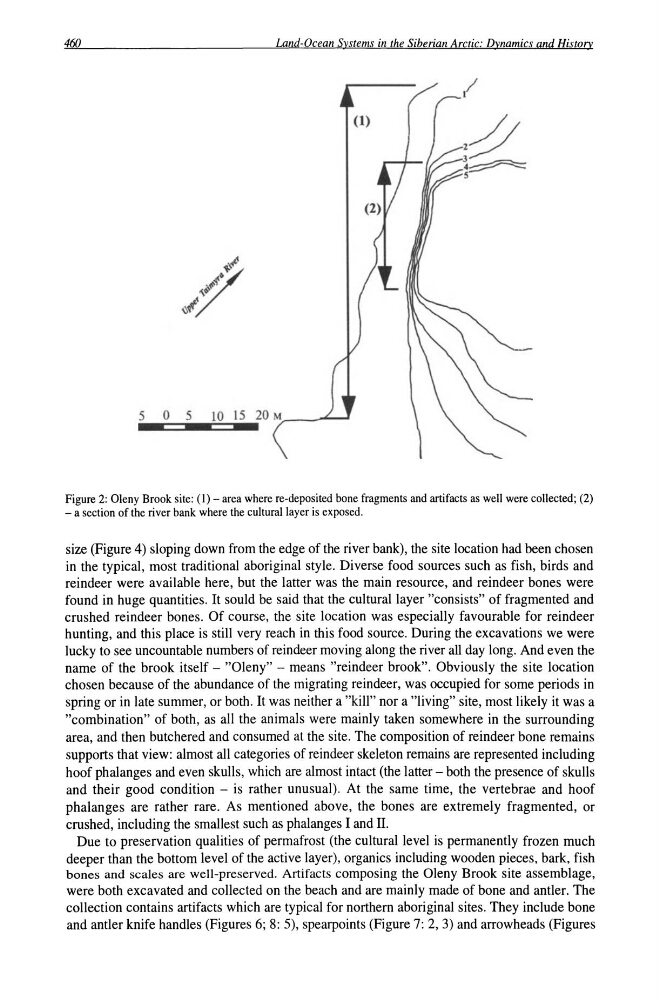
Figure 2: Oleny Brook site: (1) - area where re-deposited bone fragments and artifacts as well were collected; (2)
- a section of the river bank where the cultural layer is exposed.
size (Figure 4) sloping down from the edge of the river bank), the site location had been chosen
in the typical, most traditional aboriginal style. Diverse food sources such as fish, birds and
reindeer were available here, but the latter was the main resource, and reindeer bones were
found in huge quantities. It sould be said that the cultural layer "consists" of fragmented and
crushed reindeer bones. Of course, the site location was especially favourable for reindeer
hunting, and this place is still very reach in this food source. During the excavations we were
lucky to see uncountable numbers of reindeer moving along the river all day long. And even the
name of the brook itself - "Oleny" - means "reindeer brook". Obviously the site location
chosen because of the abundance of the migrating reindeer, was occupied for some periods in
spring or in late summer, or both. It was neither a "kill" nor a "living" site, most likely it was a
"combination" of both, as all the animals were mainly taken somewhere in the surrounding
area, and then butchered and consumed at the site. The composition of reindeer bone remains
supports that view: almost all categories of reindeer skeleton remains are represented including
hoof phalanges and even skulls, which are almost intact (the latter - both the presence of skulls
and their good condition - is rather unusual). At the same time, the vertebrae and hoof
phalanges are rather rare. As mentioned above, the bones are extremely fragmented, or
crushed, including the smallest such as phalanges I and II.
Due to preservation qualities of permafrost (the cultural level is permanently frozen much
deeper than the bottom level of the active layer), organics including wooden pieces, bark, fish
bones and scales are well-preserved. Artifacts composing the Oleny Brook site assemblage,
were both excavated and collected on the beach and are mainly made of bone and antler. The
collection contains artifacts which are typical for northern aboriginal sites. They include bone
and antler knife handles (Figures 6; 8: 5), spearpoints (Figure 7: 2, 3) and arrowheads (Figures
Land-Ocean Systems in the Siberian Arctic: Dynamics and History
5 0 5 10 IS 20 M _ _ _ -
Figure 2: Oleny Brook site: (1) - area where re-deposited bone fragments and artifacts as well were collected; (2)
- a section of the river bank where the cultural layer is exposed.
size (Figure 4) sloping down from the edge of the river bank), the site location had been chosen
in the typical, most traditional aboriginal style. Diverse food sources such as fish, birds and
reindeer were available here, but the latter was the main resource, and reindeer bones were
found in huge quantities. It sould be said that the cultural layer "consists" of fragmented and
crushed reindeer bones. Of course, the site location was especially favourable for reindeer
hunting, and this place is still very reach in this food source. During the excavations we were
lucky to see uncountable numbers of reindeer moving along the river all day long. And even the
name of the brook itself - "Oleny" - means "reindeer brook". Obviously the site location
chosen because of the abundance of the migrating reindeer, was occupied for some periods in
spring or in late summer, or both. It was neither a "kill" nor a "living" site, most likely it was a
"combination" of both, as all the animals were mainly taken somewhere in the surrounding
area, and then butchered and consumed at the site. The composition of reindeer bone remains
supports that view: almost all categories of reindeer skeleton remains are represented including
hoof phalanges and even skulls, which are almost intact (the latter - both the presence of skulls
and their good condition - is rather unusual). At the same time, the vertebrae and hoof
phalanges are rather rare. As mentioned above, the bones are extremely fragmented, or
crushed, including the smallest such as phalanges I and II.
Due to preservation qualities of permafrost (the cultural level is permanently frozen much
deeper than the bottom level of the active layer), organics including wooden pieces, bark, fish
bones and scales are well-preserved. Artifacts composing the Oleny Brook site assemblage,
were both excavated and collected on the beach and are mainly made of bone and antler. The
collection contains artifacts which are typical for northern aboriginal sites. They include bone
and antler knife handles (Figures 6; 8: 5), spearpoints (Figure 7: 2, 3) and arrowheads (Figures