

Zimichev et al.: The Features ofthe Hydrological Regime ofthe Lake-River Systems
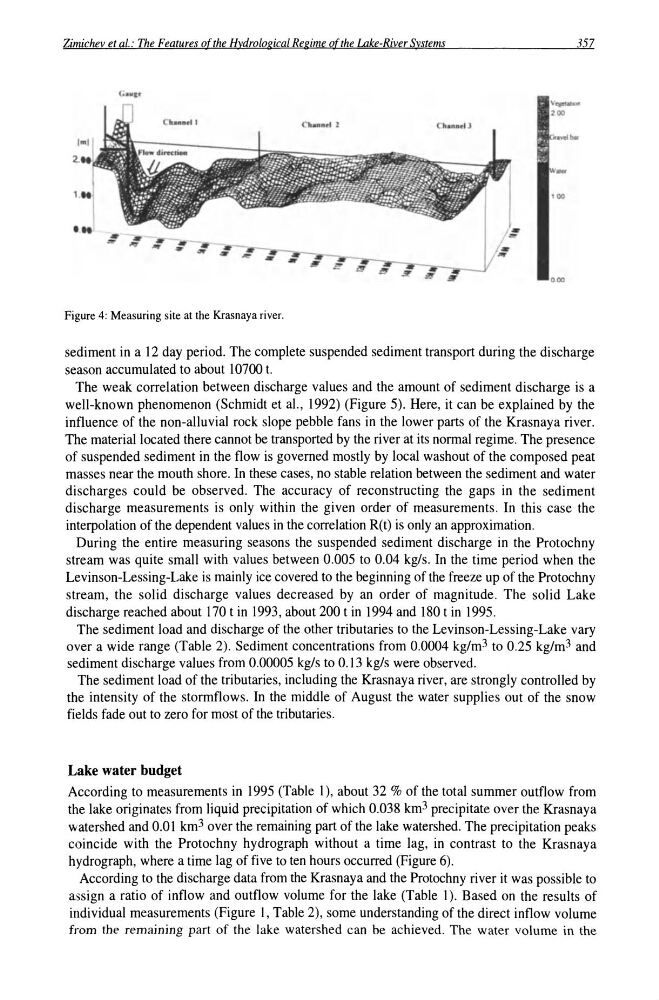
Figure 4: Measuring site at the Krasnaya river.
357
v ..........
200
. .
-
100
000
sediment in a 12 day period. The complete suspended sediment transport during the discharge
season accumulated to about 10700 t.
The weak correlation between discharge values and the amount of sediment discharge is a
well-known phenomenon (Schmidt et aI., 1992) (Figure 5). Here, it can be explained by the
influence of the non-alluvial rock slope pebble fans in the lower parts of the Krasnaya river.
The material located there cannot be transported by the river at its normal regime. The presence
of suspended sediment in the flow is governed mostly by local washout of the composed peat
masses near the mouth shore. In these cases, no stable relation between the sediment and water
discharges could be observed. The accuracy of reconstructing the gaps in the sediment
discharge measurements is only within the given order of measurements. In this case the
interpolation of the dependent values in the correlation R(t) is only an approximation.
During the entire measuring seasons the suspended sediment discharge in the Protochny
stream was quite small with values between 0.005 to 0.04 kg/so In the time period when the
Levinson-Lessing-Lake is mainly ice covered to the beginning of the freeze up of the Protochny
stream, the solid discharge values decreased by an order of magnitude. The solid Lake
discharge reached about 170 t in 1993, about 200 t in 1994 and 180 t in 1995.
The sediment load and discharge of the other tributaries to the Levinson-Lessing-Lake vary
over a wide range (Table 2). Sediment concentrations from 0.0004 kg/m3 to 0.25 kg/m3 and
sediment discharge values from 0.00005 kg/s to 0.13 kg/s were observed.
The sediment load of the tributaries, including the Krasnaya river, are strongly controlled by
the intensity of the stormflows. In the middle of August the water supplies out of the snow
fields fade out to zero for most of the tributaries.
Lake water budget
According to measurements in 1995 (Table I), about 32 % of the total summer outflow from
the lake originates from liquid precipitation of which 0.038 km 3 precipitate over the Krasnaya
watershed and 0.01 km 3 over the remaining part of the lake watershed. The precipitation peaks
coincide with the Protochny hydrograph without a time lag, in contrast to the Krasnaya
hydrograph, where a time lag of five to ten hours occurred (Figure 6).
According to the discharge data from the Krasnaya and the Protochny river it was possible to
assign a ratio of inflow and outflow volume for the lake (Table 1). Based on the results of
individual measurements (Figure 1, Table 2), some understanding of the direct inflow volume
from the remaining part of the lake watershed can be achieved. The water volume in the
Figure 4: Measuring site at the Krasnaya river.
357
v ..........
200
. .
-
100
000
sediment in a 12 day period. The complete suspended sediment transport during the discharge
season accumulated to about 10700 t.
The weak correlation between discharge values and the amount of sediment discharge is a
well-known phenomenon (Schmidt et aI., 1992) (Figure 5). Here, it can be explained by the
influence of the non-alluvial rock slope pebble fans in the lower parts of the Krasnaya river.
The material located there cannot be transported by the river at its normal regime. The presence
of suspended sediment in the flow is governed mostly by local washout of the composed peat
masses near the mouth shore. In these cases, no stable relation between the sediment and water
discharges could be observed. The accuracy of reconstructing the gaps in the sediment
discharge measurements is only within the given order of measurements. In this case the
interpolation of the dependent values in the correlation R(t) is only an approximation.
During the entire measuring seasons the suspended sediment discharge in the Protochny
stream was quite small with values between 0.005 to 0.04 kg/so In the time period when the
Levinson-Lessing-Lake is mainly ice covered to the beginning of the freeze up of the Protochny
stream, the solid discharge values decreased by an order of magnitude. The solid Lake
discharge reached about 170 t in 1993, about 200 t in 1994 and 180 t in 1995.
The sediment load and discharge of the other tributaries to the Levinson-Lessing-Lake vary
over a wide range (Table 2). Sediment concentrations from 0.0004 kg/m3 to 0.25 kg/m3 and
sediment discharge values from 0.00005 kg/s to 0.13 kg/s were observed.
The sediment load of the tributaries, including the Krasnaya river, are strongly controlled by
the intensity of the stormflows. In the middle of August the water supplies out of the snow
fields fade out to zero for most of the tributaries.
Lake water budget
According to measurements in 1995 (Table I), about 32 % of the total summer outflow from
the lake originates from liquid precipitation of which 0.038 km 3 precipitate over the Krasnaya
watershed and 0.01 km 3 over the remaining part of the lake watershed. The precipitation peaks
coincide with the Protochny hydrograph without a time lag, in contrast to the Krasnaya
hydrograph, where a time lag of five to ten hours occurred (Figure 6).
According to the discharge data from the Krasnaya and the Protochny river it was possible to
assign a ratio of inflow and outflow volume for the lake (Table 1). Based on the results of
individual measurements (Figure 1, Table 2), some understanding of the direct inflow volume
from the remaining part of the lake watershed can be achieved. The water volume in the