

Zimichev et al.: The Features ofthe Hydrological Regime ofthe Lake-River Systems
355
measuring station was equipped with temperature, electric conductivity and pH-probes. These
values were continuously recorded with a datalogger. The samples for suspended sediment
concentration in the Krasnaya river were collected in the same cross profile. Integrated water
samples were collected with a fife-litter bottle, additionally some samples were collected from a
boat with a multiple point-sampler (Bley and Schmidt 1994). In the vertical profile three one
litre samples in 5, 20 and 35 cm above ground were taken at the same time.
Mobile probes for water temperature, electric conductivity and pH-measurements were also
available.
Flow regime and runoff dynamics
The Krasnaya river has an arctic nival flow regime, dominated by the rapid melting of snow
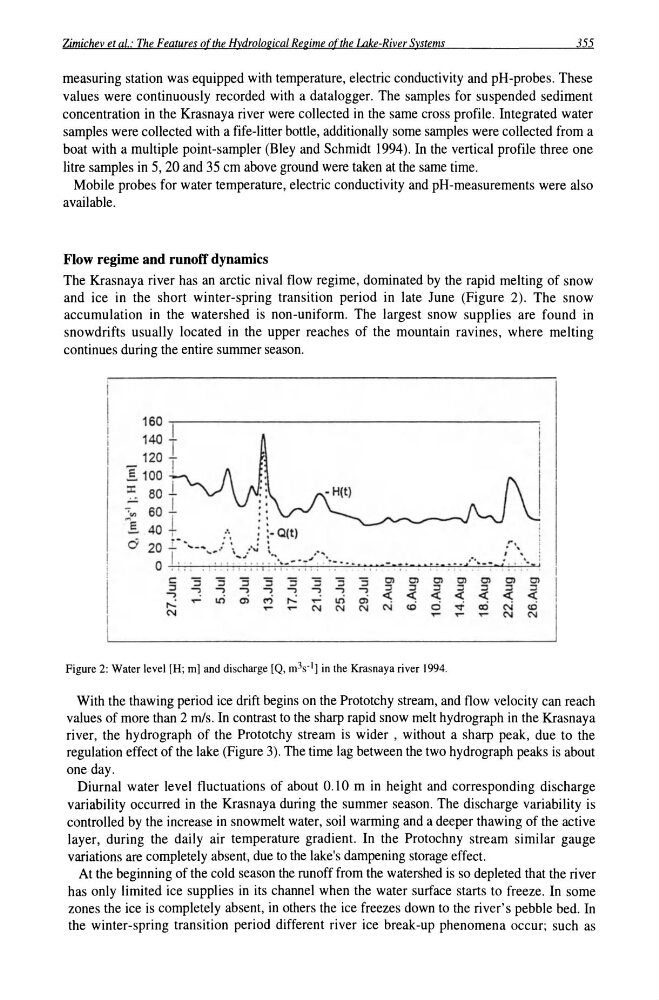
and ice in the short winter-spring transition period in late June (Figure 2). The snow
accumulation in the watershed is non-uniform. The largest snow supplies are found in
snowdrifts usually located in the upper reaches of the mountain ravines, where melting
continues during the entire summer season.
.", ,
.
- '7~ .. : .. " ........ . . .
! : : : ~= I
'S Ol Ol Ol Ol Ol Ol Ol
...., :l ~
:l
:I
::l
::l
:::l
c,; 4:
4: 4: 4: 4: 4:
N
N <0 ci - N
N
Figure 2: Water level [H; m] and discharge [Q, m 3 s· 1 ] in the Krasnaya river 1994.
With the thawing period ice drift begins on the Prototchy stream, and flow velocity can reach
values of more than 2 mls. In contrast to the sharp rapid snow melt hydrograph in the Krasnaya
river, the hydrograph of the Prototchy stream is wider, without a sharp peak, due to the
regulation effect of the lake (Figure 3). The time lag between the two hydrograph peaks is about
one day.
Diurnal water level fluctuations of about 0.10 m in height and corresponding discharge
variability occurred in the Krasnaya during the summer season. The discharge variability is
controlled by the increase in snowmelt water, soil warming and a deeper thawing of the active
layer, during the daily air temperature gradient. In the Protochny stream similar gauge
variations are completely absent, due to the lake's dampening storage effect.
At the beginning of the cold season the runoff from the watershed is so depleted that the river
has only limited ice supplies in its channel when the water surface starts to freeze. In some
zones the ice is completely absent, in others the ice freezes down to the river's pebble bed. In
the winter-spring transition period different river ice break-up phenomena occur; such as
355
measuring station was equipped with temperature, electric conductivity and pH-probes. These
values were continuously recorded with a datalogger. The samples for suspended sediment
concentration in the Krasnaya river were collected in the same cross profile. Integrated water
samples were collected with a fife-litter bottle, additionally some samples were collected from a
boat with a multiple point-sampler (Bley and Schmidt 1994). In the vertical profile three one
litre samples in 5, 20 and 35 cm above ground were taken at the same time.
Mobile probes for water temperature, electric conductivity and pH-measurements were also
available.
Flow regime and runoff dynamics
The Krasnaya river has an arctic nival flow regime, dominated by the rapid melting of snow
and ice in the short winter-spring transition period in late June (Figure 2). The snow
accumulation in the watershed is non-uniform. The largest snow supplies are found in
snowdrifts usually located in the upper reaches of the mountain ravines, where melting
continues during the entire summer season.
.", ,
.
- '7~ .. : .. " ........ . . .
! : : : ~= I
'S Ol Ol Ol Ol Ol Ol Ol
...., :l ~
:l
:I
::l
::l
:::l
c,; 4:
4: 4: 4: 4: 4:
N
N <0 ci - N
N
Figure 2: Water level [H; m] and discharge [Q, m 3 s· 1 ] in the Krasnaya river 1994.
With the thawing period ice drift begins on the Prototchy stream, and flow velocity can reach
values of more than 2 mls. In contrast to the sharp rapid snow melt hydrograph in the Krasnaya
river, the hydrograph of the Prototchy stream is wider, without a sharp peak, due to the
regulation effect of the lake (Figure 3). The time lag between the two hydrograph peaks is about
one day.
Diurnal water level fluctuations of about 0.10 m in height and corresponding discharge
variability occurred in the Krasnaya during the summer season. The discharge variability is
controlled by the increase in snowmelt water, soil warming and a deeper thawing of the active
layer, during the daily air temperature gradient. In the Protochny stream similar gauge
variations are completely absent, due to the lake's dampening storage effect.
At the beginning of the cold season the runoff from the watershed is so depleted that the river
has only limited ice supplies in its channel when the water surface starts to freeze. In some
zones the ice is completely absent, in others the ice freezes down to the river's pebble bed. In
the winter-spring transition period different river ice break-up phenomena occur; such as