

Samarkin et al.: Studies of Methane Production and Emission
o
10
.c 20 ..
- 0..
30
I
I
* ......... ':f
:.: ............... *
t . • . . • . . . . . . • . I).:
:w: • • • • • • • • • • • • • • • • • • • • ;.(
*
339
.)K" luw (:(,rll(,r (C02)
- - - - - - - - permafrost-boundary - - - - - - - - -'I()w (;(,rlt(,r (I\cutillc)
- p(1ly'l Willi (CO?)
40
o
50
100
150 200
250
300
350
methane generation rate [Ilg CH 4 *dm· 3 *d· 1 ]
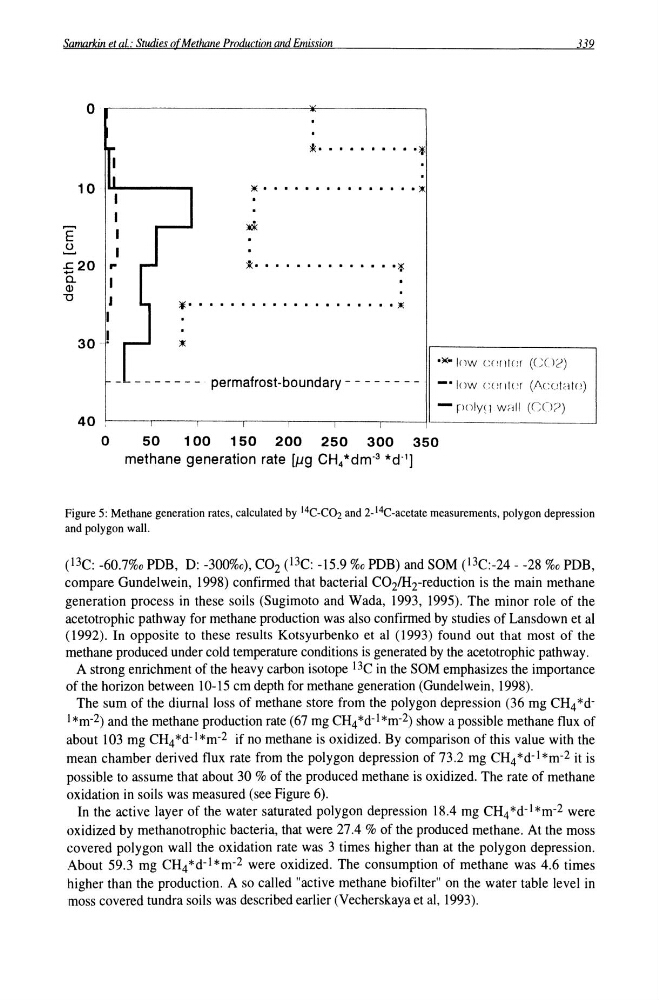
Figure 5: Methane generation rates, calculated by 14C-C02 and 2- 14 C-acetate measurements, polygon depression
and polygon wall.
(13c: -60.7%0 PDB, D: -300%0), CO 2 (13C: -15.9 %0 PDB) and SOM (13C:-24 - -28 %0 PDB,
compare Gundelwein, 1998) confirmed that bacterial C0 2 1H 2 -reduction is the main methane
generation process in these soils (Sugimoto and Wada, 1993, 1995). The minor role of the
acetotrophic pathway for methane production was also confirmed by studies of Lansdown et al
(1992). In opposite to these results Kotsyurbenko et al (1993) found out that most of the
methane produced under cold temperature conditions is generated by the acetotrophic pathway.
A strong enrichment of the heavy carbon isotope l3C in the SOM emphasizes the importance
of the horizon between 10-15 cm depth for methane generation (Gundelwein, 1998).
The sum of the diurnal loss of methane store from the polygon depression (36 mg CH 4 *d1*m- 2 ) and the methane production rate (67 mg CH 4 *d- 1 *m- 2 ) show a possible methane flux of
about 103 mg CH 4 *d- h m- 2 if no methane is oxidized. By comparison of this value with the
mean chamber derived flux rate from the polygon depression of 73.2 mg CH 4 *d- 1 *m-2 it is
possible to assume that about 30 % of the produced methane is oxidized. The rate of methane
oxidation in soils was measured (see Figure 6).
In the active layer of the water saturated polygon depression 18.4 mg CH 4 *d- l *m-2 were
oxidized by methanotrophic bacteria, that were 27.4 % of the produced methane. At the moss
covered polygon wall the oxidation rate was 3 times higher than at the polygon depression.
About 59.3 mg CH 4 *d- l *m- 2 were oxidized. The consumption of methane was 4.6 times
higher than the production. A so called "active methane biofilter" on the water table level in
moss covered tundra soils was described earlier (Vecherskaya et ai, 1993).
o
10
.c 20 ..
- 0..
30
I
I
* ......... ':f
:.: ............... *
t . • . . • . . . . . . • . I).:
:w: • • • • • • • • • • • • • • • • • • • • ;.(
*
339
.)K" luw (:(,rll(,r (C02)
- - - - - - - - permafrost-boundary - - - - - - - - -'I()w (;(,rlt(,r (I\cutillc)
- p(1ly'l Willi (CO?)
40
o
50
100
150 200
250
300
350
methane generation rate [Ilg CH 4 *dm· 3 *d· 1 ]
Figure 5: Methane generation rates, calculated by 14C-C02 and 2- 14 C-acetate measurements, polygon depression
and polygon wall.
(13c: -60.7%0 PDB, D: -300%0), CO 2 (13C: -15.9 %0 PDB) and SOM (13C:-24 - -28 %0 PDB,
compare Gundelwein, 1998) confirmed that bacterial C0 2 1H 2 -reduction is the main methane
generation process in these soils (Sugimoto and Wada, 1993, 1995). The minor role of the
acetotrophic pathway for methane production was also confirmed by studies of Lansdown et al
(1992). In opposite to these results Kotsyurbenko et al (1993) found out that most of the
methane produced under cold temperature conditions is generated by the acetotrophic pathway.
A strong enrichment of the heavy carbon isotope l3C in the SOM emphasizes the importance
of the horizon between 10-15 cm depth for methane generation (Gundelwein, 1998).
The sum of the diurnal loss of methane store from the polygon depression (36 mg CH 4 *d1*m- 2 ) and the methane production rate (67 mg CH 4 *d- 1 *m- 2 ) show a possible methane flux of
about 103 mg CH 4 *d- h m- 2 if no methane is oxidized. By comparison of this value with the
mean chamber derived flux rate from the polygon depression of 73.2 mg CH 4 *d- 1 *m-2 it is
possible to assume that about 30 % of the produced methane is oxidized. The rate of methane
oxidation in soils was measured (see Figure 6).
In the active layer of the water saturated polygon depression 18.4 mg CH 4 *d- l *m-2 were
oxidized by methanotrophic bacteria, that were 27.4 % of the produced methane. At the moss
covered polygon wall the oxidation rate was 3 times higher than at the polygon depression.
About 59.3 mg CH 4 *d- l *m- 2 were oxidized. The consumption of methane was 4.6 times
higher than the production. A so called "active methane biofilter" on the water table level in
moss covered tundra soils was described earlier (Vecherskaya et ai, 1993).