

292
Land-Ocean Systems in the Siberian Arctic: Dvnamics and History
- v - - . .
-- -- .. - . --. --- --f - -- -- - . -- . - ---------.
. . ,
- - ; t"~,2 r' -
IhJ
t
~. I , I
~,.-.-; ~ - -~'-.-.~- -- ----. -- -r !-----' .
,
' ..... >" h J
""
.... ' ...
.. .... ' .
. '
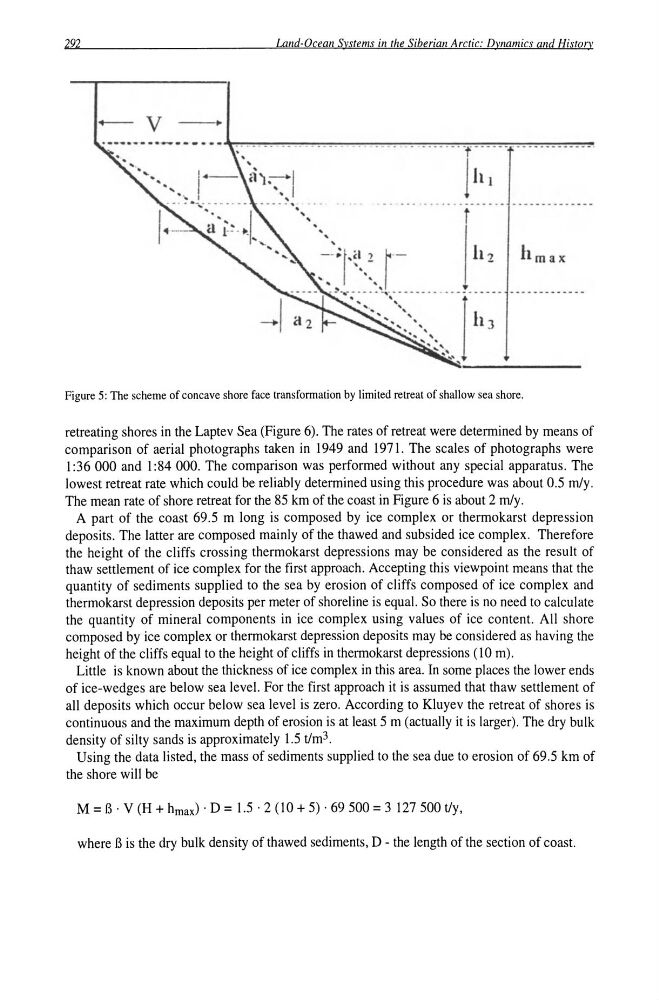
~~~'.-------------Figure 5: The scheme of concave shore face transfonnation by limited retreat of shallow sea shore.
retreating shores in the Laptev Sea (Figure 6). The rates of retreat were determined by means of
comparison of aerial photographs taken in 1949 and 1971. The scales of photographs were
1 :36 000 and 1 :84 000. The comparison was performed without any special apparatus. The
lowest retreat rate which could be reliably determined using this procedure was about 0.5 rn/y.
The mean rate of shore retreat for the 85 km of the coast in Figure 6 is about 2 rn/y.
A part of the coast 69.5 m long is composed by ice complex or thermokarst depression
deposits. The latter are composed mainly of the thawed and subsided ice complex. Therefore
the height of the cliffs crossing thermokarst depressions may be considered as the result of
thaw settlement of ice complex for the first approach. Accepting this viewpoint means that the
quantity of sediments supplied to the sea by erosion of cliffs composed of ice complex and
thermokarst depression deposits per meter of shoreline is equal. So there is no need to calculate
the quantity of mineral components in ice complex using values of ice content. All shore
composed by ice complex or thermo karst depression deposits may be considered as having the
height of the cliffs equal to the height of cliffs in thermokarst depressions (10 m).
Little is known about the thickness of ice complex in this area. In some places the lower ends
of ice-wedges are below sea level. For the first approach it is assumed that thaw settlement of
all deposits which occur below sea level is zero. According to Kluyev the retreat of shores is
continuous and the maximum depth of erosion is at least 5 m (actually it is larger). The dry bulk
density of silty sands is approximately 1.5 tlm 3 .
Using the data listed, the mass of sediments supplied to the sea due to erosion of 69.5 km of
the shore will be
M = 13 . V (H + h max ) . D = 1.5 . 2 (10 + 5) . 69 500 = 3 127 500 tly,
where 13 is the dry bulk density of thawed sediments, D - the length of the section of coast.
Land-Ocean Systems in the Siberian Arctic: Dvnamics and History
- v - - . .
-- -- .. - . --. --- --f - -- -- - . -- . - ---------.
. . ,
- - ; t"~,2 r' -
IhJ
t
~. I , I
~,.-.-; ~ - -~'-.-.~- -- ----. -- -r !-----' .
,
' ..... >" h J
""
.... ' ...
.. .... ' .
. '
~~~'.-------------Figure 5: The scheme of concave shore face transfonnation by limited retreat of shallow sea shore.
retreating shores in the Laptev Sea (Figure 6). The rates of retreat were determined by means of
comparison of aerial photographs taken in 1949 and 1971. The scales of photographs were
1 :36 000 and 1 :84 000. The comparison was performed without any special apparatus. The
lowest retreat rate which could be reliably determined using this procedure was about 0.5 rn/y.
The mean rate of shore retreat for the 85 km of the coast in Figure 6 is about 2 rn/y.
A part of the coast 69.5 m long is composed by ice complex or thermokarst depression
deposits. The latter are composed mainly of the thawed and subsided ice complex. Therefore
the height of the cliffs crossing thermokarst depressions may be considered as the result of
thaw settlement of ice complex for the first approach. Accepting this viewpoint means that the
quantity of sediments supplied to the sea by erosion of cliffs composed of ice complex and
thermokarst depression deposits per meter of shoreline is equal. So there is no need to calculate
the quantity of mineral components in ice complex using values of ice content. All shore
composed by ice complex or thermo karst depression deposits may be considered as having the
height of the cliffs equal to the height of cliffs in thermokarst depressions (10 m).
Little is known about the thickness of ice complex in this area. In some places the lower ends
of ice-wedges are below sea level. For the first approach it is assumed that thaw settlement of
all deposits which occur below sea level is zero. According to Kluyev the retreat of shores is
continuous and the maximum depth of erosion is at least 5 m (actually it is larger). The dry bulk
density of silty sands is approximately 1.5 tlm 3 .
Using the data listed, the mass of sediments supplied to the sea due to erosion of 69.5 km of
the shore will be
M = 13 . V (H + h max ) . D = 1.5 . 2 (10 + 5) . 69 500 = 3 127 500 tly,
where 13 is the dry bulk density of thawed sediments, D - the length of the section of coast.