

Are: The Role of Coastal Retreat for Sedimentation in the Larrev Sea
291
the outer boundary of a shore bench at this depth (Reimnitz et a!., 1988). Later on they came to
the conclusion that the shore erosion reaches the 6 m isobath and possibly still deeper (Barnes
et aI., 1991).
v
------------------------- --------------l h1 j------------""'-+-- ---------------.. ---------- ---- 0 0 0 0 - O f 0 0 0 0
h m 1' 1 II"
I h2 1
....... '*=" ____ ......... 0 _ _ • • • • • _ . _ _ _ _ _ . . . . . . . . ~ . . . . .
i h31
I V I
I
I
1 ... · - - - -.. • •
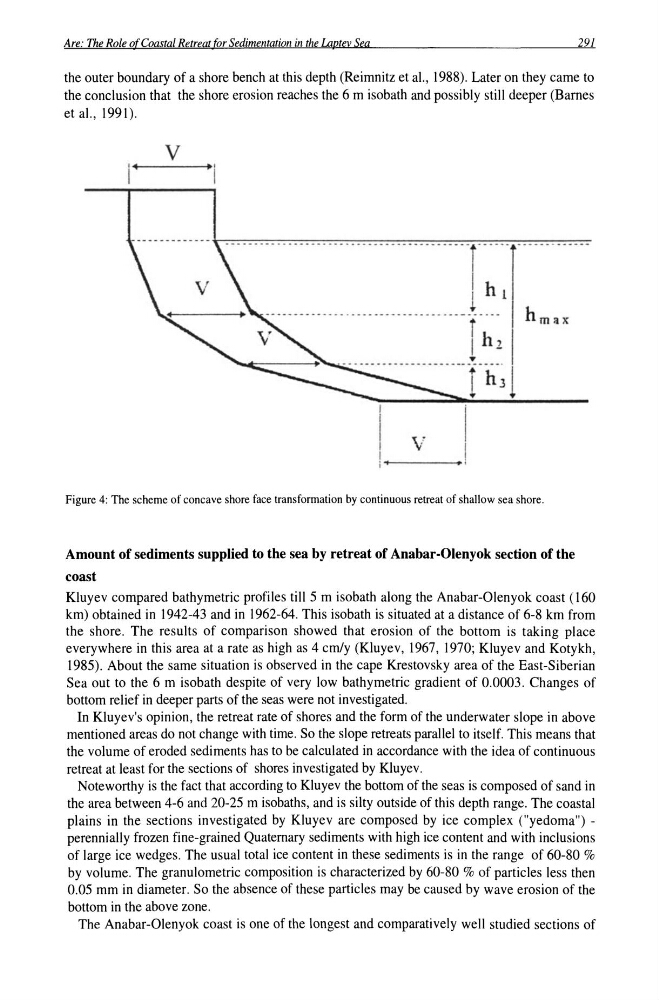
Figure 4: The scheme of concave shore face transformation by continuous retreat of shallow sea shore.
Amount of sediments supplied to the sea by retreat of Anabar-Olenyok section of the
coast
Kluyev compared bathymetric profiles till 5 m isobath along the Anabar-Olenyok coast (160
km) obtained in 1942-43 and in 1962-64. This isobath is situated at a distance of 6-8 km from
the shore. The results of comparison showed that erosion of the bottom is taking place
everywhere in this area at a rate as high as 4 cm/y (Kluyev, 1967, 1970; Kluyev and Kotykh,
1985). About the same situation is observed in the cape Krestovsky area of the East-Siberian
Sea out to the 6 m isobath despite of very low bathymetric gradient of 0.0003. Changes of
bottom relief in deeper parts of the seas were not investigated.
In Kluyev's opinion, the retreat rate of shores and the form of the underwater slope in above
mentioned areas do not change with time. So the slope retreats parallel to itself. This means that
the volume of eroded sediments has to be calculated in accordance with the idea of continuous
retreat at least for the sections of shores investigated by Kluyev.
Noteworthy is the fact that according to Kluyev the bottom of the seas is composed of sand in
the area between 4-6 and 20-25 m isobaths, and is silty outside of this depth range. The coastal
plains in the sections investigated by Kluyev are composed by ice complex ("yedoma") -
perennially frozen fine-grained Quaternary sediments with high ice content and with inclusions
of large ice wedges. The usual total ice content in these sediments is in the range of 60-80 %
by volume. The granulometric composition is characterized by 60-80 % of particles less then
0.05 mm in diameter. So the absence of these particles may be caused by wave erosion of the
bottom in the above zone.
The Anabar-Olenyok coast is one of the longest and comparatively well studied sections of
291
the outer boundary of a shore bench at this depth (Reimnitz et a!., 1988). Later on they came to
the conclusion that the shore erosion reaches the 6 m isobath and possibly still deeper (Barnes
et aI., 1991).
v
------------------------- --------------l h1 j------------""'-+-- ---------------.. ---------- ---- 0 0 0 0 - O f 0 0 0 0
h m 1' 1 II"
I h2 1
....... '*=" ____ ......... 0 _ _ • • • • • _ . _ _ _ _ _ . . . . . . . . ~ . . . . .
i h31
I V I
I
I
1 ... · - - - -.. • •
Figure 4: The scheme of concave shore face transformation by continuous retreat of shallow sea shore.
Amount of sediments supplied to the sea by retreat of Anabar-Olenyok section of the
coast
Kluyev compared bathymetric profiles till 5 m isobath along the Anabar-Olenyok coast (160
km) obtained in 1942-43 and in 1962-64. This isobath is situated at a distance of 6-8 km from
the shore. The results of comparison showed that erosion of the bottom is taking place
everywhere in this area at a rate as high as 4 cm/y (Kluyev, 1967, 1970; Kluyev and Kotykh,
1985). About the same situation is observed in the cape Krestovsky area of the East-Siberian
Sea out to the 6 m isobath despite of very low bathymetric gradient of 0.0003. Changes of
bottom relief in deeper parts of the seas were not investigated.
In Kluyev's opinion, the retreat rate of shores and the form of the underwater slope in above
mentioned areas do not change with time. So the slope retreats parallel to itself. This means that
the volume of eroded sediments has to be calculated in accordance with the idea of continuous
retreat at least for the sections of shores investigated by Kluyev.
Noteworthy is the fact that according to Kluyev the bottom of the seas is composed of sand in
the area between 4-6 and 20-25 m isobaths, and is silty outside of this depth range. The coastal
plains in the sections investigated by Kluyev are composed by ice complex ("yedoma") -
perennially frozen fine-grained Quaternary sediments with high ice content and with inclusions
of large ice wedges. The usual total ice content in these sediments is in the range of 60-80 %
by volume. The granulometric composition is characterized by 60-80 % of particles less then
0.05 mm in diameter. So the absence of these particles may be caused by wave erosion of the
bottom in the above zone.
The Anabar-Olenyok coast is one of the longest and comparatively well studied sections of