

186
Land-Ocean Systems in the Siberian Arctic: Dynamics and History
usually found at depth of 150-350 m). C. ranula is distributed between 95-628 m (mostly 250430 m) (Chernova, 1991). C. micropus has been recorded in the Faroe Trench from 988-1099
m (Gunther, 1887), and in the Davis and Dutch Straits, near Jan Mayen Island, Faroe Islands
and Iceland from 100-1785 m (Lutken, 1898), but in the Barents and Kara Seas it is known
only from 150-325 m (Chern ova, 1991).
The deepest occurring species of Careproctus appear to be C. merretti and C.
aciculipunctatus described from the Porcupine Seabight (eastern North Atlantic) at a depth of
3990-3920 m (Andriashev and Chern ova, 1988, 1997). C. merretti is characterized by a small
and depressed head, naked skin, and a black peritoneum; C. aciculipunctatus has a black body
and its skin prickles appear as a single needles. Both species have two radials in the pectoral
girdle situated opposite each other (I +0+0+ 1), one postorbital and one suprabranchial pore in
the temporal sensory canal, and a single hypural plate with no slit; thus they belong to another
morphotype than does C. solidus.
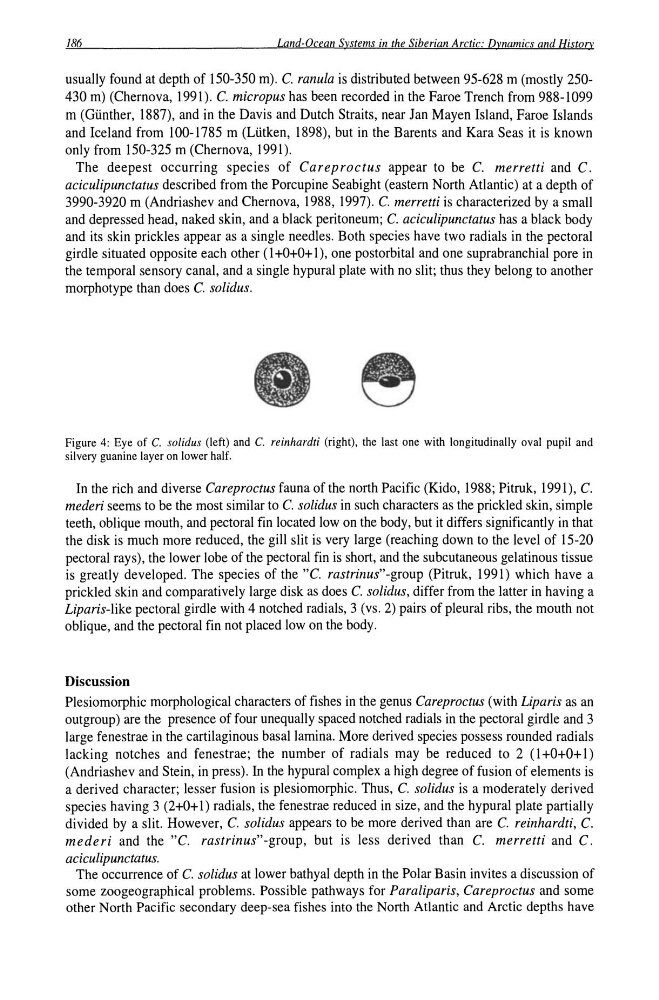
Figure 4: Eye of C. solidus (left) and C. reinhardti (right), the last one with longitudinally oval pupil and
silvery guanine layer on lower half.
In the rich and diverse Careproctus fauna of the north Pacific (Kido, 1988; Pitruk, 1991), C.
mederi seems to be the most similar to C. solidus in such characters as the prickled skin, simple
teeth, oblique mouth, and pectoral fin located low on the body, but it differs significantly in that
the disk is much more reduced, the gill slit is very large (reaching down to the level of 15-20
pectoral rays), the lower lobe of the pectoral fin is short, and the subcutaneous gelatinous tissue
is greatly developed. The species of the "c. rastrinus"-group (Pitruk, 1991) which have a
prickled skin and comparatively large disk as does C. solidus, differ from the latter in having a
Liparis-like pectoral girdle with 4 notched radials, 3 (vs. 2) pairs of pleural ribs, the mouth not
oblique, and the pectoral fin not placed low on the body.
Discussion
Plesiomorphic morphological characters of fishes in the genus Careproctus (with Liparis as an
outgroup) are the presence of four unequally spaced notched radials in the pectoral girdle and 3
large fenestrae in the cartilaginous basal lamina. More derived species possess rounded radials
lacking notches and fenestrae; the number of radials may be reduced to 2 (l +0+0+ 1)
(Andriashev and Stein, in press). In the hypural complex a high degree of fusion of elements is
a derived character; lesser fusion is plesiomorphic. Thus, C. solidus is a moderately derived
species having 3 (2+0+ I) radials, the fenestrae reduced in size, and the hypural plate partially
divided by a slit. However, C. solidus appears to be more derived than are C. reinhardti, C.
mede ri and the"C. rastrinus" -group, but is less derived than C. merretti and C.
aciculipunctatus.
The occurrence of C. solidus at lower bathyal depth in the Polar Basin invites a discussion of
some zoogeographical problems. Possible pathways for Paraliparis, Careproctus and some
other North Pacific secondary deep-sea fishes into the North Atlantic and Arctic depths have
Land-Ocean Systems in the Siberian Arctic: Dynamics and History
usually found at depth of 150-350 m). C. ranula is distributed between 95-628 m (mostly 250430 m) (Chernova, 1991). C. micropus has been recorded in the Faroe Trench from 988-1099
m (Gunther, 1887), and in the Davis and Dutch Straits, near Jan Mayen Island, Faroe Islands
and Iceland from 100-1785 m (Lutken, 1898), but in the Barents and Kara Seas it is known
only from 150-325 m (Chern ova, 1991).
The deepest occurring species of Careproctus appear to be C. merretti and C.
aciculipunctatus described from the Porcupine Seabight (eastern North Atlantic) at a depth of
3990-3920 m (Andriashev and Chern ova, 1988, 1997). C. merretti is characterized by a small
and depressed head, naked skin, and a black peritoneum; C. aciculipunctatus has a black body
and its skin prickles appear as a single needles. Both species have two radials in the pectoral
girdle situated opposite each other (I +0+0+ 1), one postorbital and one suprabranchial pore in
the temporal sensory canal, and a single hypural plate with no slit; thus they belong to another
morphotype than does C. solidus.
Figure 4: Eye of C. solidus (left) and C. reinhardti (right), the last one with longitudinally oval pupil and
silvery guanine layer on lower half.
In the rich and diverse Careproctus fauna of the north Pacific (Kido, 1988; Pitruk, 1991), C.
mederi seems to be the most similar to C. solidus in such characters as the prickled skin, simple
teeth, oblique mouth, and pectoral fin located low on the body, but it differs significantly in that
the disk is much more reduced, the gill slit is very large (reaching down to the level of 15-20
pectoral rays), the lower lobe of the pectoral fin is short, and the subcutaneous gelatinous tissue
is greatly developed. The species of the "c. rastrinus"-group (Pitruk, 1991) which have a
prickled skin and comparatively large disk as does C. solidus, differ from the latter in having a
Liparis-like pectoral girdle with 4 notched radials, 3 (vs. 2) pairs of pleural ribs, the mouth not
oblique, and the pectoral fin not placed low on the body.
Discussion
Plesiomorphic morphological characters of fishes in the genus Careproctus (with Liparis as an
outgroup) are the presence of four unequally spaced notched radials in the pectoral girdle and 3
large fenestrae in the cartilaginous basal lamina. More derived species possess rounded radials
lacking notches and fenestrae; the number of radials may be reduced to 2 (l +0+0+ 1)
(Andriashev and Stein, in press). In the hypural complex a high degree of fusion of elements is
a derived character; lesser fusion is plesiomorphic. Thus, C. solidus is a moderately derived
species having 3 (2+0+ I) radials, the fenestrae reduced in size, and the hypural plate partially
divided by a slit. However, C. solidus appears to be more derived than are C. reinhardti, C.
mede ri and the"C. rastrinus" -group, but is less derived than C. merretti and C.
aciculipunctatus.
The occurrence of C. solidus at lower bathyal depth in the Polar Basin invites a discussion of
some zoogeographical problems. Possible pathways for Paraliparis, Careproctus and some
other North Pacific secondary deep-sea fishes into the North Atlantic and Arctic depths have